The possibility of the United States Navy being drawn into a confined battlespace inside the Strait of Hormuz has raised serious concerns among defence planners. This narrow maritime chokepoint, one of the most critical energy transit routes in the world, presents a unique operational environment where asymmetric warfare could significantly undermine conventional naval superiority.
Why the Strait of Hormuz Matters
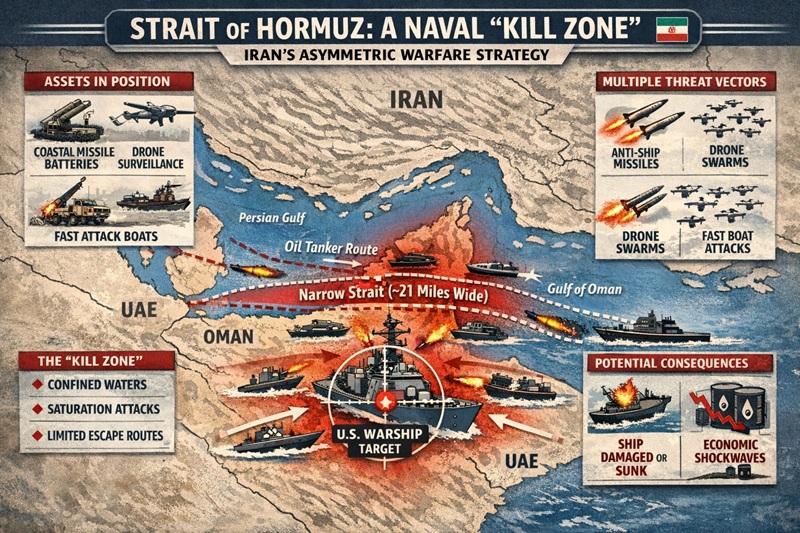
The Strait of Hormuz is not just a shipping lane—it is a strategic pressure point for the global economy. With a navigable width of roughly 21 miles, it forces vessels into predictable transit corridors, limiting manoeuvre space for large warships.
This geographic constraint creates ideal conditions for a defender employing asymmetric tactics. Instead of matching naval power ship-for-ship, a weaker force can exploit terrain, timing, and coordination to generate disproportionate effects.
Iran’s Maritime Denial Strategy
Iran’s evolving doctrine focuses on shaping the battlespace before conflict begins. The strategy is designed to funnel adversaries into a pre-prepared engagement zone—effectively a “kill box.”
Key elements include:
- Coastal missile batteries with high-precision strike capability
- Drone surveillance and swarm attacks for real-time targeting
- Fast attack craft operating in coordinated swarm tactics
- Mobile launch systems that relocate after firing
This layered approach allows Iran to attack from multiple domains—air, sea, and land—simultaneously.
The Geography Advantage
Unlike open ocean warfare, the confined waters of the Strait of Hormuz restrict naval flexibility. Large warships face several disadvantages:
- Limited turning radius and escape routes
- Predictable transit paths
- Reduced reaction time against incoming threats
- Increased vulnerability to saturation attacks
This compression of space increases target density, making it easier for attackers to overwhelm even advanced defence systems.
The “Kill Zone” Concept
Naval analysts describe the Strait as a potential “kill zone”—a space where multiple attack vectors converge on a single target.
In such an environment:
- Missiles, drones, and swarm boats can strike simultaneously
- Defensive systems are forced to divide attention
- Command-and-control networks face overload
- Even a single successful strike can have strategic consequences
Crucially, Iran does not need to defeat an entire fleet. Damaging just one major warship could disrupt global oil flows and trigger economic shockwaves.
Historical Warning: The 2009 Naval War College Study
A 2009 study by Colin Karl Boynton of the U.S. Naval War College predicted a scenario where Iran could deliberately provoke naval intervention by disrupting commercial shipping.
The objective would not be to halt trade permanently, but to:
- Force U.S. naval escorts into the strait
- Draw them into a pre-prepared engagement zone
- Launch coordinated asymmetric attacks
The study emphasized that the political and psychological impact of damaging a U.S. warship could outweigh the tactical loss itself.
Coalition Strategy: A Shift in U.S. Approach
Recent signals from Washington suggest increasing reluctance to conduct unilateral escort operations in the Gulf. Instead, the U.S. is pushing for coalition-based maritime security.
This shift reflects several strategic calculations:
- Risk distribution across multiple allied navies
- Deterrence through collective response
- Reduced exposure of individual U.S. assets
However, coalition operations introduce challenges such as coordination, communication, and differing rules of engagement.
Technology Changing the Battlefield
Advances in modern warfare have made this scenario more realistic than ever:
- Precision-guided missiles increase strike accuracy
- Unmanned aerial systems (UAS) enable persistent surveillance
- Drone swarms overwhelm defensive systems
- Integrated attack networks synchronize multi-domain operations
These technologies amplify the effectiveness of asymmetric tactics, especially in confined environments.
Strategic Implications
The Strait of Hormuz represents a fundamental challenge to traditional naval doctrine. It highlights a shift in warfare where:
- Geography can outweigh technological superiority
- Smaller, cheaper systems can counter expensive platforms
- Control of terrain determines the tempo of conflict
For military planners, the key question is no longer whether such a scenario is possible—but whether naval power can adapt to survive in it.
Conclusion
The Strait of Hormuz is more than a chokepoint—it is a strategic trap where asymmetric warfare, geography, and modern technology converge.
In this environment, even the most powerful navy in the world could face significant risks if drawn into a confined battlespace designed by its adversary.