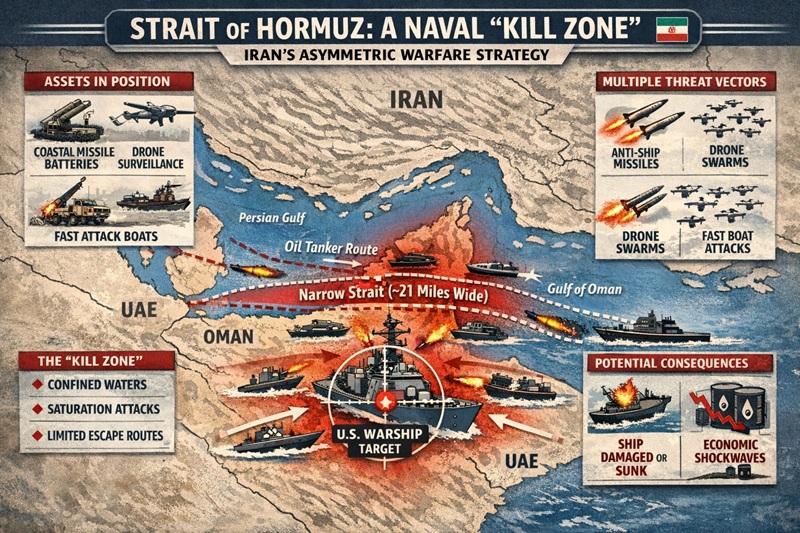
The Strait of Hormuz, a narrow maritime corridor responsible for nearly 20% of global oil and gas flows, has effectively turned into what military analysts describe as a “kill zone”—a confined battlespace where ships are exposed, predictable, and highly vulnerable.
After nearly four weeks of disruption, global energy markets are in turmoil, tanker traffic has nearly halted, and thousands of vessels remain stranded inside the Gulf.
The Kill Zone Concept
STRAIT OF HORMUZ BATTLESPACE
| Width (narrowest) | 24 miles |
| Shipping lanes | Extremely narrow |
| Escape routes | NONE |
Threat range:
| Missiles → Coastline (1000+ miles) |
| Drones → Mobile launch points |
| Mines → Hidden in shipping lanes |
Outcome: Ships enter → Exposure → High-risk zone
Why the Strait Functions as a “Kill Zone”
Unlike open oceans, the Strait of Hormuz imposes structural vulnerability on every vessel that passes through it.
1. Constrained Geography = Predictable Targets
All ships must pass through tight, predefined lanes, eliminating maneuverability. This predictability allows attackers to calculate exact timing and positioning.
2. No possibility of Rerouting
In open waters, ships can divert. In Hormuz, rerouting is impossible, turning the passage into a controlled corridor of risk.
3. Seconds-Level Reaction Time
With Iran’s coastline stretching nearly 1,000 miles, threats can emerge instantly—from missiles, drones, or fast boats—leaving ships with mere seconds to react.
Open Ocean vs Kill Zone
| OPEN SEA | HORMUZ “KILL ZONE” |
| Flexible routes | Fixed narrow lanes |
| Long detection time | Instant threat |
| Wide maneuvering space | No maneuver room |
| Low predictability | Fully predictable |
Result: Contained vulnerability
Iran’s Advantage: Geography Meets Asymmetric Warfare
Iran’s dominance in this environment is not accidental—it is designed.
Key Strategic Elements:
- Mountainous coastline + islands → Natural concealment
- Mobile missile batteries → Hard to detect and destroy
- Unconventional weapons → Low-cost, high-impact
- Layered attack capability → Simultaneous threats
This includes:
- Sea mines deployed even from civilian-looking boats
- Fast attack craft swarms
- Explosive unmanned vessels
- Drones and anti-ship missiles
Iran’s Disruption Doctrine
GOAL: DISRUPT GLOBAL TRADE (NOT NECESSARILY DESTROY)

Tools:
Drones            ██████████████████
Sea Mines         ███████████████
Fast Boats        █████████████
Missiles          ███████████████████

Strategy:
Low cost → High fear → Shipping stops
The Economics of Fear: Why Attacks Don’t Need to Succeed
Iran doesn’t need to sink ships to win.
- At least 19 vessels attacked
- Nearly 2,000 ships trapped in the Gulf
- Some tankers paying millions in safe-passage fees
- Use of disguised “ghost tankers” to bypass risks
The result: Psychological dominance over shipping routes
As long as risk remains high, global shipping companies avoid the strait entirely.
US Response: Containment Without Escalation
Under Donald Trump, the United States is pursuing a dual strategy:
Military Actions:
- Deployment of Marine Expeditionary Units
- Amphibious groups including USS Tripoli
- Consideration of naval escort missions
Strategic Limitations:
- Escorting ships is complex in a kill zone
- Threats are multi-layered and unpredictable
- Ground operations in Iran remain unlikely
Even advanced naval power struggles in such a geographically constrained battlefield.
Why Naval Escorts Are Not Enough
| TRADITIONAL ESCORT MODEL |
| Warship → Tanker → Warship |
| PROBLEM IN HORMUZ: |
| Mines below |
| Missiles from land |
| Drones from air |
| Boats from surface |
| Solution Needed: |
| Layered defense (satellite + drones + patrol aircraft) |
A Backlog Crisis: Global Trade at a Standstill
Even if the Strait reopens:
- Clearing the backlog of ships will take weeks or months
- Energy prices will remain volatile
- Insurance and shipping costs will surge
This turns a regional conflict into a global economic crisis.
The Bigger Strategic Shift: Warfare Has Changed
The Strait of Hormuz crisis demonstrates a new reality:
- Small, mobile weapons can control global trade routes
- Geography can overpower traditional military strength
- Disruption is more effective than destruction
Iran’s “kill zone” strategy is now a case study in modern asymmetric warfare.
Conclusion: A Chokepoint the World Cannot Ignore
The Strait of Hormuz is no longer just a shipping route—it is a strategic pressure point where global economics, military power, and geography collide.
Until a diplomatic solution emerges, the “kill zone” will remain active—keeping the world’s energy supply under constant threat.