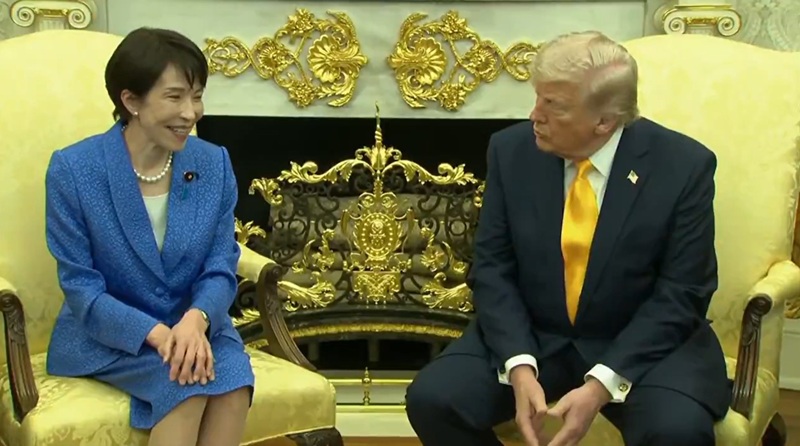
US President Donald Trump met Japanese Prime Minister Sanae Takaichi in the Oval Office as the United States approaches the third week of its escalating conflict with Iran, with discussions centered on security, energy markets, and military strategy.
The meeting highlighted growing global concern over the war’s economic and geopolitical impact—particularly the stability of the Strait of Hormuz, a critical route for nearly 20% of global oil shipments.
Trump Signals Massive Pentagon Spending Increase
One of the most significant takeaways from the meeting was Trump’s indication that he may request up to $200 billion in additional Pentagon funding.
The president described the potential increase as:
“A small price to pay”
Trump suggested the funding package could exceed the immediate needs of the Iran conflict, pointing toward a broader military expansion strategy.
Focus on Strait of Hormuz and Global Oil Supply
President Trump, speaking about Kharg Island, which handles over 90% of Iran’s oil exports, said: “We can take over the island anytime we want. I call it the little island just sitting there. It is completely unprotected. We destroyed everything except the pipelines. We left the… pic.twitter.com/ksbpblQ2px
— Open Source Intel (@Osint613) March 19, 2026
The leaders discussed ensuring safe passage through the Strait of Hormuz, a strategic chokepoint vital to global energy markets.
A joint statement from Japan and several European nations emphasized readiness to:
- Protect shipping routes
- Maintain stability in energy flows
- Prevent further disruptions caused by the conflict
Despite ongoing tensions, Trump expressed surprise that oil prices had not spiked more sharply, even as US gasoline prices hit their highest levels since 2022.
Trump Praises Japan, Criticizes NATO
Trump praised Japan’s support for US military actions, contrasting it with what he described as insufficient backing from NATO allies.
“I’m very pleased with Japan… unlike NATO,” Trump said.
The comment underscores ongoing friction between Washington and European partners over the scope and direction of the conflict.
Confusion Over Israel’s Energy Strikes
Trump revealed he had instructed Israeli Prime Minister Benjamin Netanyahu to halt attacks on Iranian oil and gas infrastructure.
This comes amid conflicting reports regarding a strike on Iran’s South Pars gas field—the world’s largest natural gas reserve.
Trump stated the US had “no prior knowledge” of the attack, though sources have disputed that claim.
No Troop Deployment—For Now
Addressing reports that the US may deploy thousands of troops to the Middle East, Trump denied any immediate plans:
“I’m not putting troops… but if I were, I certainly wouldn’t tell you.”
The ambiguous statement leaves open the possibility of future escalation while maintaining strategic uncertainty.
Trump: “I’m not putting troops anywhere.” pic.twitter.com/bRvMOommTf
— Open Source Intel (@Osint613) March 19, 2026
Pentagon and Intelligence Briefings Highlight War Progress
Defense Secretary Pete Hegseth
- Acknowledged US military casualties for the first time
- Asserted the US is “on plan” in achieving its war objectives
- Provided no clear timeline for the conflict’s end
Hegseth emphasized that preventing Iran from advancing toward nuclear capability remains a core objective.
Director of National Intelligence Tulsi Gabbard
Gabbard’s remarks introduced nuance into the administration’s narrative:
- Confirmed Iran’s nuclear capabilities were heavily damaged in previous US strikes
- Warned that Iran still intends to rebuild its nuclear infrastructure
- Highlighted differences between US and Israeli war objectives
She also noted uncertainty over whether Israel would support a negotiated settlement with Iran.
Strategic Implications
The meeting reflects several emerging dynamics:
- Growing US military commitment and spending
- Increased importance of Indo-Pacific allies like Japan
- Rising tensions between US and European partners
- Continued uncertainty over escalation, including troop deployment
Conclusion
As the Iran war enters its third week, the Trump administration is balancing military escalation, alliance management, and global economic pressures.
With potential increases in defense spending, ongoing air operations, and heightened tensions in critical النفط corridors, the conflict is shaping into a broader geopolitical confrontation with global consequences.