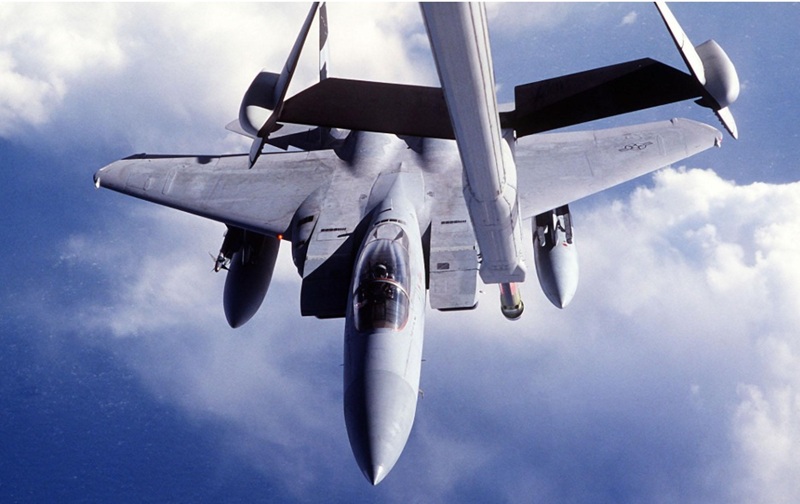
The U.S. Central Command has confirmed that F-15E Strike Eagle aircraft from the U.S. Air Force are now operating from an undisclosed base in the Middle East. The deployment was acknowledged through official imagery and statements, with specific basing and mission details withheld for operational security.
CENTCOM described the move as a measure to reinforce deterrence and preserve rapid-response options at a time when regional risks remain elevated. These risks include continued militia drone activity, periodic attacks on U.S. and partner forces, and the persistence of Islamic State networks in parts of Syria and Iraq.
Unit Origin and Force Projection
The aircraft are linked to the 494th Expeditionary Fighter Squadron, deployed forward from RAF Lakenheath in the United Kingdom. Open-source flight tracking suggests a deployment consistent with a standard expeditionary package, supported by KC-135 aerial refuelling aircraft to enable the trans-regional movement into the CENTCOM area of responsibility.
From a force-posture perspective, the deployment highlights the U.S. ability to surge combat-coded fighters from Europe and integrate them rapidly into existing regional command-and-control, tanker, and ISR networks without extensive public signalling.
Why the F-15E
The F-15E remains a practical choice for this type of mission set. Designed as a long-range, heavy multirole fighter, it combines speed, endurance, and a substantial weapons payload with advanced sensors and electronic warfare systems. Conformal fuel tanks allow extended range while preserving external hardpoints for weapons and targeting pods, making the aircraft suitable for sustained operations across large operating areas.
Its two-crew configuration—pilot and weapons systems officer—supports complex missions that may involve air defence, strike coordination, and dynamic targeting in a single sortie. The aircraft can conduct defensive counter-air tasks using air-to-air missiles, then transition to precision strike missions with guided munitions when required.
Survivability and Modernisation
A key factor in the Strike Eagle’s continued relevance is survivability. Modernised F-15Es are equipped with the APG-82(V)1 AESA radar and the Eagle Passive/Active Warning and Survivability System (EPAWSS). These systems enhance the aircraft’s ability to detect, classify, and counter radar-guided threats, an important consideration in environments where surface-to-air systems and unmanned aerial threats are increasingly common.
Even in deployments framed as stabilising or deterrent in nature, U.S. aircraft must be prepared for rapid escalation. The F-15E’s electronic warfare and self-protection capabilities support operations across that spectrum.
Operational Context
The deployment aligns with two overlapping challenges in the CENTCOM area. The first is ongoing pressure on ISIS elements, particularly in Syria, where U.S. and partner forces continue targeted strikes against logistics, infrastructure, and leadership nodes. The F-15E’s sensor suite and payload capacity make it well-suited to a mix of deliberate and time-sensitive targeting in complex terrain.
The second challenge is deterrence directed at Iran and affiliated militias. In recent months, threats to U.S. bases, coalition forces, and regional maritime traffic have kept tensions elevated. Forward-deployed Strike Eagles provide the ability to generate defensive sorties, counter unmanned systems, or conduct precision strikes against launch and command nodes if directed.
Strategic Signalling
The message behind the deployment is deliberately measured. For regional partners, it underscores continued U.S. commitment and the ability to reinforce quickly with combat-proven airpower. For potential adversaries, it signals that escalation would be met with survivable and flexible capabilities rather than symbolic presence alone. At the same time, the use of rotational deployments rather than permanent basing reflects an effort to balance forward posture with a limited footprint.
In the current Middle Eastern security environment, the F-15E functions as both deterrent and contingency asset—supporting counterterrorism operations while preserving options should regional dynamics deteriorate further.