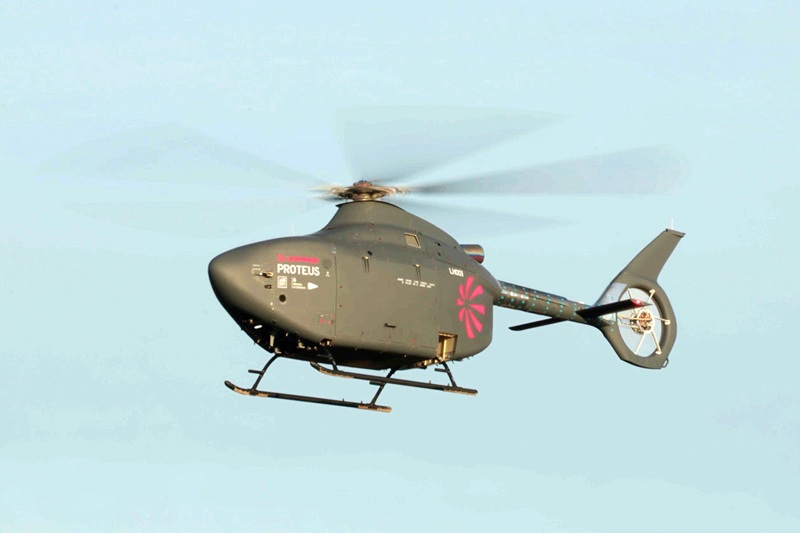
Britain’s Royal Navy has confirmed that its first full-sized autonomous helicopter, designed for anti-submarine warfare and other high-risk maritime missions, has successfully completed its maiden flight, marking a significant step in the modernization of UK and NATO naval capabilities.
The helicopter, named Proteus, completed a short initial test routine, according to a statement released by the Royal Navy on Friday. Developed under a £60 million ($80.46 million) programme, the platform is intended to enhance maritime surveillance and undersea warfare capabilities at a time of rising security concerns in the North Atlantic.
This is aviation history.
The UK’s first pilotless helicopter, Proteus, has made its debut in the skies. 🚁
Designed by @Leonardo_UK, the autonomous helicopter made 2 short flights in Cornwall. It will serve as a testbed for future hybrid air wings.https://t.co/wauUT9petY pic.twitter.com/W9083fpf4C
— Royal Navy (@RoyalNavy) January 16, 2026
A New Tool for Undersea Warfare
Proteus has been specifically designed to conduct anti-submarine operations, sea patrols, and underwater vessel tracking, missions that are becoming increasingly critical amid heightened activity by Russian submarines in North Atlantic waters.
The Royal Navy said the system will play a key role in defending Britain and its NATO allies against what it described as “evolving threats” in the region, particularly along vital sea lanes between Greenland, Iceland, and the United Kingdom—an area long regarded as strategically crucial for tracking submarine movements.
Autonomous Design Reduces Risk
Designed and built by Leonardo Helicopters, Proteus relies on advanced sensors, onboard computers, and software-driven decision-making systems that allow it to interpret its environment and operate without a human crew.
Nigel Colman, UK managing director of Leonardo Helicopters, said the aircraft represents a major shift in maritime aviation.
“Proteus represents a step-change in how maritime aviation can deliver persistence, adaptability and reach—conducting the dull, dirty and dangerous missions in challenging environments without putting human operators at risk,” he said.
Part of a Broader European Defense Shift
Europe’s defense landscape has undergone rapid transformation since Russia’s full-scale invasion of Ukraine in February 2022, prompting governments to raise defense spending, expand force structures, and accelerate investment in autonomous and unmanned systems.
The North Atlantic has re-emerged as a focal point for NATO planners, particularly as undersea infrastructure protection, submarine detection, and persistent surveillance become higher priorities.
In this context, Proteus reflects a growing reliance on autonomous platforms to provide continuous coverage and operational flexibility without the constraints associated with crewed aircraft.
🚁 Liftoff!
The UK’s first autonomous full-size helicopter, #Proteus, has completed a historic maiden flight at Predannack airfield in Cornwall.
Designed and built by #Leonardo in Yeovil, the Home of British Helicopters, Proteus is a major step forward in autonomous maritime… pic.twitter.com/nqZ9Qyp23Z
— Leonardo Helicopters (@LDO_Helicopters) January 16, 2026
More Capable Than Existing Naval Drones
The Royal Navy already operates several unmanned systems, including smaller rotary-wing surveillance drones. However, Proteus is larger, longer-ranged, and more sophisticated, bridging the gap between traditional crewed helicopters and lightweight unmanned aerial vehicles.
Its size and sensor capacity allow it to carry more advanced payloads, extending mission duration and enabling operations in harsher maritime environments.
Strategic Implications
The introduction of Proteus aligns with wider NATO efforts to improve maritime domain awareness and counter increasingly quiet and capable submarines operating in the North Atlantic.
While Russia has dismissed claims that Moscow poses a growing threat to Greenland and surrounding waters, Western militaries continue to invest in surveillance and tracking capabilities to maintain undersea superiority.