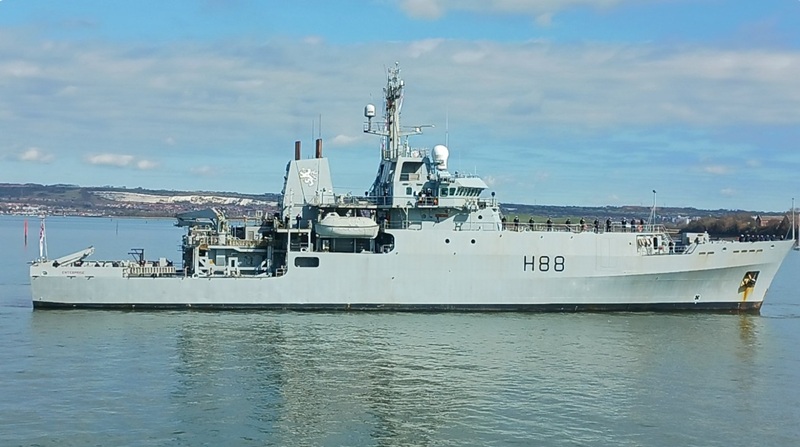
The United Kingdom will sell the Royal Navy hydrographic and oceanographic survey vessel HMS Enterprise to Bangladesh, in a move aimed at strengthening Bangladesh’s maritime security, research capacity, and disaster-response capabilities.
The deal was first reported by UK Defence Journal and was formally concluded at Bangladesh Navy headquarters in Dhaka, following extensive technical consultations involving the Bangladesh Navy, the UK Ministry of Defence, and the Royal Navy.
Strategic and Institutional Framing of the Sale
According to the British High Commission in Dhaka, the transfer of HMS Enterprise is intended to support Bangladesh’s maritime security while contributing to broader regional stability. UK officials have also framed the sale within London’s support for a “free and open Indo-Pacific”, signalling that the transaction carries both operational and strategic dimensions.
From Dhaka’s perspective, the acquisition represents a targeted capability enhancement rather than a combat-oriented procurement, aligning with Bangladesh’s long-term focus on maritime domain awareness and non-traditional security roles.
A Capability Focused on Hydrography and Research
HMS Enterprise is expected to significantly expand Bangladesh’s capacity in hydrographic and oceanographic research, enabling more detailed mapping of seabed terrain, improved nautical charting, and better understanding of maritime environmental conditions.
British officials indicated that the vessel will also be used for scientific research, creating new avenues for cooperation with Bangladeshi universities and research institutions. This dual-use profile reflects a growing emphasis on civil-military integration in maritime governance.
Disaster Response and Humanitarian Utility
Beyond its scientific role, the ship’s design makes it well-suited for humanitarian assistance and disaster response (HADR) missions. With advanced communications and command-and-control systems, HMS Enterprise has previously functioned as a coordination hub during overseas deployments.
UK statements emphasised that the vessel’s transfer will enhance Bangladesh’s ability to support disaster response operations, particularly in a region highly vulnerable to cyclones, flooding, and climate-driven maritime risks.
Part of a Broader UK–Bangladesh Defence Relationship
The sale fits within a longer pattern of defence cooperation between London and Dhaka. Bangladesh has previously acquired decommissioned C-130J Super Hercules aircraft from the UK, reflecting a preference for cost-effective procurement of proven Western platforms.
In addition, Bangladesh signalled in 2021 its interest in purchasing up to five decommissioned Royal Navy vessels, indicating that the acquisition of HMS Enterprise may represent the first step in a wider naval modernisation pathway.
HMS Enterprise: Design and Operational History
Commissioned in 2003, HMS Enterprise (H88) belongs to the Echo-class of Royal Navy survey ships and was designed specifically for hydrographic and oceanographic missions.
Its primary systems include:
- Multibeam echo sounders
- Side-scan sonar
- Advanced oceanographic sensors
Data collected by the ship supports the production of nautical charts, enhances navigational safety, and contributes to military planning, including amphibious and maritime operations.
Operational Track Record
Although unarmed, HMS Enterprise has supported a wide range of missions beyond scientific research. The vessel has deployed with the Royal Navy in the Persian Gulf, Mediterranean, and Caribbean, and has been used in both military support roles and humanitarian operations.
Its lack of onboard weapons underscores its classification as a non-combatant, enabling platform, reinforcing the narrative that its transfer to Bangladesh is focused on capacity-building rather than force projection.
Quiet but Meaningful Signal
While modest in scale, the transfer of HMS Enterprise carries a measured strategic signal. For the UK, it reinforces engagement with South Asian maritime partners under an Indo-Pacific framework. For Bangladesh, it strengthens sovereign maritime capabilities in areas increasingly critical to economic security, environmental management, and disaster resilience.
The transaction reflects a form of defence cooperation where capability, governance, and stability take precedence over combat power—an approach consistent with Bangladesh’s evolving naval doctrine.