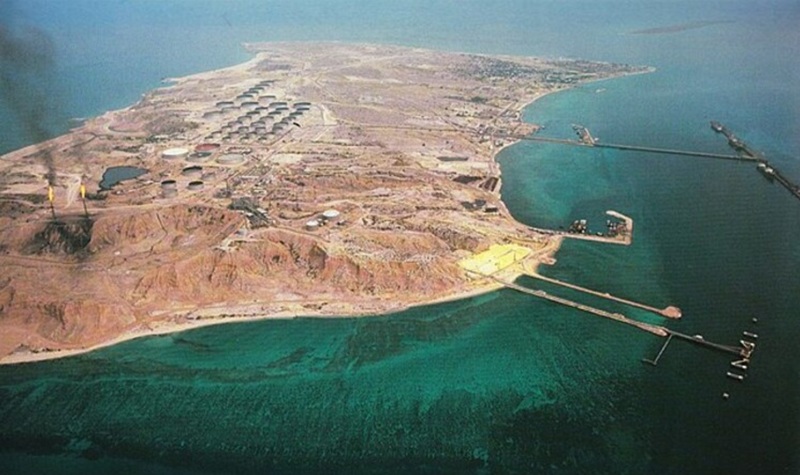
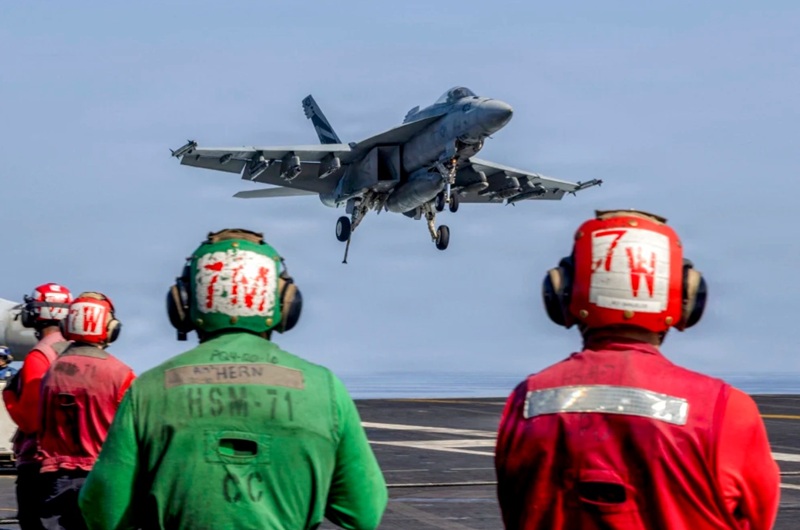
The ongoing conflict involving Iran is raising serious questions about the limits of American military power. Some defense analysts argue that the challenges seen in the current war highlight deeper structural problems that could become far more severe in a potential conflict in Asia.
In particular, the effectiveness of missile defenses, the vulnerability of military bases, and the growing role of drones in modern warfare are all becoming central to strategic debates.
Lessons From the Iran Conflict
Recent operations have demonstrated how difficult it can be to defend fixed military installations against sustained missile and drone attacks.
During the conflict, more than 1,500 interceptor missiles were reportedly used in attempts to defend critical bases and infrastructure. Despite this massive defensive effort, several key facilities still suffered damage.
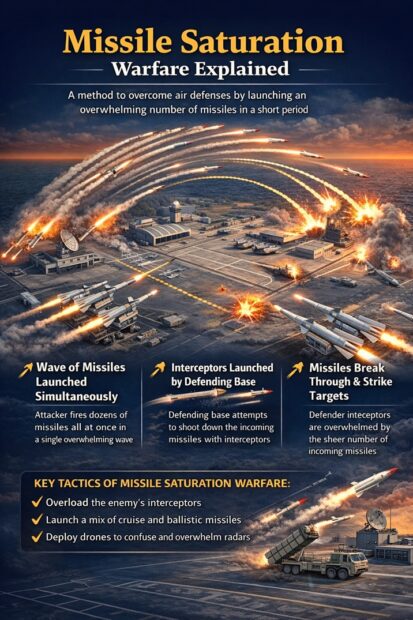
The events illustrate a growing problem in modern warfare known as missile saturation—a tactic in which an attacker launches such a large number of projectiles that air defenses cannot intercept them all.
Even the most advanced defense systems have limits when confronted with overwhelming numbers of incoming missiles or drones.
The China Scenario: A Much Larger Threat
If similar dynamics were to unfold in Asia, the scale of the challenge would likely be far greater.
China has spent decades building one of the world’s largest missile forces, designed specifically to target regional bases, ports, and naval forces. In a major conflict, waves of missiles could be launched simultaneously against multiple targets across the Indo-Pacific.
According to analysts studying China’s military buildup, the missile inventory associated with drone operations alone is enormous.
Research into China’s drone systems suggests the country may possess tens of thousands of missiles designed for unmanned platforms, dramatically expanding the scale of potential attacks.
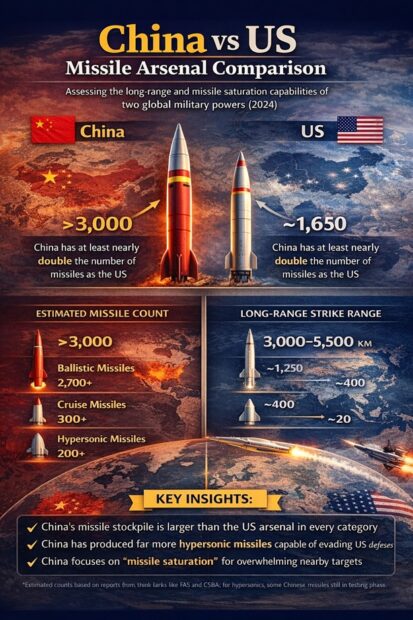
Such numbers could overwhelm even sophisticated air defense networks within hours.
Drone Warfare and the Future Battlefield
Another emerging factor is the growing role of drone swarms.
While Iran has used drones extensively in recent conflicts, analysts believe Chinese drone capabilities could be significantly larger and more advanced.
Large waves of unmanned systems can serve multiple purposes simultaneously:
- Overwhelming air defenses
- Gathering real-time intelligence
- Locating targets for missile strikes
- Disrupting radar systems
This combination makes drone warfare an increasingly important element of modern military strategy.
Vulnerability of U.S. Naval Forces
The Iran conflict has also demonstrated the risks faced by naval forces operating near hostile coastlines.
Because of the threat posed by anti-ship missiles, U.S. naval vessels involved in the operation have reportedly maintained significant stand-off distances.
A similar dynamic could occur in East Asia.
China’s extensive network of anti-ship ballistic and cruise missiles—often referred to as anti-access/area denial (A2/AD) capabilities—was specifically designed to push foreign fleets farther away from contested waters.
If U.S. ships were forced to operate at greater distances from the battlefield, their ability to directly defend allied territories could become more limited.
The Role of Regional Allies
In such a scenario, regional allies like Japan and South Korea would likely play a central role in their own defense.
Both countries possess technologically advanced militaries and modern naval fleets. However, analysts argue that some important capabilities remain underdeveloped.
One critical gap involves high-altitude drones used for intelligence, surveillance, and reconnaissance (ISR).
These systems are essential for detecting enemy movements, identifying targets, and guiding missile or naval operations across large maritime areas.
Without sufficient ISR coverage, naval and air forces may struggle to maintain situational awareness in a fast-moving conflict.
Limits of U.S. Security Guarantees
For decades, American alliances in Asia have been built around the assumption that the United States could provide overwhelming military protection in the event of war.
However, some analysts now argue that technological changes—particularly the rapid expansion of missile and drone arsenals—are altering that balance.
In a large-scale conflict with China, U.S. assistance might focus more heavily on:
- Intelligence sharing
- Cyber operations
- Submarine warfare
- Long-range strike capabilities
At the same time, frontline allies could be required to assume a greater share of the burden for defending their own territory.
Strategic Reassessment in the Indo-Pacific
The United States has already begun reassessing its strategy for the Indo-Pacific region through initiatives led by U.S. Indo-Pacific Command (INDOPACOM).
These efforts include strengthening regional alliances, expanding missile defenses, and improving distributed military operations across the Pacific.
Nevertheless, many analysts believe that the security environment in Asia is becoming far more complex than it was during previous decades.
The combination of long-range missiles, drone swarms, and advanced naval systems is reshaping how future conflicts could unfold.
A Changing Strategic Reality
The lessons emerging from current conflicts suggest that modern warfare increasingly favors large numbers of relatively inexpensive weapons—particularly missiles and drones.
For both the United States and its allies, adapting to this reality will likely require significant investment in new defensive technologies and operational concepts.
Whether these changes will be enough to maintain the traditional security guarantees that have defined the region for decades remains an open question.