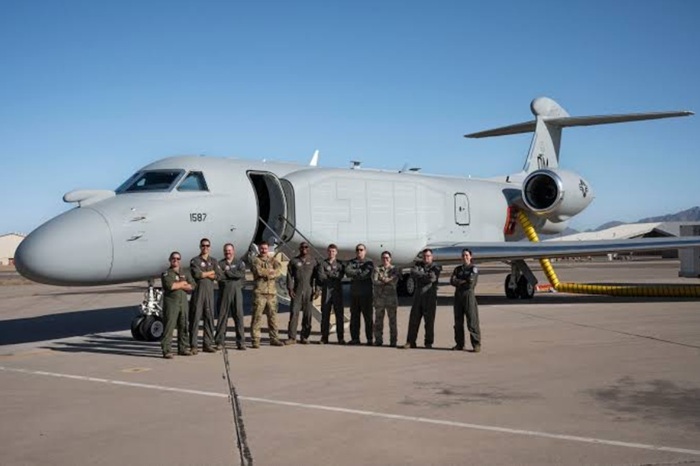
Two EA-37B Compass Call electronic warfare aircraft have arrived at RAF Mildenhall on March 31, 2026, raising expectations that the platform could soon be deployed to the Middle East as part of expanding US operations against Iran.
The aircraft departed from Davis-Monthan Air Force Base on March 30 and made a fuel stop at Joint Base McGuire-Dix-Lakehurst before arriving in the UK.
The jets were flying with the callsigns AXIS41 and AXIS43, according to flight tracking data.

Reports suggest the aircraft may later continue onward to Türkiye, potentially positioning them closer to the Middle East theater.
Possible First Operational Deployment
Defense analysts believe this could represent the first operational deployment of the EA-37B platform.
The speculation follows recent reports that two EC-130H Compass Call aircraft were damaged in the Iranian strike on Prince Sultan Air Base in Saudi Arabia.
In January 2026, the US Air Force said the aircraft had deployed to Europe but was not yet operational at that time.
The service previously indicated that Initial Operational Capability (IOC) is expected during 2026, with a full fielding decision anticipated in the first quarter of Fiscal Year 2026.
If confirmed, this would mark a major milestone for the Compass Call Rehost program.
Role in Operation Epic Fury
Should the deployment to the Middle East be confirmed, the EA-37B Compass Call would likely support Operation Epic Fury.
Its primary role is to provide electronic attack effects that protect US and allied forces operating in contested environments.
The aircraft is specifically designed to:
- disrupt enemy command-and-control communications
- jam radar systems
- interfere with navigation systems
- degrade adversary force coordination
This capability is especially relevant in a conflict with Iran, where missile coordination, radar coverage, and drone control are central to battlefield operations.
Potential Integration With Rivet Joint
One of the most significant operational aspects is the potential integration with the Boeing RC-135 Rivet Joint.
The US Air Force has been working on combining:
- Rivet Joint’s intelligence gathering
- Compass Call’s electronic warfare capability
This combination allows forces to not only detect enemy signals and emitters but also immediately jam or suppress them.

Officials described this integration as a “game-changer on the modern battlefield.”
From EC-130H to EA-37B
The EA-37B replaces the older Lockheed EC-130H Compass Call.
The new aircraft is based on the Gulfstream G550 airframe, offering major operational improvements:
- greater speed
- higher altitude
- longer endurance
- better stand-off range
- improved survivability
Compared with the older C-130-based platform, the G550-based aircraft can operate more effectively in Anti-Access / Area Denial (A2/AD) environments.
Advanced Baseline 4 Upgrade
Future aircraft are expected to receive the Baseline 4 Compass Call suite.
This includes BAE Systems’ SABER technology, built around software-defined radios and open architecture systems.
The upgrade is designed to make the platform more adaptable to future threats and enable rapid software-based updates.
Potential future enhancements may include cognitive electronic warfare capabilities, allowing the aircraft to adapt dynamically to enemy signals in real time.
Lower Cost, Higher Capability
The upgraded platform is also significantly more efficient.
According to your draft, the EA-37B is expected to reduce operating costs by around 50% compared with the EC-130H while delivering improved performance.
This includes lower cooling requirements and reduced size, weight, and power demands for mission systems.