
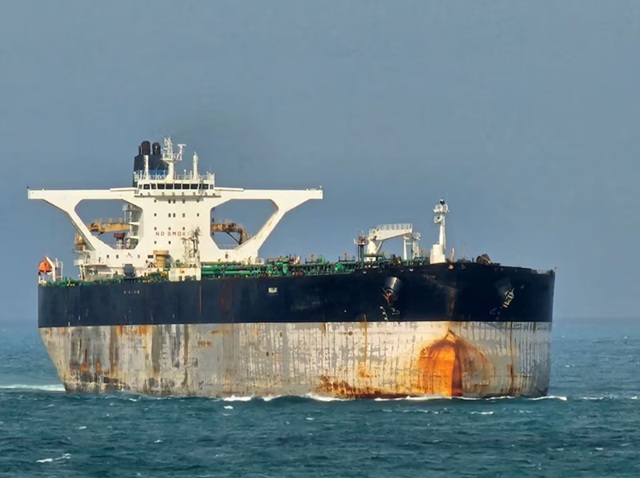
The United States is attempting to seize a Venezuela-linked oil tanker after a pursuit of more than two weeks across the Atlantic Ocean, U.S. officials told Reuters on Wednesday, in a high-stakes enforcement action that could heighten tensions with Russia.
The tanker, originally named Bella-1 and now operating under the name Marinera with a Russian flag, slipped through a U.S. maritime “blockade” of sanctioned vessels and rebuffed earlier efforts by the U.S. Coast Guard to board it near Venezuelan waters.

Blockade and Ongoing Enforcement
The operation is being carried out jointly by the U.S. Coast Guard and U.S. military forces as part of a broader crackdown on tankers suspected of transporting Venezuelan crude in violation of U.S. sanctions imposed as part of former President Donald Trump’s pressure campaign against the Maduro regime.
Sources say the tanker has been under surveillance since an attempted interception in late December. Despite being sanctioned and targeted by the U.S., the vessel changed course, raised a Russian flag, and began what U.S. officials describe as an effort to evade blockade enforcement.
The @TheJusticeDept & @DHSgov, in coordination with the @DeptofWar today announced the seizure of
the M/V Bella 1 for violations of U.S. sanctions. The vessel was seized in the North Atlantic pursuant to a warrant issued by a U.S. federal court after being tracked by USCGC Munro. pic.twitter.com/bm5KcCK30X— U.S. European Command (@US_EUCOM) January 7, 2026
Russian Naval Escort Raises Geopolitical Stakes
U.S. officials reported that Russian naval forces, including a submarine, were in the vicinity at the time of the operation, raising concerns about a potential geopolitical standoff at sea. Russia is believed to be escorting or safeguarding the tanker, which underscores how complex the situation has become amid worsening U.S.–Russia relations.
This is not the first enforcement action under the U.S. blockade: the Coast Guard has intercepted other Venezuela-linked tankers in Latin American waters in recent weeks, part of an expanded effort to choke off oil revenues that Washington says support illicit activities and help the Maduro government sustain itself.
Strategic and Legal Dimensions
The tanker’s efforts to evade boarding follow a broader U.S. naval blockade of sanctioned vessels initiated in December 2025, under the so-called “Operation Southern Spear,” part of a strategy to disrupt oil exports tied to Venezuela.
Under U.S. sanctions policy, vessels involved in transporting illicit or sanctioned crude oil can be subject to boarding and seizure in certain circumstances. The U.S. has sanctioned multiple companies and tankers since mid-2024, alleging links to prohibited operations involving Venezuelan and Iranian oil.
Diplomatic Aftermath
While U.S. officials have not detailed the legal or diplomatic justifications in public, the presence of Russian naval assets suggests Moscow may view the action as a provocative challenge to its interests. Russia has previously lodged protests over U.S. interdictions and reflagging of tankers seeking to avoid detention.
Analysts say the operation illustrates the expanding scope of the U.S. campaign to isolate the Maduro government economically and strategically, even as it risks direct confrontation with Russia on international waters.