


A U.S. airstrike on an Iranian warship near Qeshm Island in the Strait of Hormuz on March 4 produced an unusual and potentially dangerous naval incident.
According to reports and video evidence, a U.S. glide bomb struck the Iranian IRGC Navy corvette IRIS Shahid Sayyad Shirazi, triggering a fire aboard the vessel. Moments after the impact, the damaged ship unexpectedly launched one of its own anti-ship missiles.
The Americans have released footage showing several epic attacks carried out yesterday on the IRIS “Shahid Bagheri”.
It was container ship, converted into a drone carrier – operated by Iran’s Islamic Revolutionary Guards Navy (IRGCN).[CENTCOM] pic.twitter.com/2zMiUELltJ
— F76 (@f76pacificator) March 6, 2026
The missile was not fired intentionally by the crew. Instead, the launch appears to have been triggered by structural and electrical damage caused by the strike, activating the weapon system without human input.
Military analysts say the incident represents one of the most technically unusual events of the naval phase of the conflict.
Strike Near Qeshm Island

The strike took place near Qeshm Island, a strategically located Iranian island overlooking the Strait of Hormuz.
The narrow waterway is one of the most important energy chokepoints in the world, with roughly 20 percent of global oil shipments passing through it each day.
U.S. Central Command confirmed the strike, while videos circulating online showed the burning hull of the Iranian vessel offshore with thick smoke rising over the strait.
The IRIS Shahid Sayyad Shirazi Corvette
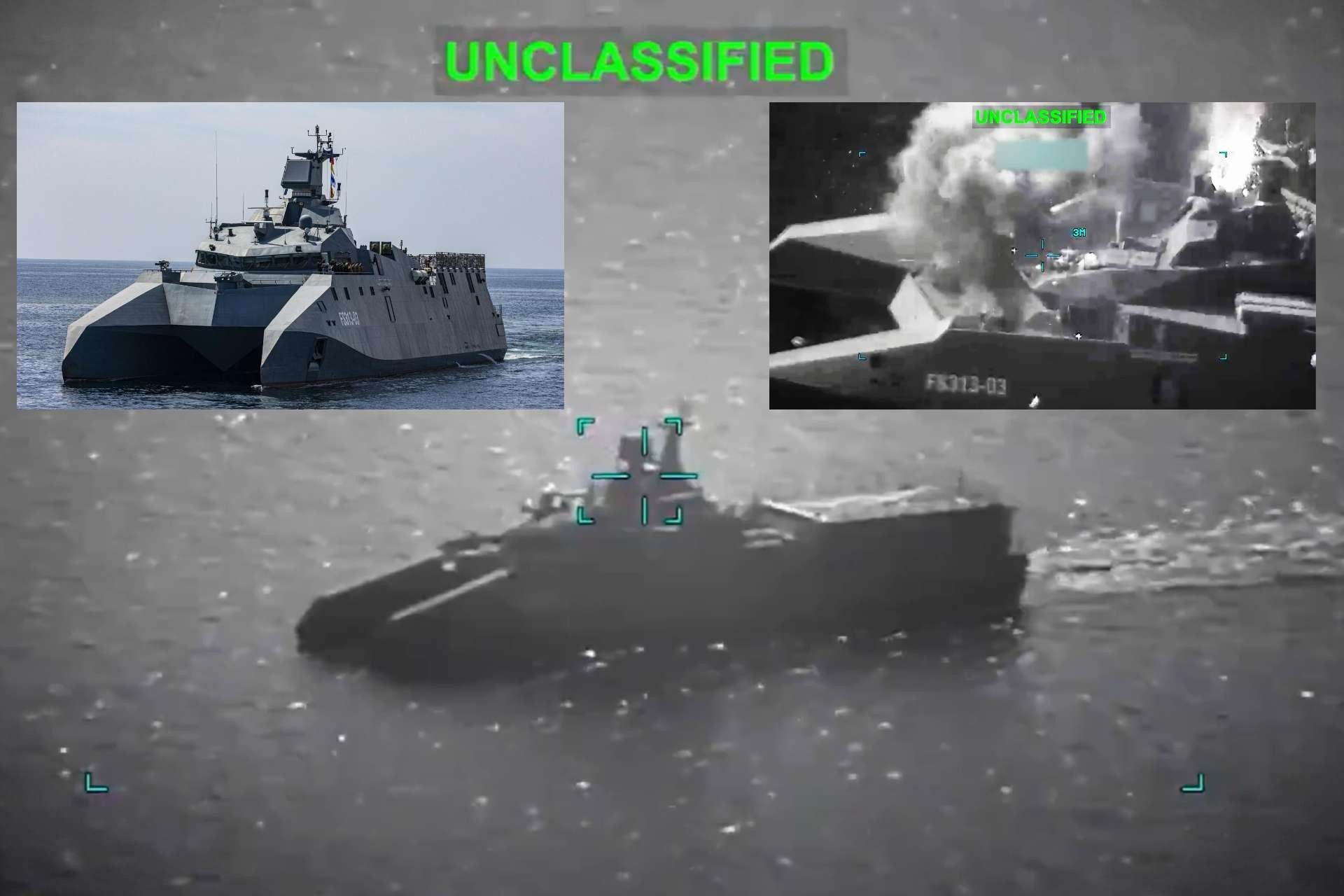
The IRIS Shahid Sayyad Shirazi (FS313-03) is the third vessel of Iran’s Soleimani-class corvettes, commissioned in February 2024.
The class represents the most advanced surface combatant currently operated by the Islamic Revolutionary Guard Corps (IRGC) Navy.
Key characteristics include:
- Length: approximately 65–68 meters
- Displacement: around 600 tonnes
- Hull design: wave-piercing catamaran for high speed and stability
- Maximum speed: around 32 knots (with promotional claims up to 45 knots)
The vessel is constructed using composite materials intended to reduce radar visibility, improving survivability in contested waters.
Heavy Armament for Littoral Warfare
Despite its relatively small size, the corvette carries a powerful weapons package designed for high-intensity combat in the Persian Gulf.
Its armament reportedly includes:
- Six anti-ship cruise missiles (Noor, Ghadir, or Nasir class)
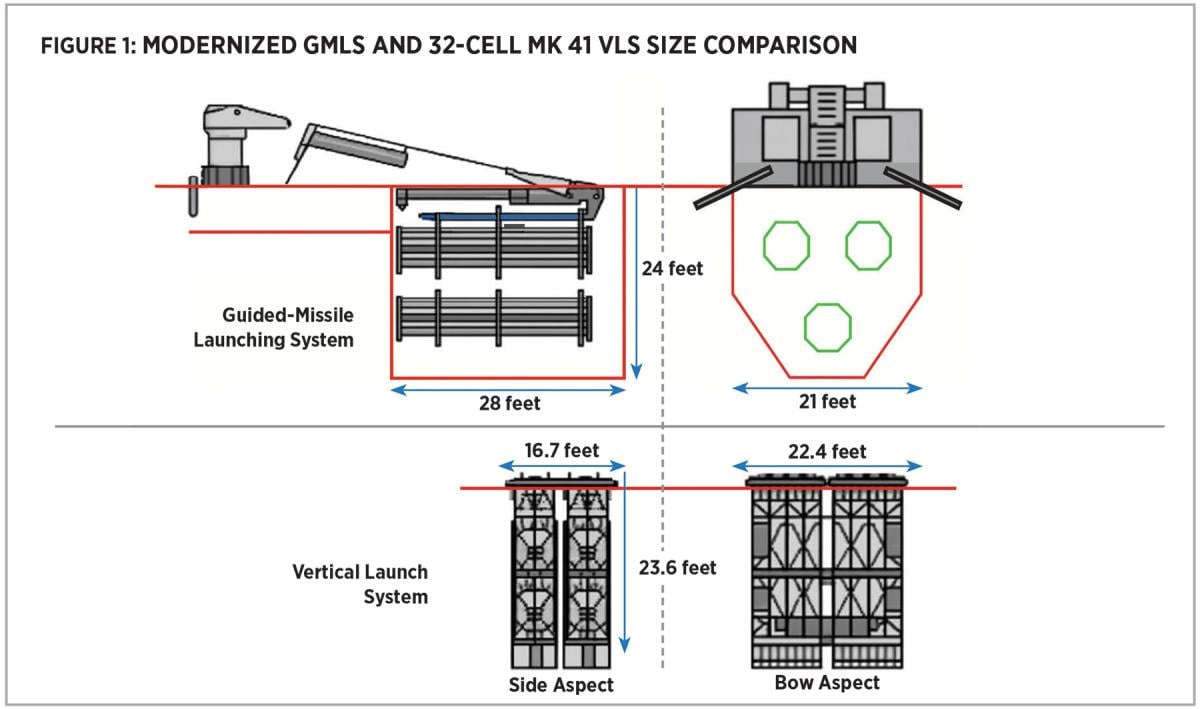
- A vertical launch system (VLS) carrying Sayad surface-to-air missiles
- Additional cells capable of launching Abu-Mahdi long-range cruise missiles
- Six 20-mm Gatling guns for close-range defense
- A helipad capable of supporting a medium combat helicopter
- Capacity to deploy three fast-attack boats simultaneously
This configuration was designed specifically for asymmetric naval warfare in the Strait of Hormuz, where Iran’s naval doctrine emphasizes speed, surprise, and missile saturation attacks.
The Accidental Missile Launch
Under normal conditions, launching an anti-ship missile requires:
- crew authorization
- targeting data
- activation of the weapon system
However, analysts believe that the damage from the U.S. glide bomb disrupted the ship’s electrical systems and structural integrity, inadvertently activating the missile launcher.
As a result, the weapon fired without deliberate human control.
In such situations, the missile launches along the bearing the launcher is facing, potentially acquiring any available target within its sensor range.
Given the heavy maritime traffic in the Strait of Hormuz, this could have posed a serious risk to nearby vessels.
Fortunately, No Secondary Damage Reported
No additional casualties or ship damage were reported following the unintended launch.
According to analysts, several outcomes are possible:
- the missile failed to acquire a target
- it impacted the water shortly after launch
- or it followed a trajectory that did not intersect with nearby ships
In any case, the absence of secondary incidents appears largely a matter of circumstance rather than control.
Strategic Context: Iran’s Naval Doctrine
The Soleimani-class corvettes were developed as part of Iran’s strategy to control or threaten the Strait of Hormuz, one of the most strategically sensitive waterways in the world.
Their design combines:
- high speed
- reduced radar signature
- heavy missile armament
- integration with fast-attack boat swarms
This concept allows relatively small vessels to threaten much larger naval forces through multi-directional missile attacks and swarm tactics.
The loss or disablement of one of these ships therefore represents a significant event in the naval dimension of the conflict.
A Warship Designed for Hormuz Fires Its Own Weapon
The IRIS Shahid Sayyad Shirazi entered service just fourteen months before the incident.
It was designed to be among the most capable surface combatants in Iran’s IRGC Navy, specifically built to operate in the narrow and heavily trafficked waters of the Persian Gulf and Strait of Hormuz.
After the U.S. strike, however, the ship fired one of its own weapons unintentionally before going down.
In a region where every naval movement carries strategic consequences, the incident highlights the unpredictable risks of modern naval combat in one of the world’s most critical maritime corridors.


