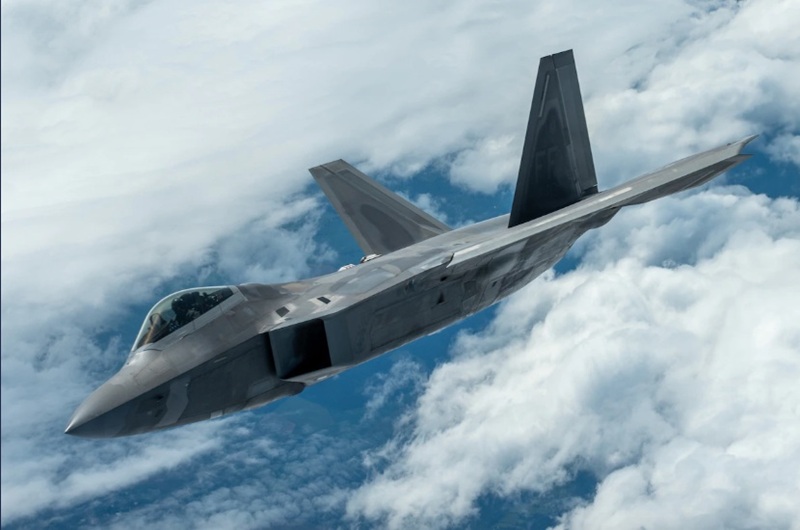
U.S. Air Force F-22 Raptor stealth fighters have again been deployed to the Middle East, according to open-source flight monitoring and regional reporting, echoing a familiar operational pattern observed ahead of earlier high-intensity contingencies. Notably, a similar F-22 forward deployment occurred four days before Operation Midnight Hammer, reinforcing the aircraft’s role as a leading indicator of shifts in U.S. airpower posture.
While U.S. Central Command has not released detailed public statements on the latest movement, the timing and repetition of F-22 deployments suggest a deliberate recalibration of deterrence and air dominance assets rather than a routine rotation.
Patterned deployment, not an anomaly
The F-22 has historically been surged into the Middle East during periods of elevated threat perception, particularly when airspace control, force protection, or rapid escalation management is required. Deploying the aircraft days ahead of major operations allows commanders to establish air superiority, conduct defensive counter-air missions, and quietly signal readiness without overt escalation.
The reappearance of F-22s in the region today mirrors this precedent, indicating that U.S. planners may be reinforcing options rather than reacting to an immediate crisis.
Why the F-22 matters in this context
The F-22 Raptor remains the U.S. Air Force’s premier air-dominance platform. Its combination of low observability, supercruise capability, advanced sensors, and data fusion enables it to operate deep inside contested airspace while maintaining a decisive edge against both aircraft and integrated air defense systems.
Beyond its combat role, the F-22 functions as a force-multiplier, cueing other assets, sharing targeting data, and shaping the air battle before it becomes visible. This makes its deployment as much about shaping the battlespace as about deterrence.
Strategic signaling and deterrence logic
Deploying F-22s ahead of or alongside other U.S. assets sends a calibrated message to both allies and adversaries. For partners, it signals commitment and reassurance. For potential adversaries, it complicates planning by raising the cost of escalation and narrowing windows of opportunity.
The earlier deployment prior to Midnight Hammer demonstrated how quietly positioned air-dominance assets can underpin subsequent operations without public fanfare. Today’s redeployment appears consistent with that same logic.
Regional context
The latest movement comes amid sustained regional volatility, including persistent drone and missile threats, heightened air defense alertness, and increased U.S. and allied force posture across the Middle East. In such an environment, air superiority is a prerequisite for virtually all other military options, making the F-22 a natural choice for early positioning.
What this does — and does not — indicate
As with previous surges, the presence of F-22s does not by itself confirm an impending operation. The aircraft are frequently deployed as a preventative measure, designed to deter escalation, protect high-value assets, and preserve decision-space for political and military leadership.
However, the repetition of the deployment pattern—particularly in light of its timing before Midnight Hammer—suggests that U.S. planners are again prioritizing flexibility, dominance, and strategic ambiguity.
Outlook
- Absent official confirmation, details of basing, numbers, and mission profiles are likely to remain undisclosed. What is clear is that the F-22’s return to the Middle East reflects a conscious adjustment in U.S. airpower posture, leveraging stealth and air dominance to quietly shape the regional balance without overt escalation.