


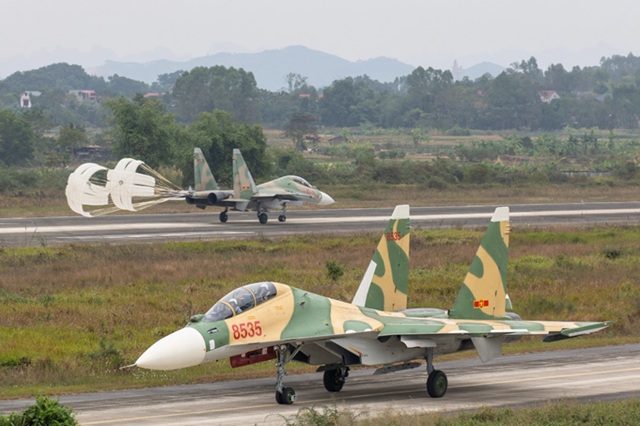
For decades, Vietnam has been one of Russia’s largest and most reliable arms markets in Asia, particularly in combat aviation. The Vietnam People’s Air Force (VPAF) remains almost entirely equipped with Soviet- and Russian-origin aircraft, reflecting Cold War-era procurement patterns that persisted well into the post-Soviet period.
At present, Vietnam’s combat aircraft inventory consists exclusively of Russian-designed platforms, including Su-22, Su-27, Su-30MK2, and Yak-130 aircraft. This reliance is mirrored across other branches of the armed forces, where Soviet- and Russian-made systems continue to dominate.
However, emerging indications that Vietnam and France have made progress in negotiations over the potential supply of Dassault Rafale fighter jets suggest a shift that is incremental in execution but structural in intent.
A Russian-Centric Legacy in Vietnamese Airpower
Vietnam’s current air force inventory includes:
- 16 Su-22M4 strike aircraft
- 9 Su-22UM3K trainer variants
- 5 Su-27SK fighters
- 5 Su-27UBK trainers
- 35 Su-30MK2 multirole fighters
- 12 Yak-130 advanced jet trainers
This composition underscores the depth of Vietnam’s historical dependence on Russian aviation supply chains, training pipelines, and munitions stocks.
Early Signals of Diversification
As early as 2022, Hanoi publicly stated its intention to diversify defence procurement to reduce reliance on Russia. In practice, steps in this direction began even earlier, reflecting both operational concerns and shifting geopolitical calculations.
Reports of Vietnam’s interest in Rafale fighters surfaced in 2024, building on a 2013 bilateral defence cooperation agreement between Vietnam and France. The current state of talks suggests these discussions have moved beyond exploratory dialogue, though no formal decision has been announced.
Diversification Beyond Combat Aviation
Vietnam’s move away from additional Russian procurement is not limited to aircraft. Instead of ordering more T-90S tanks from Russia, Hanoi opted to modernise its legacy T-54 and T-55 fleets with Israeli involvement, signalling a willingness to integrate non-Russian subsystems into core force structures.
Similarly, Vietnam’s decision to procure K9 Thunder 155-mm self-propelled howitzers from South Korea reflects a broader shift toward systems compatible with Western and NATO-adjacent standards.
The U.S. Dimension and Its Limits
The United States lifted its arms embargo on Vietnam in 2016, opening the door to limited defence trade. Since then, Hanoi has purchased approximately USD 400 million worth of U.S.-made equipment, primarily coast guard vessels and training aircraft, and has explored the possible acquisition of C-130J transport aircraft.
Vietnam has also held discussions with Washington regarding F-16 fighters, but no tangible progress has been observed. Budgetary constraints—Vietnam’s annual defence spending is estimated at around USD 10 billion—make the simultaneous acquisition of multiple Western fighter types financially unrealistic.
Rafale: Capability Versus Cost and Time
A transition from Russian to Western combat aircraft would impose significant structural costs. Rafale induction would require:
- Comprehensive upgrades to airbase infrastructure
- Establishment of entirely new munitions stockpiles
- New maintenance, training, and logistics ecosystems
Existing Russian-origin weapons would be incompatible with French aircraft, making the transition both costly and time-intensive.
Compounding this challenge is the fact that Rafale production slots are currently in high demand, with a substantial backlog in France. Even if Vietnam were to place an order in the near term, initial aircraft deliveries before the end of the decade would be unlikely.
Strategic Meaning of the Shift
Despite these constraints, the broader direction is clear. Vietnam is not executing a rapid pivot away from Russian arms, but it is deliberately widening its procurement options, reducing long-term dependency, and aligning selected capabilities with Western standards.
Given the scale of legacy Russian equipment still in service, this transition will inevitably span many years. Nevertheless, the trajectory itself carries strategic weight.
Implications for Russia and the Global Arms Market
Vietnam has long been considered a cornerstone Russian defence customer in Southeast Asia. Its gradual reorientation—however cautious—signals more than a single fighter competition outcome.
What is unfolding represents:
- The erosion of a traditionally loyal Russian arms market
- A recalibration of defence partnerships in Southeast Asia
- And a broader realignment within the global arms trade
While incremental in pace, Vietnam’s procurement choices increasingly point toward a tectonic shift in how middle powers balance autonomy, interoperability, and strategic hedging in a changing security environment.


