Iran’s attack near Fujairah in the United Arab Emirates on March 3 may appear limited in physical damage, but strategically it may represent one of the most precise signals Iran has sent during the current conflict.
The incident demonstrated that a key piece of global energy infrastructure—designed specifically to reduce dependence on the Strait of Hormuz—is also within Iran’s reach.
Even if the strike caused limited operational disruption, the message to the global energy system may be far more significant.
What Fujairah Is and Why It Matters

To understand why Fujairah matters, it is necessary to understand the strategic importance of the Strait of Hormuz.
Roughly 20 million barrels of oil per day move through the narrow waterway between Iran and the Arabian Peninsula. Because Iran sits directly on the strait, it has long been able to threaten global oil supply by targeting shipping routes.
For decades, global energy planners sought ways to reduce this vulnerability.
The Fujairah Oil Industry Zone (FOIZ) was built as part of that solution.
Located on the Gulf of Oman coast, Fujairah allows oil from Abu Dhabi to reach international markets without passing through the Strait of Hormuz.
A 380-kilometer pipeline connects Abu Dhabi’s oil fields directly to Fujairah’s export terminals.
A Critical Node in the Global Energy System
Fujairah is now one of the most important energy hubs in the world.
Key features include:
- The world’s third-largest bunkering port
- Storage capacity for tens of millions of barrels of crude oil and refined fuels
- Major terminal operators including Vopak, VTTI, MENA Terminals, and GPS Chemoil
- Strategic export access directly to the Indian Ocean
In practical terms, Fujairah is the infrastructure that the global energy market built to reduce the strategic leverage of the Strait of Hormuz.
What Happened During the March 3 Strike
On March 3, an Iranian drone reportedly entered UAE airspace near Fujairah.
Air defense systems intercepted the drone before it could directly strike its target.
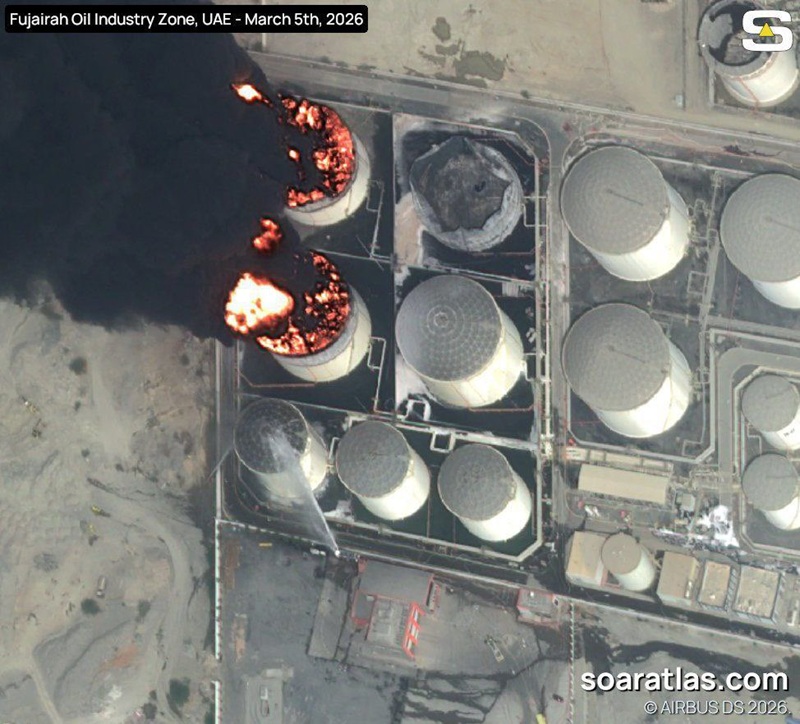
However, debris from the interception reportedly fell into the Fujairah Oil Industry Zone, igniting a fire near storage infrastructure.
The UAE confirmed:
- the fire was contained
- no casualties were reported
- port operations were resuming normally
However, reporting from Argus Media indicated that storage tanks were struck and thick smoke was visible over the terminal area.
Satellite imagery released on March 6 showed signs of fire damage in the storage zone.
The Strategic Meaning of the Strike
Officially, the incident has been described as a near miss caused by debris from an intercepted drone.
But from a strategic perspective, the message may be different.
Iran demonstrated that Fujairah itself is within range.
Those two statements can exist simultaneously:
- The damage may be limited.
- But the vulnerability has been publicly demonstrated.
For global energy markets and maritime insurers, the second point may be the more important one.
Why Energy Markets Are Watching Fujairah

The investment logic behind Fujairah relies on one key assumption: the bypass route must be physically safe.
If infrastructure in Fujairah itself can be targeted, the bypass strategy becomes more complicated.
Energy markets operate heavily on risk pricing. Even limited incidents can influence insurance costs, shipping rates, and long-term investment decisions.
In this war, Iran has repeatedly demonstrated a strategy focused on targeting infrastructure nodes rather than destroying them outright.
The goal appears to be demonstrating reach and vulnerability.
Iran’s Broader Energy Targeting Pattern
Analysts note that recent strikes across the Gulf appear to follow a broader strategic pattern.
Several key energy sites have been targeted during the conflict:
- Ras Tanura – a major Saudi oil export terminal
- Ras Laffan – Qatar’s LNG infrastructure hub
- Ahmadi – a key pipeline and refining complex in Kuwait
- Fujairah – the Hormuz bypass export route
Taken together, these targets represent critical nodes in the Gulf’s energy architecture.
The message appears consistent: no part of the regional energy network is completely outside Iranian reach.
Market Impact: A New Risk Premium
Global energy markets had already been pricing in a Hormuz closure risk premium due to the ongoing conflict.
The Fujairah incident may introduce a second factor.
Energy traders now consider not only the risk of disruption in the Strait of Hormuz, but also the possibility that alternative export routes could be targeted.
These risks can stack together in market pricing.
At the time of the incident, jet fuel prices were already trading above $225 per barrel, reflecting heightened geopolitical risk across the region.
A Strategic Signal Rather Than a Destructive Strike
From a military perspective, the Fujairah incident did not shut down the port or destroy major infrastructure.
But the strategic objective may not have been physical destruction.
Instead, the strike demonstrated that even infrastructure designed to bypass the Strait of Hormuz can still be reached.
For Iran, that signal may have been the central goal.
For global energy markets, it introduces a new layer of uncertainty in an already volatile geopolitical environment.