Claims that Iran possesses an operational stockpile of up to 80,000 Shahed loitering munitions, supported by a reported production rate of around 400 drones per day, have elevated Tehran’s unmanned warfare capability into a central factor shaping regional and global military planning.
If accurate, these figures would place Iran at the apex of global loitering-munition inventories—far beyond any other state actor—and signal a decisive shift from symbolic drone use toward industrial-scale endurance warfare.

From Tactical Weapon to Strategic Arsenal
The assessment gained traction after widely circulated reports citing Israeli estimates that Iran is producing hundreds of Shahed-class drones daily and has accumulated tens of thousands ready for deployment. Such a force would represent not merely a large arsenal, but a doctrinal transformation in how drones are used—as instruments of sustained pressure rather than precision strike alone.
Battlefield experience reinforces these concerns. Ukrainian wartime disclosures have shown how Shahed-derived systems, when employed at scale, can maintain daily attack tempos that exhaust air-defence systems and strain national infrastructure. The operational lesson is clear: quantity and persistence can offset technological inferiority.
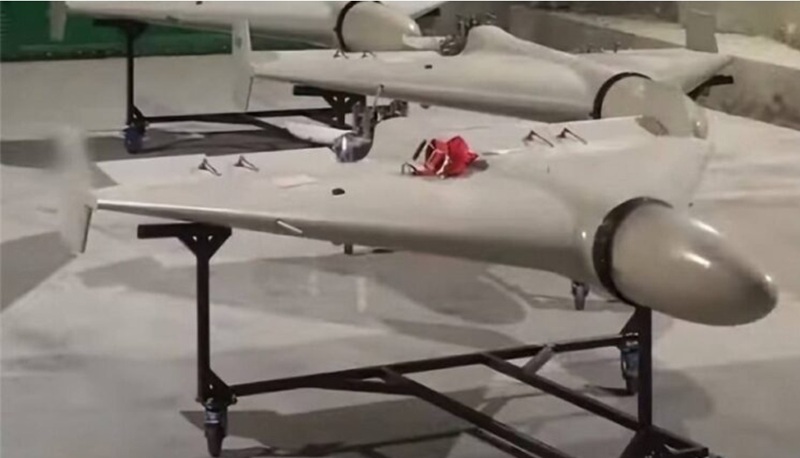
Why the Shahed-136 Matters
At the centre of this capability is the Shahed-136, engineered for manufacturability, range, and cost efficiency rather than sophistication. With an estimated range exceeding 2,000 kilometres and a warhead capable of damaging economically critical infrastructure, the platform is designed to impose cumulative costs on defenders.
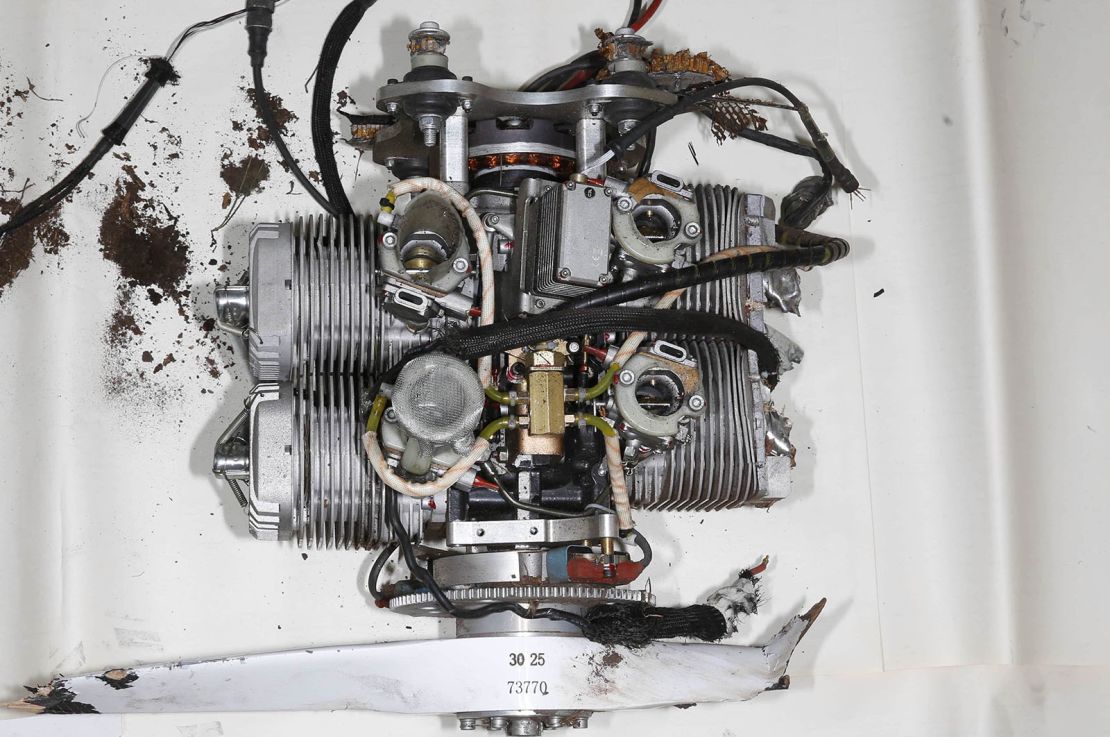
Powered by a simple piston engine and guided by basic inertial navigation, the Shahed prioritises ease of production and resilience under sanctions. Unit costs—estimated far below those of interceptor missiles—create highly unfavourable exchange ratios, forcing defenders to spend vastly more to stop each incoming drone.
Industrial Scale and Endurance Warfare
If Iran can sustain production approaching 400 units per day, annual output would exceed 140,000 drones—an extraordinary figure for a sanctioned economy. Such capacity implies a distributed manufacturing ecosystem, multiple assembly sites, modular components, and stockpiled airframes ready for rapid activation during crises.
This approach reflects Iran’s long-standing industrial philosophy: dispersion, redundancy, and rapid iteration based on battlefield feedback. The result is not just replenishment during conflict, but the ability to expand inventories even under sustained attack.
Strategic Implications for the Middle East and Beyond
An inventory measured in tens of thousands enables Iran to conduct prolonged saturation campaigns across multiple theatres simultaneously. In the Gulf, this could target ports, desalination plants, and energy infrastructure. Against Israel, drone waves could be designed to deplete interceptor stocks before higher-end missile salvos. In the Levant, coordinated launches from Iran and proxy territories could compress response timelines and overwhelm layered defences.
Even interception rates above 80 percent would still allow hundreds of drones through during mass launches, shifting the definition of air-defence success from interception percentages to long-term endurance.
A Global Wake-Up Call on Defence Economics
Beyond physical damage, a mass Shahed arsenal functions as a tool of strategic coercion. Persistent drone pressure imposes psychological strain, economic disruption, and continuous high-alert postures that degrade readiness over time. The real battleground becomes industrial capacity and stockpile depth, not individual platform performance.
For Asia, the implications are profound. From South Asia to East Asia and Southeast Asia, loitering munitions challenge air-defence architectures optimised for ballistic and cruise missiles. The lesson is that future resilience depends on cheap interceptors, electronic warfare, distributed sensors, rapid repair, and shared stockpiles, not solely on exquisite systems.
A Structural Shift in Warfare
Whether Iran ultimately possesses exactly 80,000 Shahed drones or a smaller number, the strategic direction is unmistakable. Warfare is shifting toward manufacturing-versus-magazine competition, where endurance, economics, and psychological pressure matter as much as precision.
States that adapt early—by making defence cheaper, more distributed, and more repairable—will remain resilient. Those that do not risk being strategically coerced by an adversary that can simply keep drones in the sky night after night.