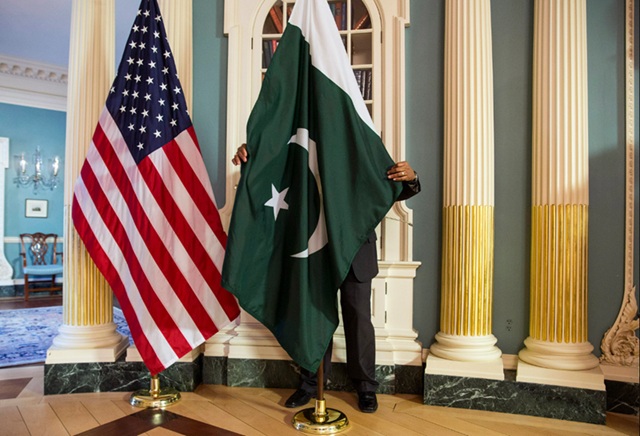
For the first time in decades, Pakistan barely features in the United States’ long-term defence planning. The shift is most visible in the latest US defence legislation and strategic documents, where India is elevated as a key partner while Pakistan is referenced only indirectly, mainly in the context of counterterrorism and Afghanistan.
This change marks a structural transformation in Washington’s South Asia policy rather than a temporary diplomatic setback.
From Frontline Ally to Peripheral Actor
After 9/11, Pakistan was a central pillar of US military strategy. It served as:
- A logistics hub for Afghanistan
- A counterterrorism partner
- A key intelligence interlocutor
That era ended with the US withdrawal from Afghanistan in 2021. Once American combat operations ceased, Pakistan’s primary utility in US defence planning sharply declined.
Washington no longer requires:
- Pakistani supply routes
- Pakistani basing access
- Large-scale military cooperation
As a result, Pakistan shifted from being operationally essential to strategically peripheral.
The China Factor: Why India Replaced Pakistan
The dominant driver of US defence planning today is strategic competition with China. In this framework:
- Pakistan is not positioned to counter China
- Pakistan maintains a deep strategic partnership with Beijing
- Pakistan is a core participant in China’s Belt and Road Initiative
By contrast, India is seen as:
- A demographic, economic, and military counterweight to China
- A naval power in the Indian Ocean
- A state willing to align—though selectively—with US Indo-Pacific objectives
From Washington’s perspective, India fits the China-centric strategy; Pakistan does not.
Trust Deficit and Strategic Friction
A persistent trust gap also shapes US thinking.
American policymakers believe Pakistan:
- Pursues strategic autonomy, not alignment
- Maintains ties with actors Washington considers adversarial
- Resists becoming part of any formal US-led security bloc
At the same time, Pakistan views the US as:
- Transactional and unreliable
- Willing to disengage abruptly (as in Afghanistan)
- Overly tilted toward India
This mutual skepticism has discouraged long-term defence planning.
From Partnership to Risk Management
In current US defence documents, Pakistan appears—when it does at all—under:
- Counterterrorism monitoring
- Regional stability concerns
- Afghanistan-linked security risks
There is no language on:
- Defence co-production
- Advanced technology sharing
- Military interoperability
- Strategic integration
This reflects a policy shift from partnership to risk management.
Congressional Politics Matter
Another factor is US domestic politics.
- India enjoys strong bipartisan support in Congress
- Pakistan lacks an effective lobbying presence
- Afghanistan’s collapse hardened congressional attitudes toward Islamabad
As a result, Pakistan is often viewed through a post-Afghanistan accountability lens, not as a future-oriented defence partner.
Not a Sanction, But a Signal
Importantly, Pakistan’s absence from US defence planning does not mean:
- Sanctions
- Hostility
- Diplomatic rupture
It signals something subtler but more consequential:
Pakistan is no longer central to how Washington imagines future wars, alliances, or deterrence.
What Would Change This?
Analysts say Pakistan would need:
- A clearer role in regional stability beyond Afghanistan
- More visible counterterrorism outcomes aligned with US concerns
- Expanded diplomatic engagement beyond security transactions
Even then, US defence planning is unlikely to return to the post-9/11 model.
The Bottom Line
The US defence architecture is now built around:
- China competition
- Technology dominance
- Networked alliances
In this design:
- India is embedded
- Pakistan is managed
- Afghanistan is the past
Pakistan’s absence is not an oversight—it is a reflection of a new global order and a US strategy that has moved on.