


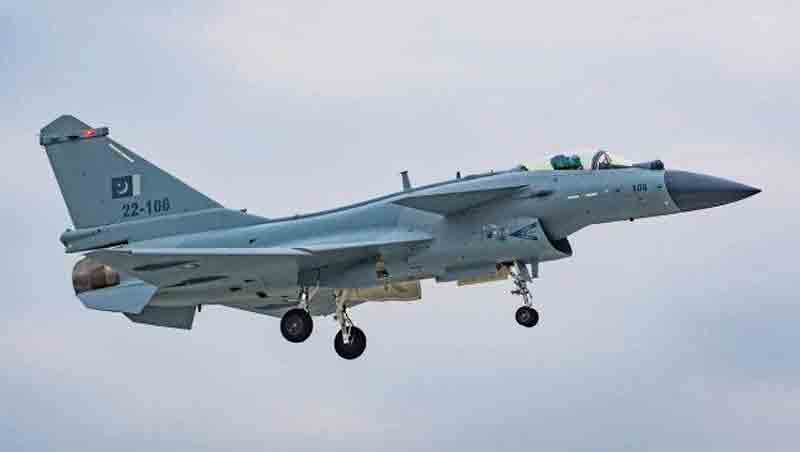
China has officially confirmed that its export-oriented J-10CE multirole fighter jet achieved its first combat success in May, shooting down multiple opposing aircraft during aerial combat without suffering any losses. The confirmation marks a significant milestone for China’s defence aviation industry and is expected to boost the aircraft’s credibility on the global arms market.
The announcement was made by the State Administration of Science, Technology and Industry for National Defense, which oversees China’s military-industrial development and arms exports. While the agency did not disclose the location of the engagement or the identities of the opposing aircraft, it described the encounter as a real-world validation of the J-10CE’s combat effectiveness.
#BREAKING 🇨🇳China has officially confirmed that its export-oriented J-10CE fighter jet achieved its first combat victory last May, shooting down multiple aircraft in aerial combat without suffering any losses, boosting its global appeal.
– China’s State Administration of… pic.twitter.com/YkUbYVO4R8
— Shen Shiwei 沈诗伟 (@shen_shiwei) January 12, 2026
The J-10CE is the export variant of China’s J-10C, a single-engine, fourth-plus-generation fighter equipped with an active electronically scanned array (AESA) radar, modern electronic warfare systems, and compatibility with advanced beyond-visual-range air-to-air missiles. Beijing has promoted the aircraft as a cost-effective alternative to Western fighters, combining modern sensors and weapons with comparatively lower acquisition and operating costs.
Chinese analysts say the confirmed combat performance strengthens Beijing’s claim that the J-10CE is not merely a theoretical or parade-ground platform, but a mature system capable of surviving and prevailing in contested air combat environments. Unlike test flights or exercises, real combat engagements are widely viewed in the global arms market as the most credible measure of a fighter’s effectiveness.
The announcement comes amid intensifying competition in the international fighter jet market, where combat-proven platforms often enjoy a decisive advantage in export campaigns. Aircraft such as the F-16, Rafale, and Su-35 have historically leveraged combat records to secure foreign sales, and China appears keen to position the J-10CE in a similar category.
Although Beijing has not released operational details, defence observers note that a “no-loss” outcome suggests effective integration of sensors, pilot training, command-and-control support, and missile performance. It also indicates that the aircraft was likely employed within a broader air defence or air combat network rather than operating in isolation.
The confirmation is expected to enhance the J-10CE’s appeal among countries seeking to modernize their air forces without relying on Western suppliers or navigating political restrictions attached to U.S. or European defence exports. China has increasingly marketed the J-10CE to regions including South Asia, the Middle East, and parts of Africa, where demand for advanced but affordable combat aircraft remains strong.
From Beijing’s perspective, the announcement also serves a strategic signalling purpose. By publicly acknowledging combat success, China underscores the growing maturity of its aerospace industry and its ability to field—and export—systems capable of performing under real combat conditions.
At the same time, analysts caution that the lack of detailed disclosure leaves unanswered questions about the operational context, the quality of the adversary aircraft, and the broader strategic circumstances of the engagement. Even so, the confirmation alone represents a notable shift in China’s messaging, moving from theoretical capability claims to asserted battlefield results.


