Tensions between Yemen’s internationally recognised government and the United Arab Emirates have sharply escalated after Yemeni authorities accused Emirati forces of leaving explosives and assassination equipment at a military facility in Hadramout Governorate, allegations strongly denied by Abu Dhabi.
The dispute centres on Al-Rayyan Airport in Mukalla, a strategic site previously under Emirati military control during the Saudi-led coalition’s intervention in Yemen.
Yemeni Governor Makes Explosive Allegations
Hadramout Governor Salem Al-Khanbashi said explosives allegedly linked to the UAE were discovered at camps inside Al-Rayyan Airport and were intended to be used for assassinations and acts of sabotage.
“We will take decisive steps to ensure the UAE pays the price,” Al-Khanbashi said, accusing groups affiliated with Aidarous Al-Zubaidi, the UAE-backed head of the Southern Transitional Council (STC), of looting state institutions and undermining local authority.
The governor said Hadramout had “turned a bitter page” with the help of Saudi Arabia, signalling a shift away from Emirati-backed factions in the governorate.
Yemeni State TV Publishes Images
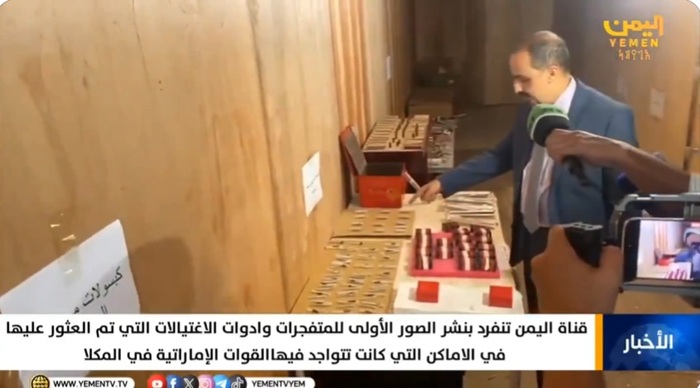
Yemen’s official television channel broadcast what it described as the first images of explosives, including C4, detonators and assassination tools, allegedly found at sites previously used by Emirati forces at Al-Rayyan Airport.
#Breaking: Yemen’s 🇾🇪 official TV exclusively published the first images of UAE 🇦🇪 explosives and assassination tools found at sites previously used by Emirati forces in the city of Mukalla, Hadramout Governorate. The channel accompanied Yemen’s Minister of Information, @ERYANIM. https://t.co/LcM2Sfa5hC pic.twitter.com/Pi1518jUEM
— Salman Al-Ansari | سلمان الأنصاري (@Salansar1) January 19, 2026
The footage was aired alongside officials from Yemen’s Ministry of Information and coalition representatives, who claimed the materials were evidence of planned assassinations and enforced disappearances.
According to Yemeni officials, the presence of weapons at a facility under long-term Emirati control establishes direct responsibility, arguing that no military material could have entered or remained at the site without Emirati approval.
Saudi Intelligence Reports Cited
Saudi-linked intelligence reports were also cited by Yemeni officials, alleging that weapons were transferred from Fujairah in the UAE to Al-Rayyan Airport shortly before Abu Dhabi’s claimed withdrawal.
Officials said the explosives were deliberately left behind to be used by allied militias, but that the plan was thwarted by Yemen’s National Shield Forces, a Saudi-backed formation.
“A genuine withdrawal removes its weapons,” one Yemeni official said, arguing that underground storage of explosives indicated an intent to sustain instability rather than promote security.
UAE Denies Allegations, Rejects “Secret Prison” Claims
In response, the UAE Ministry of Defence (MoD) issued a categorical denial, calling the accusations “false, misleading and devoid of evidence.”
The ministry said Emirati forces completed their full withdrawal from Yemen on January 2, 2026, transferring all weapons and equipment in accordance with recognised military procedures. It rejected claims that explosives or assassination tools were left behind and dismissed allegations of secret prisons at Al-Rayyan Airport as “fabrications.”
The MoD said the underground facilities referenced by Yemeni officials were standard military shelters, operations rooms and accommodation, commonly found at airports and military installations worldwide.
The UAE also accused unnamed actors of promoting false narratives to advance political agendas and undermine Abu Dhabi’s role in supporting Yemen’s security over the past decade.
Contradictions and Long-Standing Allegations
Yemeni officials said the UAE statement undermined its own credibility, noting that an earlier version cited December 3, 2025, as the withdrawal date before being edited to January 2, 2026.
They also pointed to United Nations reports, international human rights organisations and the US State Department’s 2019 human rights report, which documented allegations of secret detention facilities run by UAE-backed forces in southern Yemen.
A Wider Power Struggle in Southern Yemen
Analysts say the dispute reflects a broader power struggle in southern Yemen between the Saudi-backed Yemeni government and the UAE-backed STC, particularly in resource-rich and strategically located areas such as Hadramout.
With Yemen’s fragile political process stalled and regional rivalries unresolved, the Mukalla allegations risk further deepening divisions within the anti-Houthi camp and complicating efforts to stabilise southern Yemen.