From a defence-industrial perspective, the latest presentations by Azerbaijani firms Azshield Defense and RD Smart point to a clear shift from adaptation-based solutions toward purpose-built, serial unmanned combat systems.
Maturation of Indigenous UAV Capability
The showcased portfolio spans bomber drones, reconnaissance platforms, FPV strike systems, and high-speed interceptors—suggesting a deliberate effort to cover multiple tactical niches rather than relying on a single class of UAV. This breadth is notable for a domestic industry that only recently relied on modified commercial platforms.
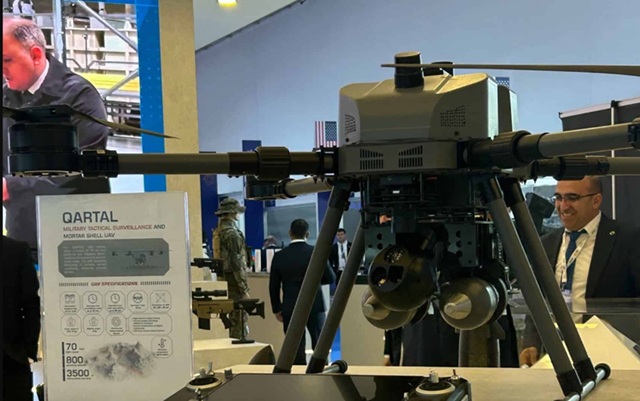
The QARTAL bomber drone represents the upper end of RD Smart’s tactical UAV lineup. Its ability to carry multiple munitions, operate in harsh temperature conditions, and integrate day/thermal optoelectronic payloads indicates an emphasis on reliability and repeatable battlefield use rather than one-off experimentation. While its combat radius and speed remain modest, these parameters are consistent with short-range strike and support roles close to the forward edge of the battlefield.
The reconnaissance variant, QARTAL-M, reflects a more pronounced focus on intelligence, surveillance, and reconnaissance (ISR). Increased range, extended endurance, higher operating altitude, and significantly improved optical zoom suggest an effort to provide commanders with persistent situational awareness beyond immediate tactical depth. This aligns with contemporary lessons from recent conflicts, where ISR drones have proven at least as decisive as strike platforms.
Emphasis on FPV and Light Strike Drones
RD Smart’s lighter systems, including QUZGHUN, QUZGHUN-Z, and QIRGHI-S, indicate that Azerbaijan is fully incorporating the FPV and loitering-strike paradigm that has reshaped modern ground combat. The use of C4-based warheads, moderate ranges, and relatively high speeds reflects a design philosophy optimized for cost-effective attrition, precision strikes against soft and semi-hardened targets, and rapid deployment in contested environments.
Notably, the diversity of warhead options suggests flexibility rather than platform specialization, allowing the same airframe to be adapted for different mission profiles with minimal logistical burden.
Interceptors and Counter-UAS Thinking
Azshield Defense’s presentation of FPV interceptor drones, particularly the BARS series, signals awareness of the growing counter-UAS challenge. High speeds, high-altitude operating envelopes, and lightweight combat units point toward a role focused on engaging enemy drones rather than ground targets. This is a relatively recent development in UAV doctrine and reflects a more sophisticated understanding of drone-on-drone warfare.
The Batur family further underscores this trend, with multiple frame sizes, scalable warhead weights, and the option of fiber-optic control—an increasingly relevant feature in environments saturated with electronic warfare.
From Improvisation to Serial Production
The contrast with earlier experimentation is instructive. In 2024, Azerbaijani forces were still adapting commercial Chinese platforms such as Splash Drone systems to deliver mortar munitions. While effective as stopgap measures, such solutions typically suffer from limited durability, integration challenges, and inconsistent performance.
The current lineup demonstrates a transition toward factory-produced systems designed from the outset for military use. This suggests improvements not only in airframe and payload integration, but also in training, logistics, maintenance, and doctrinal employment.
Strategic Implications
Taken together, these developments indicate that Azerbaijan is moving beyond experimental UAV use toward a layered unmanned capability integrated into regular force structures. While none of the presented systems individually represent a technological breakthrough, their cumulative effect lies in scalability, standardisation, and doctrinal coherence—factors that increasingly define effectiveness in modern drone warfare.
If production volumes and operational integration follow, Azerbaijan would be positioning itself not merely as a UAV user, but as a sustained producer of tactically relevant unmanned systems.