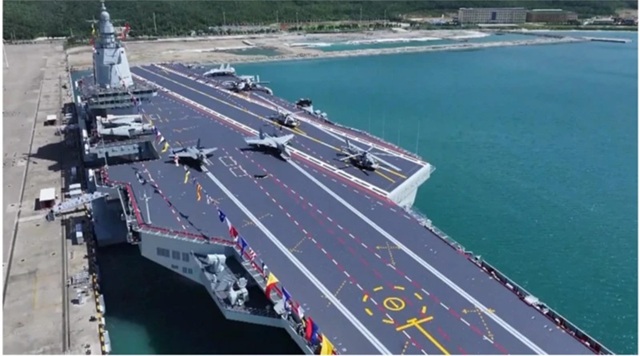
Experts say China’s third aircraft carrier, Fujian, launched in November 2025, is far more advanced than the country’s previous two carriers, marking a significant step in Beijing’s quest to challenge US naval dominance in the Western Pacific.
Weighing around 80,000 tons and named after the Chinese province closest to Taiwan, the carrier can host up to 70 aircraft at a time, including fighter jets, helicopters and early-warning aircraft capable of detecting threats at long range, coordinating air defence and striking distant targets.
A leap toward US-level capability
Fujian is China’s first carrier equipped with a flat flight deck and electromagnetic catapults, enabling the launch of heavier aircraft with greater weapons and fuel loads—technology previously available only to the United States.
According to Taiwan-based defence experts, this capability lifts China’s carrier strike groups to a new level well beyond its earlier carriers, Liaoning and Shandong.
Xi Jinping’s naval vision
Chinese state media have called Fujian a major milestone in the country’s naval development. Reports say President Xi Jinping personally approved the decision to install electromagnetic catapults and attended the carrier’s high-profile commissioning ceremony dressed in military uniform while praising pilots as “heroes.”
Xi has repeatedly asserted that the Pacific Ocean is “big enough for both China and the United States,” signalling Beijing’s ambition to achieve strategic parity.
Regional concerns and US response
Analysts warn that Fujian poses emerging risks to Taiwan’s eastern front from the Pacific side. However, US military bases in Okinawa, South Korea, Guam and the Philippines maintain strong counter-strike capabilities.
By comparison, all 11 US aircraft carriers are nuclear-powered and heavier than Fujian. Experts note that China’s limited overseas bases and Fujian’s diesel engines will require frequent refuelling, constraining its sustained combat range.
Toward a maritime arms race
Despite the growing role of long-range missiles and drones, satellite imagery shows China is already building a fourth carrier and pursuing plans for nuclear-powered platforms.
Some analysts say this trajectory points toward an accelerating naval arms race between the world’s two largest powers.
As one Taiwan-based defence researcher told the New York Times, “The risks exist on both sides—whether it’s China or the United States.”