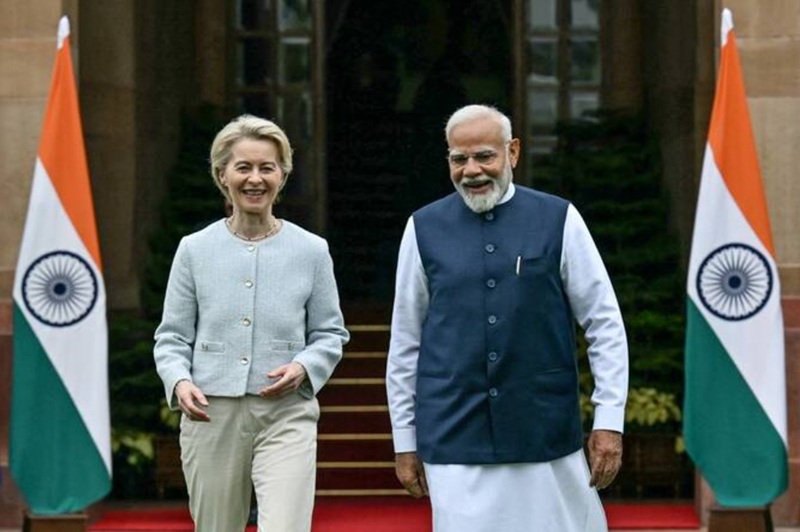
European Union leaders’ decision to finalize a free trade agreement (FTA) with India during high-level meetings in New Delhi has wider consequences beyond EU-India commerce. One of the most affected—but often overlooked—stakeholders is Turkey, whose long-standing Customs Union with the EU creates a structural imbalance whenever Brussels signs trade deals with third countries.
The EU–India FTA, expected to be concluded around January 26, 2026, once again exposes the limitations of Turkey’s current trade framework with Europe and risks deepening Ankara’s trade imbalance with major emerging economies.
How the EU–India FTA Affects Turkey
Under the EU–Turkey Customs Union, in force since 1996, Turkey is required to align its external tariffs with the EU’s Common External Tariff for industrial goods. This means that when the EU lowers or eliminates tariffs for a third country through an FTA, Turkey must do the same—even if it is not a party to that agreement.
In the case of India, this creates a clear asymmetry:
- Indian goods gain low-tariff or tariff-free access to the Turkish market
- Turkey does not automatically receive reciprocal access to India’s market
- Turkish exports to India continue to face Indian tariffs unless Ankara negotiates a separate FTA
As a result, Indian products can enter the EU duty-free and then flow onward to Turkey under Customs Union rules, while Turkish exporters remain disadvantaged in India.
A Familiar Structural Problem
This is not a new issue. Turkey has faced similar challenges following EU FTAs with countries such as South Korea, Canada, and Japan. Each time, Turkish imports increase, while exports struggle to keep pace due to the lack of guaranteed reciprocity.
The EU–India deal, however, magnifies the problem because of India’s scale, competitiveness, and export capacity, particularly in sectors where Turkey is already under pressure.
Sectors Most at Risk
Several Turkish industries could be disproportionately affected by the EU–India FTA:
- Automotive components and vehicles, where Indian manufacturers benefit from economies of scale
- Textiles and apparel, a sector central to Turkey’s export economy
- Chemicals and light manufacturing, where Indian producers are highly price-competitive
Without equivalent access to India’s large and fast-growing consumer market, Turkish firms face heightened competition at home without compensating export opportunities abroad.
Impact on Turkey’s Trade Balance
The asymmetry created by the EU–India FTA is likely to:
- Increase Turkish imports from India
- Exert downward pressure on domestic producers
- Worsen Turkey’s trade balance
- Reduce competitiveness in export-oriented manufacturing sectors
Over time, this dynamic could reinforce Turkey’s dependence on imports while limiting its ability to diversify export markets—an outcome at odds with Ankara’s long-term economic objectives.
Why Turkey Lacks Automatic Reciprocity
The core issue lies in Turkey’s unique position: it is bound by EU trade policy without having a seat at the table. As a non-EU member, Turkey does not participate in EU trade negotiations, nor does it automatically benefit from agreements Brussels signs with third countries.
While the Customs Union grants Turkish manufacturers access to the EU market, it also leaves Ankara exposed to decisions made elsewhere—without veto power or guaranteed compensation.
What Options Does Turkey Have?
To mitigate the impact of the EU–India FTA, Turkey has limited but clear options:
- Negotiate its own bilateral FTA with India, ensuring reciprocal tariff reductions
- Push for reform or modernization of the EU–Turkey Customs Union, including automatic inclusion in EU FTAs
- Diversify export markets to reduce exposure to asymmetric trade shocks
Among these, a Turkey–India FTA appears the most immediate solution, though negotiations could be lengthy and politically complex.
A Broader Strategic Signal
Beyond trade figures, the EU–India deal underscores a deeper strategic reality: Turkey’s current trade framework is increasingly misaligned with a world of mega-FTAs and shifting supply chains.
As the EU expands its global trade network, the cost of Turkey’s exclusion from decision-making grows. Each new agreement signed by Brussels reinforces the urgency for Ankara to either renegotiate the terms of its Customs Union or risk repeated economic disadvantages.
Conclusion
The EU–India free trade agreement may strengthen ties between Brussels and New Delhi, but it also highlights unresolved structural weaknesses in Turkey’s trade relationship with the EU. By granting Indian goods easier access to the Turkish market without guaranteed reciprocity, the deal risks widening Turkey’s trade deficit and undermining key industries.
Unless Turkey secures its own agreement with India or achieves meaningful reform of the Customs Union, similar challenges are likely to recur—each time the EU signs another global trade deal.