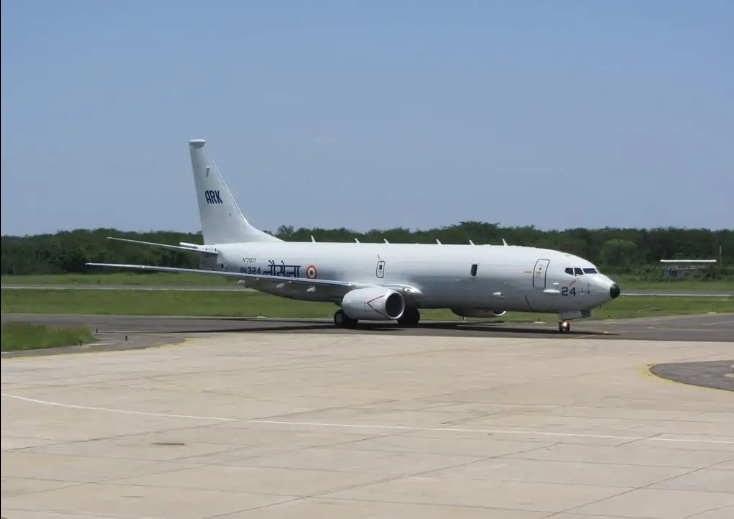
As 2025 draws to a close amid intensifying great-power competition in the Indo-Pacific, negotiations between India and the United States over the acquisition of six additional Boeing P-8I Poseidon maritime patrol aircraft remain frozen, trapped by a sharp cost escalation and a widening trade dispute that has begun to erode defence cooperation between Washington and New Delhi.
Once viewed as one of the most secure and operationally critical procurements for the Indian Navy, the P-8I expansion has become a test case for how inflation, tariff-driven economic pressure, and strategic mistrust can derail even mature military partnerships. Despite repeated high-level engagements involving senior US defence officials and Boeing executives, no breakthrough has emerged, reinforcing concerns in New Delhi that Washington’s Indo-Pacific rhetoric is increasingly at odds with its transactional trade posture.
The stalled deal now sits at the intersection of India’s maritime security needs, America’s economic statecraft, and China’s expanding naval footprint across the Indian Ocean Region. For the Indian Navy, the delay carries direct operational consequences, threatening surveillance gaps at a time when People’s Liberation Army Navy submarines and intelligence vessels are appearing with greater frequency near India’s maritime approaches.
A force multiplier under strain
The Boeing P-8I Poseidon has, for more than a decade, been the backbone of India’s maritime domain awareness. Derived from the US Navy’s P-8A but customised for Indian requirements, the aircraft integrates advanced radar, electro-optical sensors, sonobuoy processing, anti-submarine warfare (ASW) suites, torpedoes, and anti-ship missiles into a long-range, network-centric platform.

India currently operates 12 P-8I aircraft, split between INS Rajali in Tamil Nadu and Goa. The Navy has long assessed that a minimum fleet of 18 aircraft is necessary to sustain continuous coverage across the Arabian Sea, Bay of Bengal, Andaman Sea, and critical chokepoints such as the Malacca Strait. The urgency has grown as Chinese nuclear-powered submarines, including Type-093 Shang-class boats, conduct longer and more complex patrols in the region.
Beyond maritime roles, the aircraft has demonstrated strategic versatility, including overland surveillance during the 2017 Doklam standoff, highlighting its value as a multi-domain intelligence platform rather than a purely naval asset.
Cost shock and trade fallout
At the heart of the impasse is a dramatic rise in projected costs. The deal, cleared under the US Foreign Military Sales framework in 2021 at about USD 2.42 billion, was revised in mid-2025 to nearly USD 3.6 billion—an increase of almost 50 percent. Indian defence planners privately describe the escalation as operationally unjustifiable and politically untenable, particularly given the absence of similar inflation in earlier P-8I acquisitions.
The dispute has been compounded by a broader trade confrontation after Washington imposed a 25 percent tariff on Indian imports in August 2025, citing New Delhi’s continued purchases of discounted Russian oil. US President Donald Trump publicly defended the move, while India dismissed it as a double standard, pointing to China’s larger Russian oil imports facing no comparable penalties.
The tariff decision has effectively poisoned the negotiating climate, prompting India’s Ministry of Defence to pause talks and review major US defence acquisitions. Analysts say the episode has exposed vulnerabilities in India’s reliance on FMS mechanisms, where limited pricing flexibility and US domestic industrial pressures can collide with long-term force-planning assumptions.
Strategic implications
For Washington, the stalemate risks undermining its image as India’s most reliable high-end defence partner at a moment when Beijing is actively offering alternative surveillance and maritime solutions to regional states on more flexible commercial terms. Strategically, the deadlock weakens Indo-Pacific deterrence narratives by signalling that economic leverage can override shared security objectives.
For India, the episode reinforces a doctrinal shift toward procurement diversification and accelerated indigenisation under the “Aatmanirbhar Bharat” policy. Without meaningful offsets, local assembly, or deeper industrial participation by Indian firms, the deal is unlikely to regain momentum.
While alternatives such as indigenous UAV programmes or platforms like Japan’s Kawasaki P-1 exist, analysts note that none match the P-8I’s operational maturity, sensor fusion, or interoperability with US and allied forces. As China’s naval shadow lengthens across the Indian Ocean, the fate of the P-8I negotiations has become a litmus test for whether India–US defence cooperation can withstand the pressures of transactional geopolitics—or whether economic disputes will continue to blunt a partnership central to balancing maritime power in the Indo-Pacific.