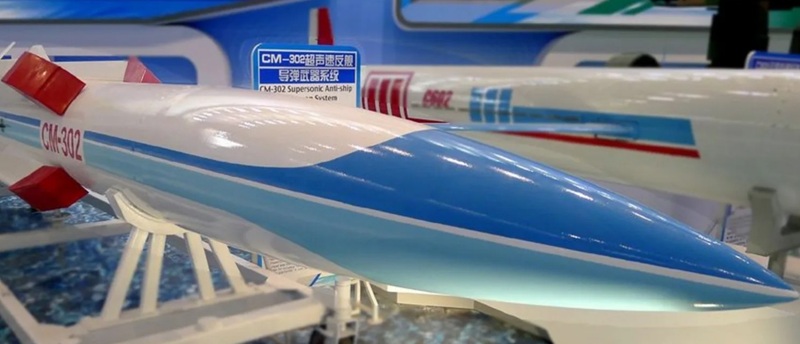
According to Reuters, Iran is close to finalising a deal with China to acquire the Chinese-made CM-302 supersonic anti-ship cruise missile, a development that comes amid a significant build-up of U.S. naval forces near the Iranian coastline.
Multiple sources familiar with the negotiations say the agreement is in its final stages, although a delivery timeline has yet to be confirmed. Talks that began at least two years ago accelerated sharply following the 12-day conflict between Israel and Iran in June, underscoring how recent regional warfare has reshaped Tehran’s defence priorities.
A Major Leap in Iran’s Naval Strike Capability
The CM-302 is a supersonic anti-ship cruise missile with an estimated range of around 290 kilometres. Designed to fly at very low altitudes and high speeds, the missile is intended to evade modern ship-borne air defence systems, making interception extremely difficult.
Defence analysts say the introduction of such missiles would significantly enhance Iran’s anti-access/area-denial (A2/AD) posture in the Persian Gulf and the Gulf of Oman—key maritime chokepoints through which a large share of global energy supplies transit.
“It’s a complete game-changer if Iran acquires supersonic anti-ship capability,” said Danny Citrinowicz, a former Israeli intelligence officer and senior researcher at Israel’s Institute for National Security Studies. “These missiles are extremely difficult to intercept and pose a serious threat to naval assets.”
Senior Iranian Officials Reportedly Involved
As negotiations entered their final phase last summer, senior Iranian defence and government officials reportedly travelled to China. Among them was Massoud Oraei, Iran’s deputy defence minister, whose visit has not previously been publicly reported, according to security officials cited by Reuters.
If completed, the CM-302 transfer would represent one of the most advanced weapons systems China has supplied to Iran in decades.
Sanctions, Embargoes, and Strategic Defiance
The potential deal would defy United Nations arms restrictions that were first imposed on Iran in 2006, suspended under the 2015 nuclear agreement, and then reimposed in September last year. Analysts say the sale highlights the growing willingness of Beijing to challenge Western-led sanctions regimes when its strategic interests are at stake.
The move also reflects deepening military and political coordination between China, Iran, and Russia—countries that already conduct annual joint naval exercises and increasingly align on opposition to U.S. influence in the Middle East.
Last year, the U.S. Treasury Department sanctioned several Chinese entities for allegedly supplying chemical precursors to Iran’s Islamic Revolutionary Guard Corps for missile development. Beijing rejected the accusations, insisting it strictly enforces export controls on dual-use technologies.
U.S. Naval Build-Up Raises Stakes
The missile negotiations come as the United States assembles a powerful naval armada within striking distance of Iran. This includes the aircraft carrier USS Abraham Lincoln and its strike group, alongside the USS Gerald R. Ford and its escorts. Together, the two carrier groups can deploy more than 5,000 personnel and approximately 150 aircraft.
Military experts note that the CM-302 is marketed by China’s state-owned China Aerospace Science and Industry Corporation as capable of sinking large surface combatants, including aircraft carriers and destroyers. The missile can be launched from ships, aircraft, or mobile ground platforms, and can also be configured for land-attack missions.
Broader China–Iran Defence Cooperation
Beyond the CM-302, sources say Iran is also discussing the acquisition of additional Chinese systems, including man-portable air defence systems (MANPADS), surface-to-air missiles, anti-ballistic technologies, and even anti-satellite capabilities.
During a military parade in Beijing last September attended by Iranian President Masoud Pezeshkian, Xi Jinping publicly stated that China supports Iran in safeguarding its sovereignty and national dignity. Shortly thereafter, China joined Russia and Iran in formally opposing the reimposition of UN sanctions.
“Iran has effectively become a geopolitical battlefield between the United States on one side and China and Russia on the other,” said one official briefed on the missile talks.
Rebuilding an Arsenal After War
According to Pieter Wezeman of the Stockholm International Peace Research Institute, the CM-302 acquisition would significantly replenish an Iranian arsenal depleted by last year’s fighting and years of sanctions pressure.
China was a major arms supplier to Iran during the 1980s, but large-scale transfers declined by the late 1990s. A renewed flow of advanced Chinese weapons would signal a major shift in regional power dynamics and further complicate U.S. efforts to contain Iran’s missile and nuclear programmes.