


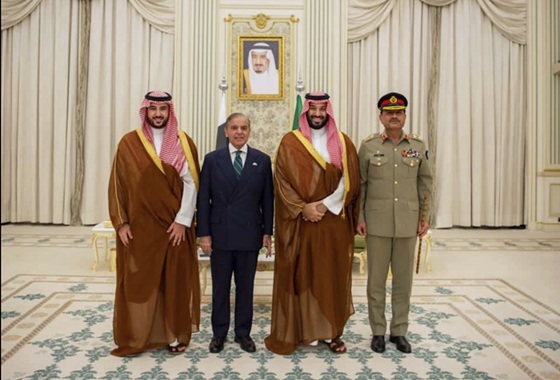
Saudi Arabia has formally announced the arrival of a Pakistani military air contingent at King Abdulaziz Air Base in Dhahran, marking one of the most significant operational moves under the Strategic Mutual Defense Agreement signed between Riyadh and Pakistan in September 2025.
According to the Saudi Ministry of Defense, the deployed force includes fighter and support aircraft from the Pakistan Air Force, with the stated aim of strengthening joint operational readiness, enhancing military coordination, and supporting regional stability.
The timing of the deployment has immediately elevated its geopolitical significance, particularly as diplomatic talks involving the United States and Iran continue in Islamabad.
Pakistani Air Assets Arrive in Eastern Saudi Arabia
The Saudi statement confirmed that the force arrived at King Abdulaziz Air Base, a strategically critical installation in the kingdom’s Eastern Province.
Ministry of Defense: Pakistani Military Force Arrives in Saudi Arabia Under Strategic Mutual Defense Agreement.https://t.co/OrEqVoZ9zG#SPAGOV pic.twitter.com/OzLihvV9vt
— SPAENG (@Spa_Eng) April 11, 2026
Open-source observations over the last 24 hours indicate the landing of:
- Lockheed C-130 Hercules C-130H transport aircraft
- Ilyushin Il-78 Il-78MP aerial refueling tankers
The presence of transport and tanker aircraft strongly suggests that the deployment includes not only fighter jets but also sustainment and refueling capability, pointing toward an operational rather than symbolic force package.
This gives the contingent extended endurance and rapid-response flexibility across the Gulf theater.
Defense Pact Now Moves Into Operational Phase
The deployment appears to be the clearest sign yet that the Strategic Mutual Defense Agreement signed on 17 September 2025 has moved into its operational phase.
Under the terms publicly described at the time, an attack on either state is treated as an attack on both.
That clause makes this development particularly significant in the current regional environment.
The arrival of Pakistani military assets in eastern Saudi Arabia sends a visible signal that Riyadh now has an activated mutual defense layer involving one of the region’s most capable air forces.
Timing Points to Strong Deterrence Signal Toward Iran
The deployment’s timing strongly suggests a deterrence message aimed at Iran.
This comes after recent reports of attacks on Saudi energy infrastructure, including concerns surrounding the kingdom’s East-West pipeline network following the ceasefire.
Dhahran’s location near the Gulf and within operational reach of key maritime and energy infrastructure further amplifies the signal.
Military analysts are likely to interpret the move as an effort to discourage any Iranian retaliation or spillover strike into Saudi territory.
This is especially relevant as separate reports indicate possible Chinese military support shipments to Iran, further increasing regional uncertainty.
Pakistan and Saudi Military Ties Are Deep and Longstanding
While the move is significant, it is not without precedent.
Pakistan and Saudi Arabia have long maintained close military cooperation, with Pakistani personnel historically involved in training, advisory, and defense support roles inside the kingdom.
Pakistani officers and defense specialists have for years worked closely with Saudi military institutions.
This means the latest deployment is less a new alliance and more an intensification of an already deeply integrated security relationship.
That longstanding familiarity may enable faster joint operational coordination than would normally be possible between partner states.
Talks in Islamabad Remain Critical
The deployment comes as diplomatic negotiations continue in Islamabad involving the United States and Iran.
This creates a highly sensitive balance:
- military deterrence increases in the Gulf
- Chinese-Iran arms concerns continue
- blocked assets remain disputed
- ceasefire terms remain fragile
Against this backdrop, the Islamabad talks increasingly appear to be the most important diplomatic channel for preventing a broader regional war.
The coming days may determine whether the region moves toward stabilization or renewed escalation.
Why This Matters Globally
This development goes beyond Saudi-Pakistan bilateral defense ties.
It directly affects:
- Gulf energy security
- Strait of Hormuz stability
- U.S.-Iran diplomacy
- China-Iran strategic calculations
With global oil markets already highly sensitive, any further military signaling in eastern Saudi Arabia will be closely watched by international markets and allied governments.
The operationalization of the pact is now one of the most consequential regional security developments of the week.


