Russia is aiming for a first flight of the Su-75 “Checkmate” light stealth fighter in 2026, according to a report by Izvestia published on January 12, 2026. While no specific date has been confirmed, the timeline would mark the aircraft’s first transition beyond the full-scale mock-up unveiled in 2021.
The Su-75 was officially revealed at the MAKS Air Show in August 2021 as a single-engine Light Tactical Aircraft, intended to complement the heavier Su-57 and eventually replace aging MiG-29 variants in Russian service. Since its debut, the program has remained in the development and preparation phase, with no confirmed flight testing milestones achieved to date.
Initial plans had projected a maiden flight as early as 2023, but the schedule was subsequently revised multiple times—to 2024, then 2025, and now early 2026—reflecting funding constraints, industrial prioritisation, and broader geopolitical pressures. As of January 2026, the aircraft remains in a pre-flight stage, with no publicly announced domestic or export orders.
Russian state officials have stated that prototype manufacturing activities are underway at the Komsomolsk-on-Amur Aircraft Plant, which also produces Su-35S and Su-57 fighters. However, development has taken place under the impact of international sanctions, which have constrained access to imported electronics, machine tools, and financing, while production capacity has been focused on meeting operational requirements for existing aircraft types.
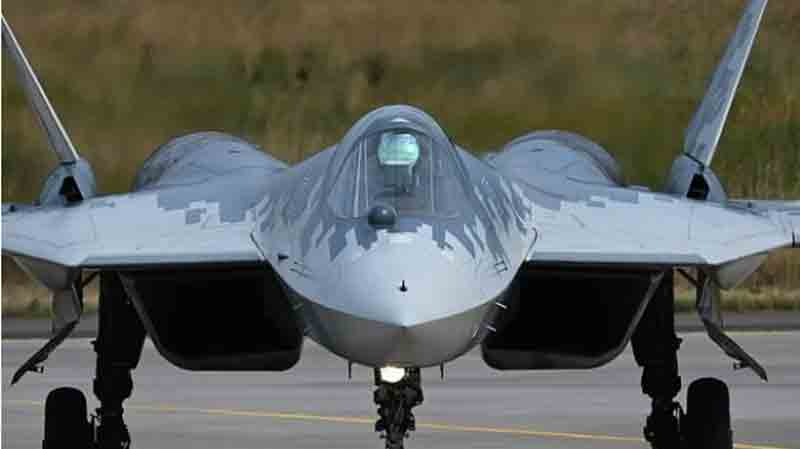
From a design perspective, the Su-75 features a configuration aimed at reducing radar signature while maintaining manufacturing simplicity. The aircraft incorporates a diverterless supersonic inlet, a V-tail layout, and internal weapons bays to support low-observable operations. Publicly available imagery and patent filings since 2021 indicate ongoing refinement of aerodynamic surfaces and structural elements.
The Su-75 is planned as a single-seat, multirole fighter capable of air-to-air and air-to-ground missions. It is expected to be powered by a derivative of the Saturn AL-51F-1 engine, also associated with later Su-57 variants. Published specifications suggest a maximum takeoff weight of around 26,000 kilograms, a payload capacity of up to 7,400 kilograms, and a maximum speed in the Mach 1.8–2.0 range, though all figures remain provisional pending flight testing.
Avionics concepts include an open-architecture electronic suite and a cost-optimised AESA radar, with reported efforts to maintain component commonality with the Su-57. The cockpit is expected to feature large multifunction displays consistent with recent Sukhoi designs.
Analysts note that the Su-75 program has been advanced with a strong emphasis on export potential and cost control, rather than immediate large-scale domestic procurement. Russian officials have repeatedly linked the aircraft’s future production volume and timeline to foreign interest, suggesting that serial manufacturing will depend on confirmed external commitments.
If the planned 2026 first flight takes place, it would represent a significant milestone for Russia’s effort to reintroduce a lightweight, single-engine combat aircraft after several decades. However, the aircraft’s operational role, production prospects, and competitiveness will remain uncertain until flight testing begins and performance claims are validated.