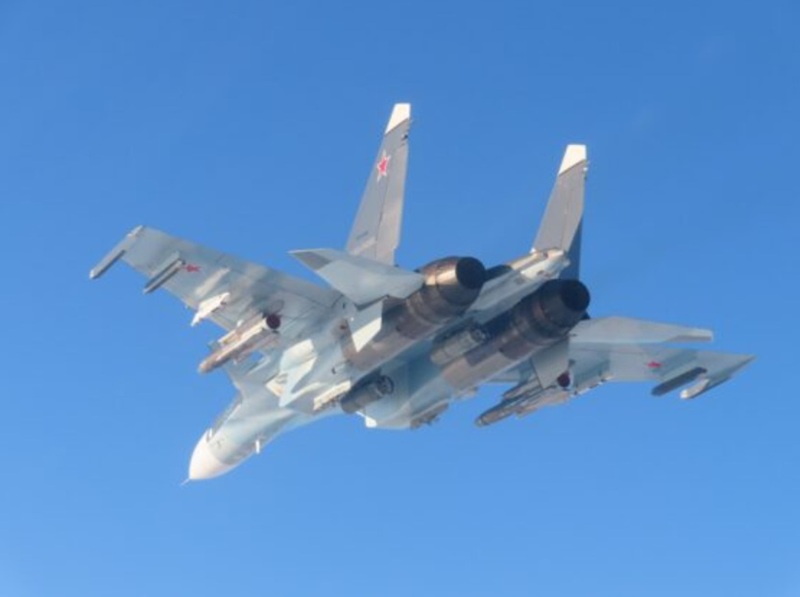
A Su-30SM2 fighter jet carried out an unusually armed show-of-force flight close to NATO-controlled airspace, signalling a potential shift in how Russia conducts aerial provocations along the alliance’s borders.
According to reporting by the Soniashnyk Telegram channel, the incident occurred in late January when Spanish EF-18M Hornet fighters deployed to the Baltic region under NATO’s Baltic Air Policing mission intercepted the Russian aircraft. The Su-30SM2 was observed carrying two Kh-31A anti-ship missiles and two RBK-500 cluster bombs.
An Unusual Weapons Loadout
What makes the encounter notable is not only the presence of live strike munitions, but also what was missing. The Russian jet was reportedly not equipped with any air-to-air missiles, which are normally essential for self-defence or air combat. This suggests the sortie was not intended for engagement with NATO aircraft, but rather as a demonstrative display of force.
Historically, Russian military aircraft conducting close approaches to NATO airspace have avoided carrying live weapons, particularly during escort or signalling missions. As recently as November, Russian Navy Su-30 fighters escorting a high-value Tu-134UBL training aircraft reportedly flew without any missiles at all, reflecting a long-standing effort to reduce escalation risks.
Psychological Signalling, Not Combat Readiness
The decision to fly with strike weapons but without air-to-air missiles points to a carefully calibrated message. Analysts assess that Moscow may be seeking to increase psychological pressure on NATO pilots and heighten the impact of aerial provocations, while still avoiding configurations that could plausibly lead to direct confrontation.
By excluding air-to-air missiles, Russia appears to be signalling restraint even as it escalates the symbolism of its actions. This approach reduces the risk of a rapid, uncontrollable escalation stemming from miscalculation in close aerial encounters.
Kh-31A: A Symbolic Anti-Ship Threat
The Kh-31A is a supersonic tactical missile designed to strike surface combatants ranging from patrol vessels to destroyer-class warships. With an engagement range of roughly 5 to 70 kilometres, it relies on high-speed penetration and a high-explosive warhead to disable or destroy its target.
In practical terms, launching such a missile against heavily defended NATO or U.S. naval vessels would be militarily unrealistic and potentially suicidal. In this context, its carriage during the flight was almost certainly symbolic rather than operational, intended to underline Russia’s anti-access and maritime strike credentials in the Baltic region.
RBK-500: Area-Effect Strike Capability
The RBK-500 is a 500-kilogram cluster munition designed to attack personnel, lightly armoured vehicles, and infrastructure over a wide area. After release, the bomb’s casing opens mid-air, dispersing dozens or even hundreds of submunitions depending on the variant.
RBK-500 variants include fragmentation, anti-tank shaped-charge, incendiary, and antipersonnel submunitions, including models fitted with PTAB-1M or SHOAB-0.5 bomblets. Its presence further reinforces the impression that the flight was meant to demonstrate strike capability, not air combat readiness.
Strategic Implications
The incident suggests a subtle but meaningful adjustment in Russian aerial behaviour near NATO borders. Rather than relying solely on proximity and aggressive manoeuvring, Moscow appears to be adding visible combat payloads to amplify deterrence messaging and political signalling.
At the same time, the continued absence of air-to-air weapons indicates that Russia is still deliberately managing escalation thresholds. The result is a posture that is more intimidating, yet still controlled—designed to unsettle, not to provoke an immediate military response.