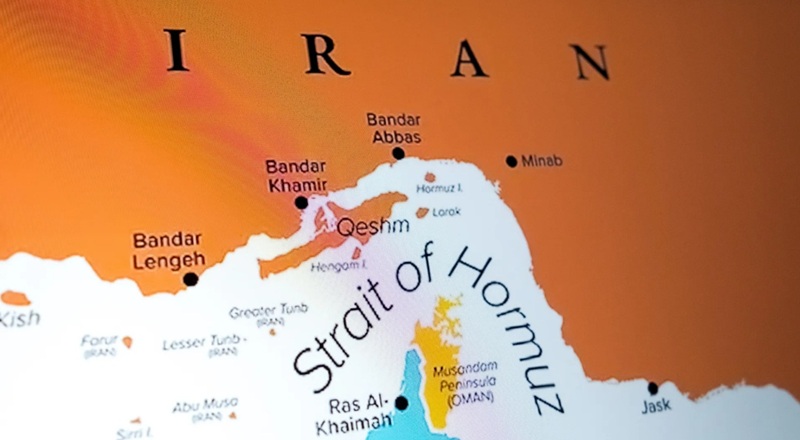
The situation in the Strait of Hormuz, one of the world’s most critical energy chokepoints, illustrates the fragile balance of power shaping the ongoing conflict with Iran.
Within the same week, two dramatically different events unfolded in the narrow waterway that carries roughly 21 percent of global seaborne oil and about 20 percent of global liquefied natural gas (LNG).
One large oil tanker successfully passed through the strait under heavy U.S. protection. Another vessel was struck by an Iranian drone and set ablaze.
Together, these incidents reveal the current reality in the Persian Gulf: the strait remains physically open but commercially paralyzed.
U.S. Energy Secretary Highlights Successful Transit
Speaking on Fox News, U.S. Energy Secretary Chris Wright announced that a large tanker had successfully navigated the Strait of Hormuz without incident.
The transit reportedly occurred approximately 24 hours before Wright’s remarks on March 8, during a controlled security window coordinated by the U.S. Navy.
According to reports, the vessel likely traveled under strict security measures:
- Temporary AIS tracking blackout
- Naval de-confliction corridor
- Insurance coverage backed by a $20 billion U.S. Development Finance Corporation (DFC) reinsurance program
Such protection has become essential because most commercial insurers have withdrawn coverage for tankers attempting to pass through the strait during the conflict.
Iranian Drone Strike on Tanker Prima
Just two days earlier, a very different outcome occurred in the same waterway.
According to reports from Tasnim News Agency, the official media outlet associated with Iran’s Islamic Revolutionary Guard Corps (IRGC), a Malta-flagged tanker named Prima was attacked on March 7.
The vessel reportedly ignored repeated warnings not to enter the strait.
Iranian sources claim that a suicide drone struck the oil and chemical carrier, setting it on fire.
While the full extent of the damage has not been independently confirmed by Western authorities, the reported incident has been referenced by several international media outlets including Reuters, Al Jazeera, NDTV, and IranWire.
Tanker Traffic Through Hormuz Collapses
Before the conflict escalated on February 28, between 24 and 37 oil tankers typically transited the Strait of Hormuz every day.
Since the outbreak of hostilities, traffic has dropped by roughly 90 percent, according to shipping industry estimates.
The collapse reflects the growing risks faced by commercial vessels operating in the region.
Without military protection and government-backed insurance, many shipping companies have suspended operations in the strait entirely.
A Strait That Is “Selectively Permeable”
These developments suggest the strait is neither fully open nor fully closed.
Instead, maritime traffic has become selectively controlled by security guarantees.
Ships traveling under U.S. government protection and insurance support may still attempt the crossing.
Those without such backing face a much higher risk of attack.
In practice, this dynamic has turned the strait into a restricted corridor rather than a normal commercial shipping route.
Echoes of the 1980s Tanker War
The emerging strategy resembles Operation Earnest Will, a U.S. naval mission conducted during the Iran-Iraq War between 1987 and 1988.
During that operation, the United States deployed roughly 30 warships to escort 11 Kuwaiti tankers through the Strait of Hormuz.
Even with this large military presence, Iran carried out 546 attacks on commercial vessels during the broader tanker war.
The escorts allowed oil shipments to continue, but only because the level of protection matched the level of threat.
A More Complex Challenge in 2026
Today’s situation may be even more complicated.
Iran is reportedly using relatively inexpensive suicide drones costing tens of thousands of dollars, while defending warships rely on interceptor missiles that can cost millions.
At the same time, global shipping traffic through Hormuz is vastly larger than during the 1980s.
While Operation Earnest Will protected just 11 tankers, the modern global economy depends on hundreds of commercial vessels moving through the Gulf each week.
Economic Impact Already Visible
The disruption has already triggered extreme volatility in shipping markets.
Daily charter rates for Very Large Crude Carriers (VLCCs) have surged to record levels, reportedly reaching more than $423,000 per day, reflecting the massive risk premium associated with Gulf voyages.
For energy markets, the difference between a single successful transit and the normal flow of dozens of tankers per day is enormous.
One ship passing safely may make headlines, but the global economy depends on consistent, large-scale traffic.
A Strait Open in Theory, Closed in Practice
The events of the past week highlight the paradox currently facing global energy trade.
The Strait of Hormuz remains physically navigable.
Yet commercially, it is nearly shut down.
The safe passage of one tanker and the burning of another illustrate the same reality: transit is possible—but only under extraordinary security conditions.
Until normal commercial shipping resumes, one of the world’s most vital energy arteries will remain under severe strain.