The Pentagon has claimed that the United States inflicted sweeping damage on Iran’s military during its 38-day campaign, declaring the country’s armed forces “combat ineffective for years to come” as a fragile ceasefire takes hold.
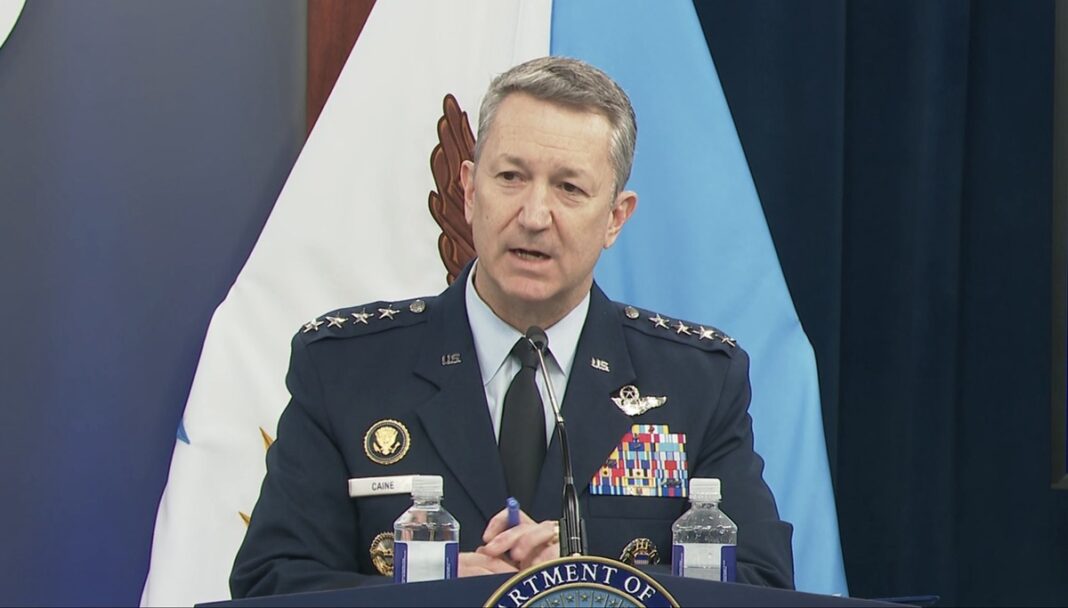
Speaking at the Pentagon, U.S. Defense Secretary Pete Hegseth and Chairman of the Joint Chiefs Gen. Dan Caine outlined what they described as the battlefield results of Operation Epic Fury.
According to the Pentagon, U.S. forces conducted more than 800 strikes in the final hours before the ceasefire, targeting air defenses, missile storage facilities, drone infrastructure and naval assets.
Officials said the campaign destroyed:
- 80% of Iran’s air-defense systems
- 800 one-way attack drone storage facilities
- 450 ballistic missile storage facilities
- 150 naval vessels
- half of IRGC small attack boats
Hegseth described the campaign as a “historic and overwhelming victory,” saying the U.S. had dismantled one of the world’s largest militaries using less than 10% of total American combat power.
Ceasefire Holds, But U.S. Forces Remain in Region
Despite the pause in fighting, Washington signaled that U.S. military forces will remain deployed across the Middle East.
Hegseth said American forces would be “hanging around” for the duration of the armistice, underscoring that the ceasefire remains provisional rather than a full peace agreement.
Strait of Hormuz continues to be a critical concern, as Iran retained the ability to influence shipping routes throughout the conflict.
This strategic leverage has contributed to volatility in global oil markets.
Pentagon Focuses on Damage Metrics, Not Remaining Capability
While the Pentagon’s numbers are striking, military analysts are likely to focus on what remains unknown.
The figures describe outputs — facilities struck and percentages degraded — rather than outcomes.
Critical operational questions remain unanswered:
- How many launchers survived?
- How many missiles remain deployable?
- What drone production capacity is still active?
- Which air-defense systems remain operational?
- At what altitude and in which sectors is Iranian airspace still contested?
For example, the Pentagon did not disclose the denominator behind the 450 missile facilities hit.
Without knowing Iran’s original total stockpile and dispersal network, it is difficult to assess the real strategic effect.
The same applies to drone infrastructure.
Iran has historically relied on dispersed production lines and commercially available components, allowing relatively rapid reconstitution of drone manufacturing.
Iran Still Demonstrated Operational Resilience
Despite the Pentagon’s claims, Tehran continued launching sustained attacks during the conflict.
According to the same assessment, Iran maintained an average of up to 120 drone and missile attacks per day across the region.
This suggests that while infrastructure may have been damaged, Iran’s decentralized command structure remained functional.
The country’s military doctrine is built specifically to survive leadership decapitation and infrastructure strikes through dispersed control and mobile assets.
That raises important questions about whether the U.S. campaign achieved long-term strategic degradation.
Hormuz and Naval Threat Still Matter
The Pentagon also claimed severe damage to Iran’s naval capabilities, including the destruction of half of the Islamic Revolutionary Guard Corps’ small attack boats.
Yet even residual numbers can remain strategically significant in the narrow waters of the Strait of Hormuz.
Iran’s well-known swarm tactics do not require a large fleet to threaten commercial shipping.
Even a reduced force can still pose substantial risks to tanker traffic and regional maritime security.
Similarly, claims that 95% of naval mines were destroyed still leave open the possibility of hundreds of remaining mines, enough to disrupt one of the world’s most important energy chokepoints.
Uranium Stockpile Remains a Major Flashpoint
One of the most significant unresolved issues remains Iran’s enriched uranium stockpile.
Hegseth said Washington expects Tehran to surrender it voluntarily but warned that the United States reserves the option to seize it by force if necessary.
This issue is likely to dominate any future negotiations and will remain central to the durability of the ceasefire.
Human Cost of the Conflict
The Pentagon said 13 American service members were killed and more than 365 were wounded during the 38-day conflict.
Those figures underscore the scale of the war even as both sides now signal interest in a diplomatic off-ramp.