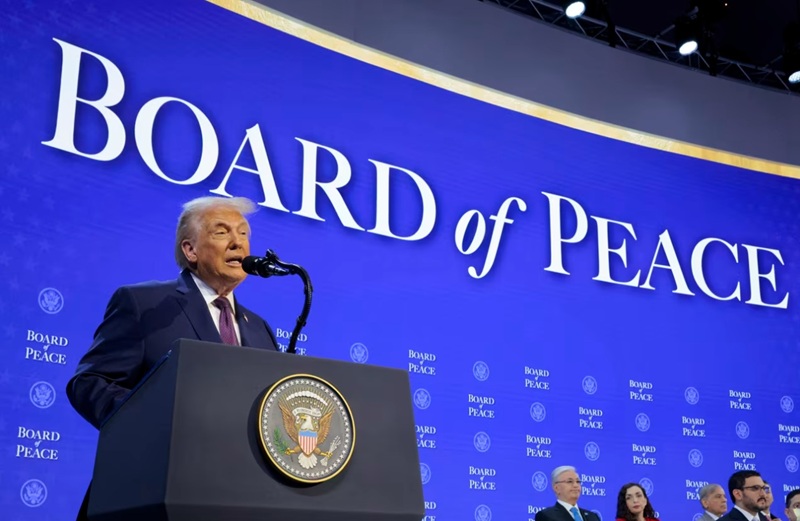
US President Donald Trump on Tuesday used the launch of his new international “Board of Peace” to deliver a mix of domestic political messaging and hardline foreign-policy warnings, declaring that Hamas must disarm or face annihilation, while claiming that Israel’s war in Gaza is “coming to an end.”
Opening the signing ceremony before an audience of fewer than 20 foreign leaders, Trump veered quickly from the stated purpose of the event to boast about the US economy, portraying his leadership as a global stabilising force.
“We have a great mandate back at home. The US economy is booming,” Trump said. “When America booms, the entire world booms.”
Gaza, Hamas and Threats of Force
Trump struck an optimistic tone on global security, claiming the world is “more peaceful” than it was before his presidency. However, his remarks on Gaza were marked by stark threats toward Hamas, which he described as a movement whose members were “born with rifles in their arms.”
“They have to give up their weapons,” Trump said. “And if they don’t do that, it’s going to be the end of them.”
He insisted that Israel’s war in Gaza is nearing its conclusion and said his newly formed board would play a role in securing a lasting settlement. According to Trump, the “Board of Peace” is committed to ensuring Gaza is fully demilitarised and “beautifully rebuilt,” echoing language previously used by his administration to frame post-war reconstruction under strict security conditions.
A New Global Body — With Old Questions
Trump described the Board of Peace as having “the chance of being the most consequential board in history,” adding that it would work “in conjunction” with the United Nations. However, no senior UN official was present at the ceremony, and the precise mandate, legal authority, and operational structure of the board remain unclear.
The launch immediately raised questions among diplomats and analysts, particularly in Europe, where officials have privately expressed concern that the initiative could include US adversaries — including Russia — despite ongoing conflicts involving American allies.
Notable Absences and Diplomatic Signals
Perhaps the most striking aspect of the ceremony was who was not there. None of the United States’ traditional Western European allies attended, despite earlier expectations that roughly 35 countries would be represented.
Instead, the gathering skewed heavily toward the Middle East and South America. Leaders from Saudi Arabia, Qatar, the United Arab Emirates, Argentina and Paraguay were among those on stage with Trump. Addressing them directly, Trump quipped that they were, “in most cases very popular leaders — in some cases not so popular.”
The limited turnout, combined with the absence of NATO allies, has fueled speculation that the Board of Peace may reflect Trump’s preference for bilateral deal-making over established multilateral frameworks, as well as his willingness to engage leaders shunned by parts of the Western alliance.
Political Messaging at Home and Abroad
The ceremony also underscored Trump’s continued blending of domestic political rhetoric with international diplomacy. By emphasising economic growth and claiming global peace dividends from his leadership, Trump appeared to be speaking as much to voters at home as to leaders abroad.
Whether the Board of Peace evolves into a functioning diplomatic mechanism or remains largely symbolic will depend on follow-up actions, particularly in Gaza, where the conflict’s endgame remains deeply contested and humanitarian conditions continue to draw international scrutiny.
Meta Description