
Recent conflicts have clarified a reality now shaping defence planning worldwide: uncrewed aerial systems (UAS) have become central to modern warfare. The shift is not limited to tactical employment; it increasingly influences strategy, force structure, and deterrence.
The 2024 Israel–Iran conflict, the first sustained state-on-state drone confrontation in the Middle East, underscored the value of persistent intelligence, surveillance, and reconnaissance (ISR) and precision targeting. Iran relied heavily on large volumes of uncrewed systems and cruise missiles to threaten critical infrastructure, while Israel countered through layered air and missile defences supported by long-range strike and advanced ISR platforms.
The episode reinforced a broader lesson: airpower effectiveness now depends as much on survivable sensing and integration as on kinetic reach.
Regional Demand for Persistent ISR and Maritime Awareness
For Gulf states such as Saudi Arabia, the UAE, and Qatar, the requirement for persistent ISR has become structural rather than episodic. Border surveillance, maritime domain awareness, and the ability to sustain deterrence over extended periods increasingly drive procurement priorities.
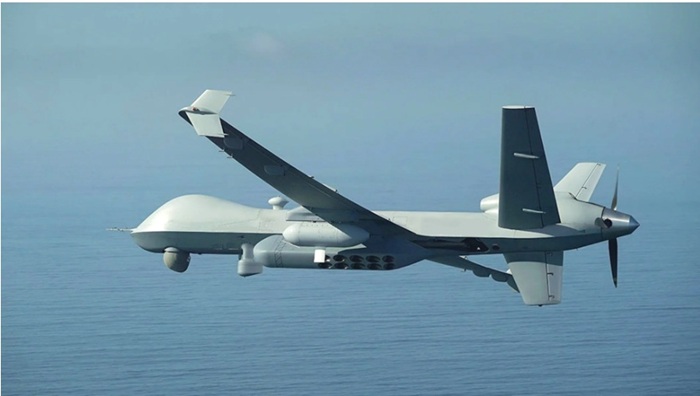
Within this context, the MQ-9B SkyGuardian and SeaGuardian, produced by General Atomics Aeronautical Systems (GA-ASI), are positioned as long-endurance ISR platforms designed to operate within coalition frameworks. Their emphasis lies in persistence, sensor coverage, and standoff targeting rather than penetration of heavily defended airspace.
The SeaGuardian variant, in particular, addresses maritime security requirements such as exclusive economic zone (EEZ) monitoring, anti-piracy missions, and naval interoperability, supported by wide-area maritime radar coverage.
Contested Airspace and the Limits of ISR-Only Platforms
At the same time, Middle Eastern airspace is becoming increasingly contested. Integrated air-defence systems, electronic warfare, and counter-UAS measures limit the freedom of operation for slow, non-stealthy platforms.
This environment has driven interest in semi-autonomous, survivable uncrewed systems that can complement ISR-focused aircraft rather than replace them. The objective is not persistence alone, but force multiplication under threat.
The Gambit Series and Collaborative Combat Concepts
GA-ASI’s Gambit Series reflects this shift toward collaborative combat operations, where uncrewed platforms extend the reach, survivability, and flexibility of crewed and uncrewed air assets.
Built around a common core architecture, Gambit variants share major components—including avionics, landing gear, and structural elements—intended to reduce cost and accelerate production. Modularity allows configuration for different mission sets without duplicating entire platforms.
Gambit Variants (as outlined by GA-ASI)
- Gambit 1:
Long-endurance ISR, optimised for extended patrols and early warning in contested environments. - Gambit 2:
Air-to-air focused configuration prioritising combat performance over endurance. - Gambit 3:
Adversary air platform for training against advanced air defences and fifth-generation threats. - Gambit 4:
Stealth-oriented reconnaissance variant with tailless design for high-risk missions. - Gambit 5:
Carrier-capable version extending the concept to naval aviation environments. - Gambit 6:
Expanded air-to-ground roles, including electronic warfare, suppression of enemy air defences, and deep strike.
Rather than serving as standalone solutions, these platforms are presented as enablers—designed to operate alongside ISR assets, crewed aircraft, and allied command-and-control networks.
Complementary Roles, Not Substitutes
In operational terms, the MQ-9B family and the Gambit Series address different layers of the battlespace. MQ-9B provides endurance, wide-area sensing, and standoff precision effects. Gambit-type systems, by contrast, are oriented toward survivability and mission execution in higher-threat environments.
Together, they reflect an approach in which coverage, survivability, and scalability are balanced rather than optimised in isolation.
Adoption Signals and Export Context
MQ-9B has already attracted interest beyond the Middle East, with customers including Japan, Canada, Poland, India, and Germany. In 2025, Qatar announced its intent to acquire eight MQ-9B aircraft, signalling regional confidence in the platform’s ISR and maritime roles.
These adoption patterns suggest that demand is driven less by novelty and more by interoperability, certification, and sustainment confidence—factors that increasingly shape UAS procurement decisions.
Assessment
The growing prominence of UAS in the Middle East reflects a broader shift in airpower thinking. Persistence without survivability is no longer sufficient, while high-end systems without scalable ISR struggle to deliver strategic effect.
GA-ASI’s MQ-9B and Gambit concepts illustrate how industry is responding to this balance—pairing endurance with collaboration, and ISR with contested-environment capability. Whether such approaches deliver lasting advantage will depend less on individual platforms than on how effectively they are integrated into national doctrine, coalition structures, and evolving threat environments.