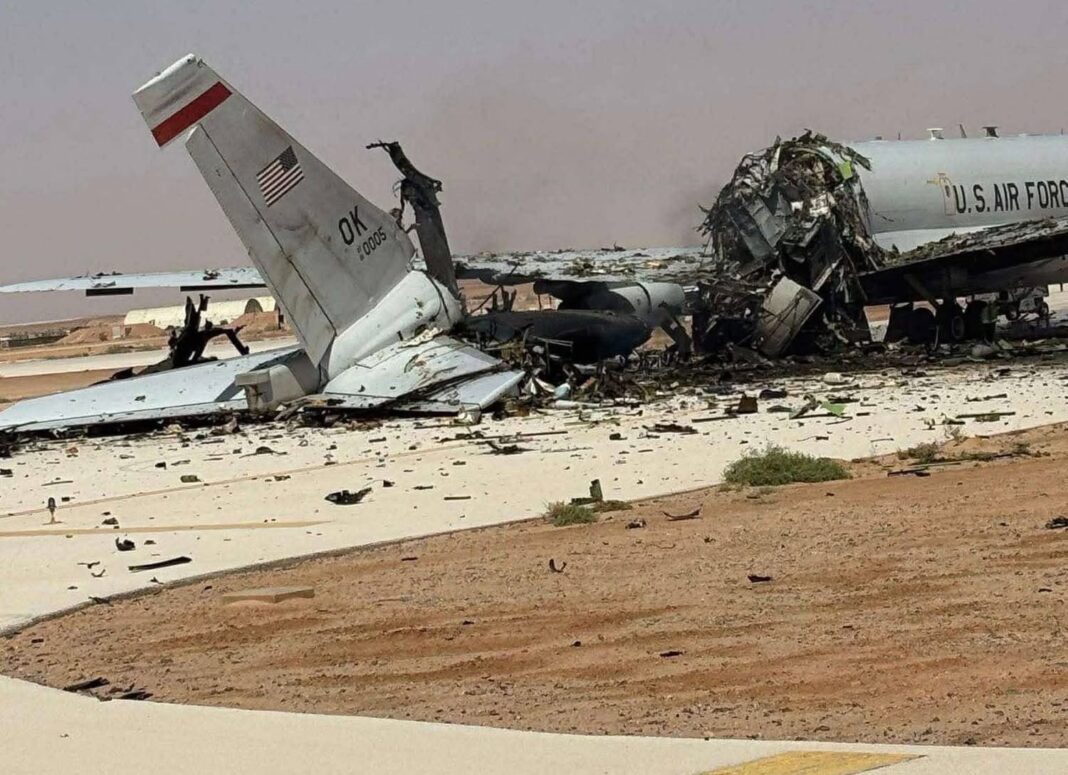
The destruction of a US Air Force E-3 Sentry airborne warning and control aircraft (AWACS) in an Iranian strike on a Saudi Arabian air base could significantly weaken Washington’s ability to detect incoming threats at long range, according to analysts.
Dramatic images circulating on social media over the weekend showed the aircraft heavily damaged at Prince Sultan Air Base, with its tail section broken off and its distinctive rotating radar dome lying on the ground. The radar dome is one of the most critical components of the AWACS platform, serving as the core of its airborne surveillance and command system.
Defense analysts described the loss as a major setback for US surveillance and combat coordination capabilities in the region.
“The loss of the AWACS is a serious blow to surveillance capabilities,” analysts said, warning that it could affect the US military’s ability to direct combat aircraft, track hostile threats, and protect allied forces from missile and drone attacks.
Why the E-3 AWACS Matters
The Boeing E-3 Sentry is one of the most important airborne battle management assets in the US arsenal.
The aircraft can monitor as much as 120,000 square miles of battlespace, covering everything from ground level to the stratosphere. It is capable of tracking approximately 600 targets simultaneously, including aircraft, missiles, large drones, and even battlefield armor such as tanks.
Personnel aboard the aircraft relay real-time intelligence to commanders in theater, naval assets at sea, and the Pentagon. At the same time, controllers on board can guide interceptor jets toward incoming threats or redirect strike aircraft to support troops under fire.
A recent report by the Center for a New American Security described the AWACS as the “quarterback” of the battlefield, highlighting its role in providing situational awareness and real-time coordination.
Early Warning Capability Hit
Experts say airborne radars dramatically extend threat detection times compared with ground-based systems.
In the current conflict, an E-3 AWACS could reportedly detect an incoming Iranian Shahed drone launched from 200 miles away approximately 85 minutes earlier than ground radar systems.
This extended warning window is considered crucial in defending against missile and drone attacks, particularly in a fast-moving regional conflict.
Because the aircraft is mobile, it can quickly reposition to crisis zones and is typically harder to target than fixed radar installations.
Questions Over Vulnerability
Military analysts have questioned how such a high-value asset became vulnerable to attack.
AWACS aircraft are usually heavily protected while airborne, often receiving fighter escorts and avoiding hostile airspace. Analysts suggested the strike may indicate Iran received assistance in identifying key US military assets.
Some experts suggested that Russia may have provided geographic coordinates and satellite imagery that helped identify the aircraft’s precise location, though this remains an analytical assessment rather than a confirmed fact.
Kelly Grieco, a fellow at the Stimson Center, said the strike reflects Iran’s focus on high-value military targets.
According to her analysis, Iran has increasingly targeted radar systems, satellite communications infrastructure, tanker aircraft, and airborne command platforms across the region.
Aging and Limited Fleet
The loss is especially significant because the US Air Force has a limited number of E-3 aircraft remaining.
According to FlightGlobal’s 2026 World Air Forces directory, the US began the year with only 17 E-3 aircraft, fewer than its fleet of Northrop Grumman B-2 Spirit bombers.
The fleet is also aging rapidly.
The first E-3 entered service in 1978, and the fleet has declined from 32 aircraft in 2015 to just 17 today.
Each aircraft, based on the Boeing 707 airframe, carries a crew of four pilots plus 13 to 19 mission specialists depending on operational requirements.
The Air Force estimated the cost of each aircraft at $270 million in 1998 dollars, equivalent to roughly $540 million today.
Replacement Challenges
The Pentagon has been exploring replacement options for the aging E-3 fleet, but no final platform has yet been selected.
While the US Navy operates the Northrop Grumman E-2 Hawkeye, analysts note that it is not a direct substitute.
The Hawkeye’s smaller size means fewer onboard personnel and lower operating altitude, reducing radar coverage compared with the Sentry.
This makes the loss of even a single E-3 especially significant as regional operations continue to place heavy demands on the remaining fleet.