Ukrainian military specialists say Russia has begun integrating Starlink-type satellite communication terminals—not SpaceX’s Starlink system itself—into its one-way attack drones, marking a potentially significant evolution in Moscow’s drone warfare capabilities.
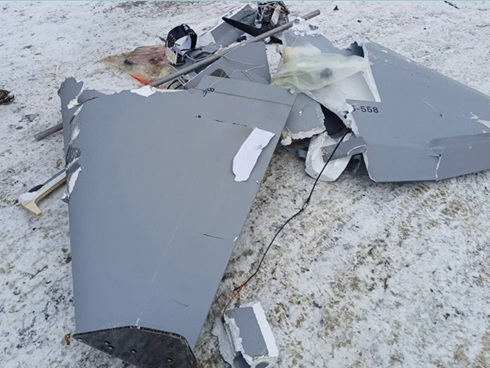
The assessment follows the interception and recovery of a BM-35 loitering munition by Ukrainian forces earlier this week. According to Serhii Beskrestnov, a Ukrainian UAV specialist known by the call sign “Flash,” technical inspection of the downed drone revealed hardware consistent with commercial low-Earth-orbit satellite communication terminals similar in design and function to Starlink.
Breaking: 🇷🇺 New Russian drone operated via Starlink spotted for the first time.
🇺🇸 **Starlink Controls New Russian Drone.
🇷🇺 A Russian BM-35 drone being controlled via Starlink satellite internet has been discovered for the first time.
Source: Serhii “Flash” Beskrestnov,… pic.twitter.com/wC7r1PMHUR
— Results (@ResultsOOO) January 16, 2026
“For the first time, the use of a Starlink-type satellite control system on a BM-35 UAV has been recorded,” Beskrestnov said. He emphasized that while the equipment resembles Starlink, it is not confirmed to be part of SpaceX’s network.
Beskrestnov warned that satellite-based control of this kind poses a serious challenge. “Drones using this method of communication are largely resistant to electronic warfare,” he said. “They can be guided precisely under real-time operator control, even in environments where radio links are heavily jammed.”
Photographs and technical evaluations shared by Ukrainian specialists show the satellite terminal integrated into the drone’s airframe in a configuration designed to maintain stable connectivity throughout the flight. Such an arrangement would allow operators to adjust navigation and targeting dynamically rather than relying solely on pre-programmed routes.
The BM-35 is one of Russia’s newer long-range one-way attack drones, traditionally guided via radio links or inertial navigation systems. The introduction of satellite-based control using Starlink-type terminals would extend operational range and significantly reduce vulnerability to Ukrainian electronic countermeasures.
Ukrainian analysts also report that Russia is preparing to deploy its Geran-4 strike drone, an unmanned platform reportedly capable of carrying air-to-air missiles. These drones, described as unmanned interceptors, are expected to rely on similar satellite communication systems for flight control and target acquisition in contested airspace.
According to Ukrainian assessments, Russia has established procurement channels for Starlink-type satellite terminals through intermediary companies in the United Arab Emirates, Singapore, and Malaysia. These systems are reportedly distributed to frontline units and drone manufacturers rather than sourced directly from SpaceX.
Kyiv has repeatedly warned that Russia is adapting commercially available Western-style technologies to enhance its strike capabilities. Frontline reports over recent months have pointed to improved control links across multiple Russian drone platforms.
Military analysts say the appearance of a satellite terminal on a one-way attack drone represents a notable escalation, allowing Russian operators to bypass electronic defenses and retain control until the final phase of flight—without relying on confirmed Starlink infrastructure.