


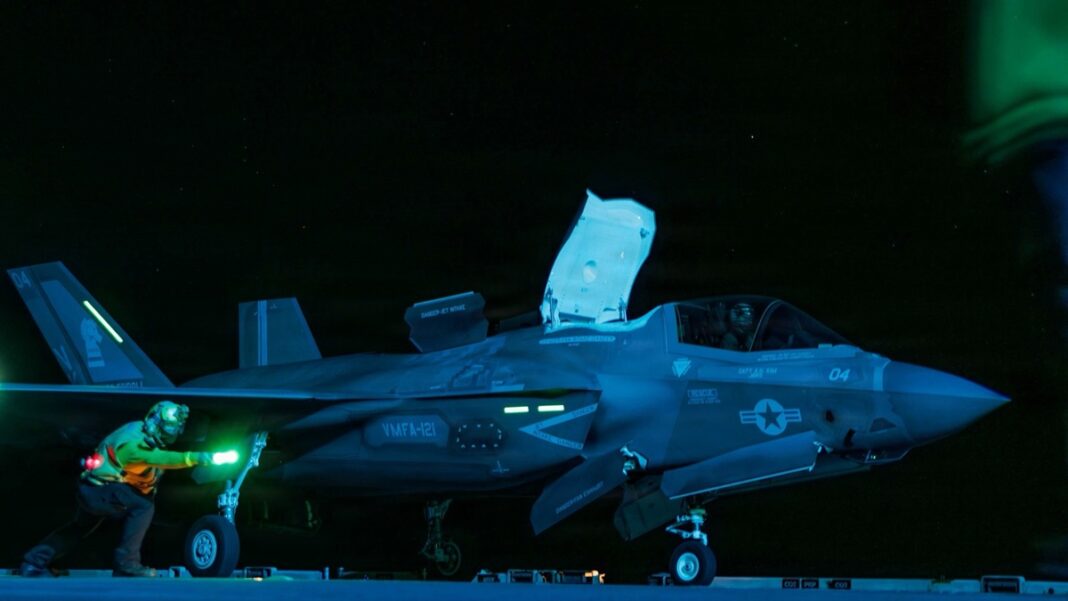
The United States has deployed 15 warships to enforce a naval blockade on Iranian ports and monitor maritime activity around the Strait of Hormuz, according to a report cited from the The Wall Street Journal and senior U.S. officials.
The naval force reportedly includes:
- an aircraft carrier
- multiple guided-missile destroyers
- an amphibious assault ship
- additional support warships across the Middle East
The deployment marks one of the most significant U.S. naval concentrations in the region in recent years.

According to U.S. Central Command (United States Central Command), vessels attempting to enter the Strait of Hormuz without authorization may be intercepted, diverted, or captured by U.S. forces.
CENTCOM Says Neutral Shipping Will Not Be Blocked
CENTCOM clarified that the blockade is specifically aimed at Iranian-linked maritime traffic and will not impede neutral commercial transit.
According to the official notice:
neutral passage to or from non-Iranian destinations will continue
This distinction is aimed at reassuring global energy markets and international shipping operators that normal commercial transit can continue through the world’s most important oil chokepoint.
The Strait of Hormuz handles roughly 20% of global oil shipments, making any military escalation in the area immediately relevant to global markets.
USS Tripoli and Carrier Strike Assets Move Into Theater
Among the most significant assets in the U.S. deployment is the USS Tripoli (LHA-7), which has been conducting night flight operations in the Arabian Sea.
The ship is optimized for aviation operations and can surge to support more than 20 F-35B Lightning II stealth fighters.

In parallel, the USS George H. W. Bush (CVN-77) was reported transiting eastbound through the Strait of Gibraltar, suggesting additional carrier strike capability may soon enter the operational theater.
China Issues Warning Over Hormuz Shipping
The crisis widened further after China issued a strong message to Washington regarding freedom of navigation and trade agreements with Iran.
Chinese Defense Minister Admiral Dong Jun stated:
“Our ships are moving in and out of the waters of the Strait of Hormuz.”
He added that China would continue to honor its trade and energy agreements with Iran and expects other states not to interfere.
This signals that the Hormuz confrontation may be evolving from a regional standoff into a wider strategic contest involving major powers.
China Expands Legal Countermeasures
At the same time, Chinese Premier Li Qiang signed new regulations aimed at countering what Beijing describes as unlawful foreign extraterritorial jurisdiction measures.
The new State Council rules include:
- legal blocking mechanisms
- countermeasures against foreign sanctions
- malicious entity lists
- support for Chinese firms facing foreign enforcement actions
This appears designed to provide a legal framework for Chinese companies and shipping interests if the Hormuz blockade begins affecting Chinese trade routes.
Global Economic Stakes Rising
The convergence of:
- a U.S. naval blockade
- Iranian maritime tensions
- Chinese legal and strategic response
raises the risk of major disruption to global energy flows.
Asian markets, particularly China, remain highly dependent on Gulf energy imports.
Any sustained disruption in Hormuz could rapidly affect:
- oil prices
- shipping insurance
- LNG deliveries
- global inflation expectations


[…] 15 US Warships Enforce Iran Port Blockade, China Signals Hormuz Standoff […]