
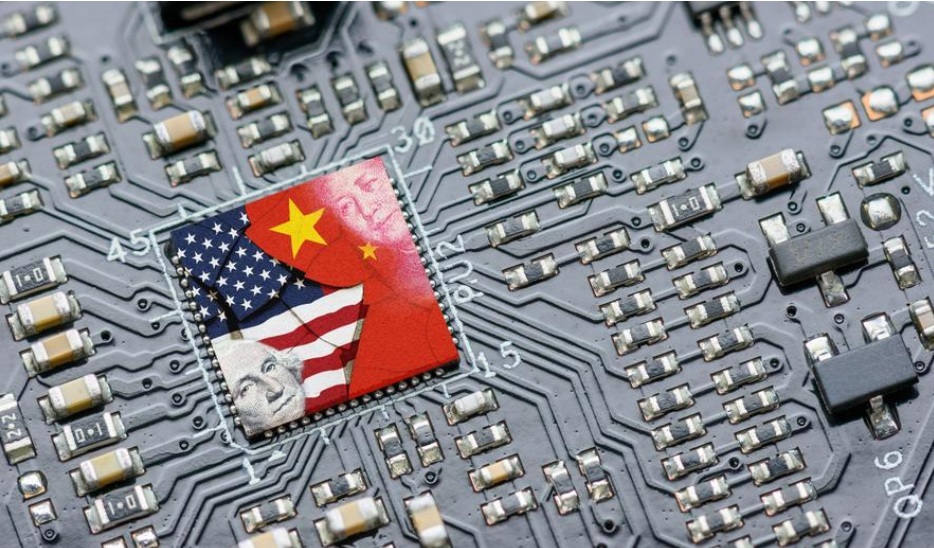
A new investigation by the House Select Committee on the Strategic Competition between the United States and the Chinese Communist Party has laid out a stark assessment of China’s artificial intelligence ambitions, concluding that Beijing is pursuing a dual strategy to secure dominance: “buy what it can, steal what it must.”
The report argues that while China has made rapid progress in AI development, it remains structurally dependent on Western technology—particularly in advanced semiconductor manufacturing.

China’s Core Weakness: Advanced Chip Manufacturing
Despite significant investment, China still struggles to produce cutting-edge AI chips at scale.
According to the report:
- China lacks the ability to manufacture frontier AI chips at required scale and yield
- It remains dependent on foreign suppliers for chipmaking equipment and software
- Domestic firms lag behind global leaders in advanced logic and memory chips
For example, China’s top chipmaker has not yet achieved mass production of advanced processors, while its memory sector also remains behind in high-bandwidth memory (HBM) — a key component for AI systems.
How China ‘Buys’ Its Way Into AI Capability
The report highlights that China continues to legally acquire significant amounts of AI-related technology despite export controls.
Key findings include:
- China remains the largest global buyer of chipmaking equipment
- It lawfully purchases large volumes of near-threshold AI chips
- It accesses advanced computing power through foreign cloud services
In 2024 alone, China reportedly spent $38 billion on foreign semiconductor equipment, underscoring the scale of its reliance on external supply chains.
Cloud Loopholes and Global Workarounds
One of the most critical vulnerabilities identified is the ability of Chinese firms to bypass restrictions through offshore infrastructure.
Instead of importing restricted chips directly, companies:
- train AI models using data centers in Southeast Asia
- access U.S. chips through cloud platforms and APIs
- rely on foreign intermediaries to maintain compute capacity
This effectively allows Chinese firms to use advanced hardware without physically importing it into China.
How China ‘Steals’ Technology
Where legal access is restricted, the report alleges that Chinese actors turn to more covert methods.
These include:
- smuggling networks routing chips through third countries
- use of shell companies to bypass export controls
- unauthorized access to AI models via API exploitation
- industrial-scale data extraction from U.S. firms
In some cases, investigators found large-scale operations involving:
- relabeling hardware shipments
- using fake end-users
- routing transactions through multiple jurisdictions
AI Model ‘Extraction’ Raises New Concerns
Beyond hardware, the report highlights a growing concern: extraction of AI model capabilities.
Chinese firms are accused of:
- using large volumes of API queries
- reverse-engineering outputs from U.S. AI systems
- training competing models using extracted data
The report describes this as a form of industrial-scale digital espionage, enabled by proxy networks and thousands of fraudulent accounts.

Why the US Still Holds the Advantage
Despite China’s progress, the report concludes that the United States and its allies still control key chokepoints in the AI supply chain.
These include:
- advanced semiconductor manufacturing equipment
- high-end AI chips
- software ecosystems
- cloud infrastructure
However, the report warns that policy gaps and weak enforcement are allowing China to continue narrowing the gap.
Policy Recommendations and the Road Ahead
The Committee calls for a major tightening of U.S. policy, including:
- stricter export controls on AI chips
- regulation of cloud access to advanced compute
- stronger penalties for violations
- new laws targeting shell companies and smuggling
It also recommends treating AI capability extraction as economic espionage.
A Defining Front in Global Competition
The report frames AI as the central battleground of 21st-century geopolitical competition.
China’s strategy, it argues, is not simply about catching up—but about controlling the entire AI ecosystem, from chips to models to applications.
At the same time, its continued dependence on Western technology suggests that the outcome of this competition remains undecided.