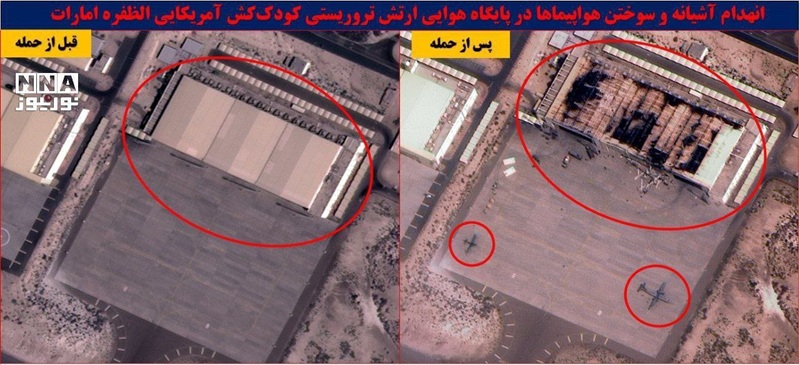
Satellite imagery circulating globally since March 12, 2026, has sparked intense debate among defense analysts after appearing to show a large impact crater at Al Dhafra Air Base in the United Arab Emirates, one of the most important U.S. military airpower hubs in the Gulf.
New satellite imagery released by pro-IRGC media shows pinpoint impact sites from drone and missile strikes on Al Dhafra Air Base in the UAE.
One of the strikes appears to have directly hit an aircraft shelter that is used to house American MQ-9 Reaper and MQ-4C Triton drones. pic.twitter.com/AyNoUzW4kA
— Egypt’s Intel Observer (@EGYOSINT) March 9, 2026
The images, widely shared across social media platforms including X, Telegram and Instagram, appear to show a developed section of the base where rows of rectangular buildings previously stood, replaced by a large dark circular crater.
Iranian sources claim the strike involved the Khorramshahr-4 ballistic missile, one of the most powerful medium-range missiles in Iran’s arsenal, designed to penetrate advanced missile-defense systems and strike hardened military infrastructure.
Strategic Importance of Al Dhafra Air Base
Al Dhafra Air Base is a central node in the United States’ military presence in the Middle East.
The facility serves as a forward-deployed air combat center supporting operations across the Gulf region and beyond. Its role includes hosting advanced aircraft and coordinating air operations across multiple theaters.
Because of this strategic role, the base has long been considered a high-priority target in any potential confrontation with Iran.
Analysts note that any confirmed ballistic missile impact at the facility would have implications not only for the UAE but also for the broader U.S. military logistics and deterrence network across the Gulf.
Iranian Claims and Missile Identification
Iran’s Islamic Revolutionary Guard Corps (IRGC) has claimed responsibility for targeting what it described as the base’s “U.S. air combat center.”
Iranian-aligned reporting has identified the weapon as the Khorramshahr-4 missile, also known as Kheibar, a heavy-payload medium-range ballistic missile unveiled by Iran in 2023 and believed to have entered operational service by 2026.
With an estimated range of about 2,000 kilometers, the missile can reach most U.S. military installations across the Gulf region.
Heavy Payload Raises Alarm
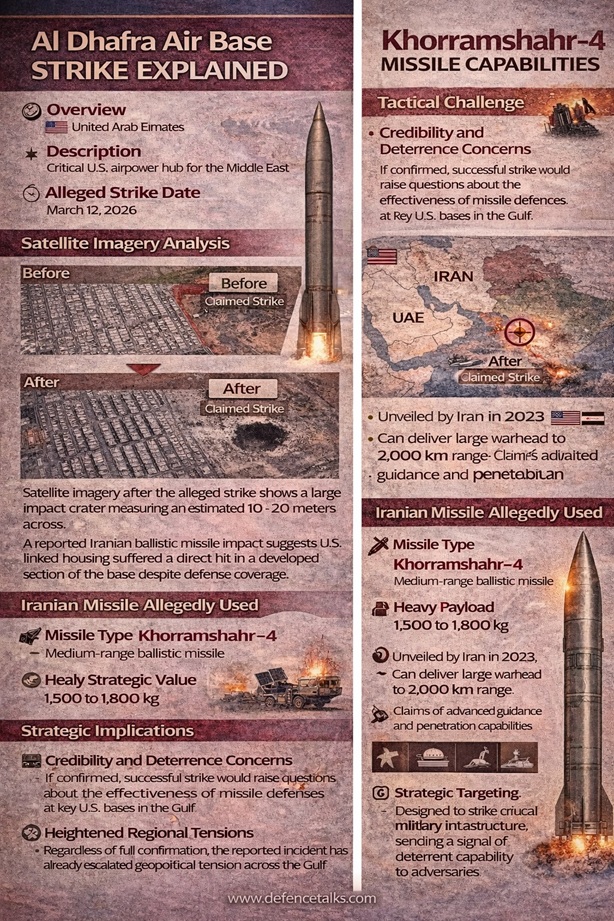
The Khorramshahr-4 is notable for carrying one of the largest warheads among Iran’s medium-range ballistic missiles, with a payload estimated between 1,500 and 1,800 kilograms.
Such a heavy payload is capable of producing large impact craters and significant structural damage, especially if the missile penetrates missile-defense systems and strikes a hardened facility directly.
Defense analysts say the crater visible in the viral imagery—estimated at roughly 10 to 20 meters wide—could be consistent with a large conventional ballistic missile warhead.
Advanced Missile Capabilities
The Khorramshahr-4 uses a single-stage liquid-fuel propulsion system with storable propellants, allowing the missile to remain ready for launch for extended periods.
The system is deployed on road-mobile transporter-erector-launchers, enabling rapid relocation after launch to avoid counterstrikes.
Iranian descriptions also highlight several advanced features:
- High-speed reentry approaching hypersonic velocity
- Maneuverable reentry vehicle (MaRV) capable of evasive maneuvers
- Inertial navigation with possible satellite guidance updates
- Flexible payload configurations
These capabilities are designed to complicate interception by layered missile-defense systems deployed around major Gulf bases.
Information Warfare and Satellite Imagery
Even though the exact level of damage at Al Dhafra remains unconfirmed by U.S. or Emirati officials, the rapid spread of satellite imagery demonstrates how space-based observation has become central to modern information warfare.
The before-and-after format of the images—showing intact building structures replaced by a large impact crater—has been widely used in online narratives claiming a successful Iranian strike.
Analysts believe the coordinated distribution of the imagery across multiple platforms suggests intentional information amplification rather than random sharing.
Strategic Signal Beyond the Battlefield
The alleged strike carries significance beyond the tactical level.
Linking the attack to the Khorramshahr-4 missile system serves as a strategic signal from Iran highlighting its ability to strike heavily defended U.S.-linked installations across the Gulf.
Even unverified evidence of a missile penetrating air defenses forces military planners to reconsider the resilience of forward-deployed bases in the region.
For regional allies and U.S. strategists, the incident underscores the growing challenge of defending fixed military infrastructure located within range of large-payload ballistic missile systems.
Implications for the 2026 Conflict
In the context of the ongoing 2026 regional conflict, the Al Dhafra crater imagery represents more than a single potential strike.
It highlights the evolving balance between offensive missile capability and defensive missile-defense systems across the Gulf region.
Whether or not the damage is eventually confirmed, the imagery has already become a focal point in debates about missile defense effectiveness, forward base survivability, and the future of military deterrence in the Middle East.