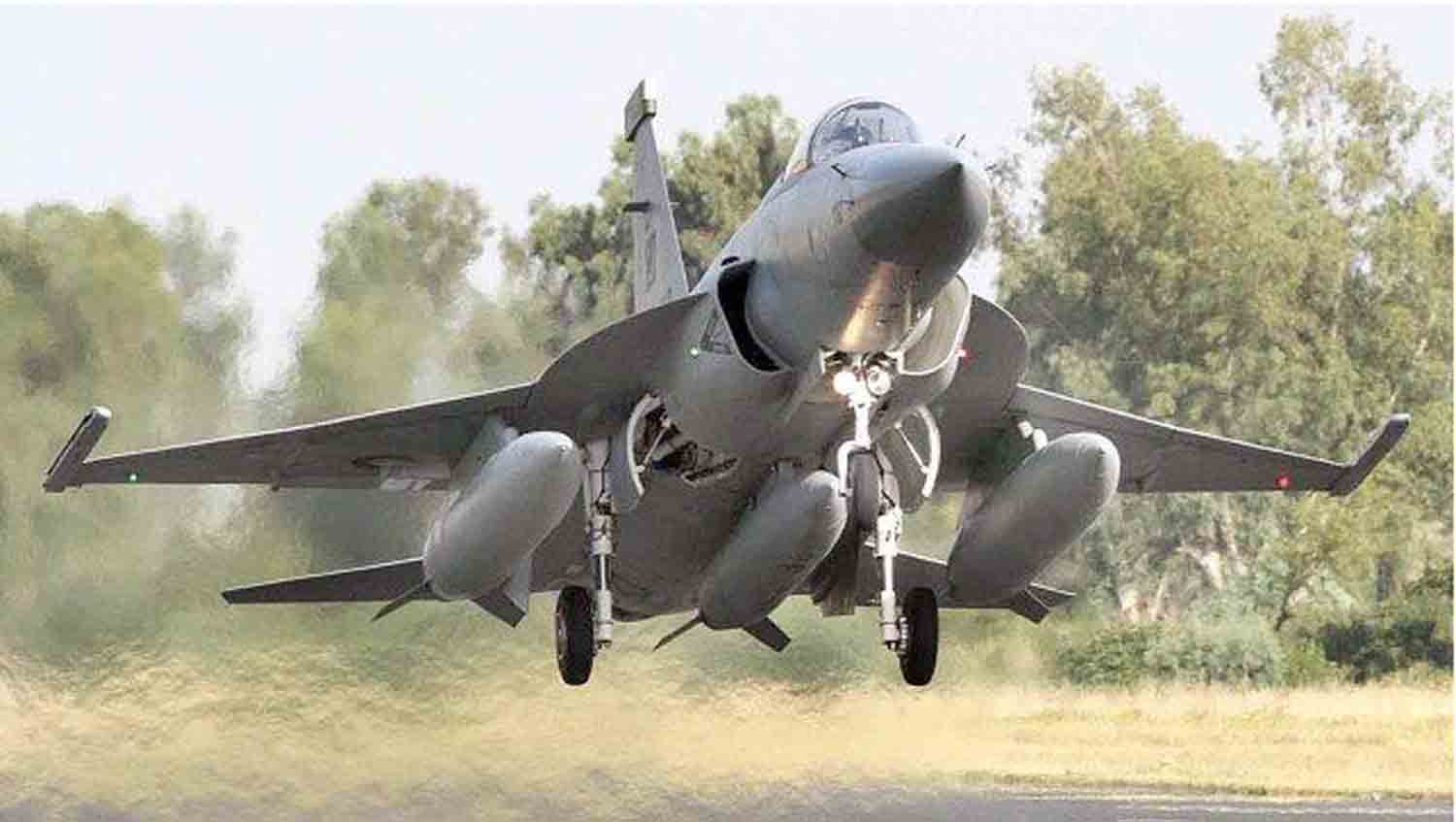
Somalia is engaged in advanced negotiations to acquire up to 24 JF-17 Thunder multirole fighter jets from Pakistan, marking what would be the country’s most consequential defence procurement since the Cold War era .
The discussions centre on the Block III variant and are understood to be part of a multi-phase package valued at around $900 million—a scale that would fundamentally alter Somalia’s military posture and signal a return of sovereign air combat capability after more than 30 years of absence.
From Collapse to Reconstitution
Somalia once fielded one of sub-Saharan Africa’s more capable air forces, operating Soviet MiG-21s and British Hawker Hunters. That force disintegrated following the 1991 collapse of the state, leaving airbases derelict and combat aircraft grounded indefinitely .
Since then, Mogadishu has relied almost entirely on foreign partners—most notably the United States and Turkey—for aerial surveillance, drone strikes, and precision support in its long campaign against Al-Shabaab. The pursuit of fast jets therefore represents a strategic shift from dependency toward autonomy.
Why the JF-17
Jointly developed by the Pakistan Aeronautical Complex and China’s AVIC Chengdu, the JF-17 is positioned as a cost-effective alternative to Western fighters. With unit costs estimated between $30–40 million, it undercuts platforms such as the F-16 while still offering supersonic speed, multirole flexibility, and modern sensors.
The Block III configuration adds an AESA radar, improved avionics, and enhanced precision-strike capability—features that would allow Somalia to conduct air defence, ground attack, and maritime patrol missions across its vast territory and 3,300-kilometre coastline .
A Window Opened by Diplomacy
The talks follow a pivotal development: the United Nations Security Council decision in December 2023 to lift a decades-old arms embargo on Somalia’s federal government. That move unlocked access to advanced weapons systems and created momentum for broader military modernisation .
The timing also coincides with the transition from the ATMIS peacekeeping mission to the new AUSSOM stabilisation force, increasing pressure on Somali national forces to assume responsibility for territorial control—including airspace security.
Financing and Regional Politics
At nearly $1 billion, the proposed programme would dwarf Somalia’s annual security budget, which has hovered around $170 million. Analysts therefore widely expect external backing, particularly from Saudi Arabia and Turkey, both of which have expanded their strategic footprints in Mogadishu through defence agreements and training missions .
These partnerships have deepened amid rising geopolitical tensions in the Horn of Africa, including disputes involving Ethiopia and Somaliland, reinforcing Mogadishu’s incentive to strengthen its independent military capabilities.
Capability Is More Than Aircraft
Experts caution that acquiring fighter jets alone will not restore air power. Sustained operations require trained pilots, maintenance crews, hardened airbases, secure supply chains, and reliable munitions stocks. Early foreign operators of the JF-17 have faced maintenance challenges—lessons Somalia would need to absorb quickly.
Still, even a limited fast-jet capability could constrain militant movement, enhance maritime domain awareness, and give Somalia tools it has lacked for a generation. More broadly, the JF-17 negotiations signal renewed strategic agency for a state long shaped by external intervention.
If finalised and successfully implemented, the deal would not merely add aircraft to an inventory—it would mark Somalia’s re-entry into the ranks of African states capable of controlling their own skies.