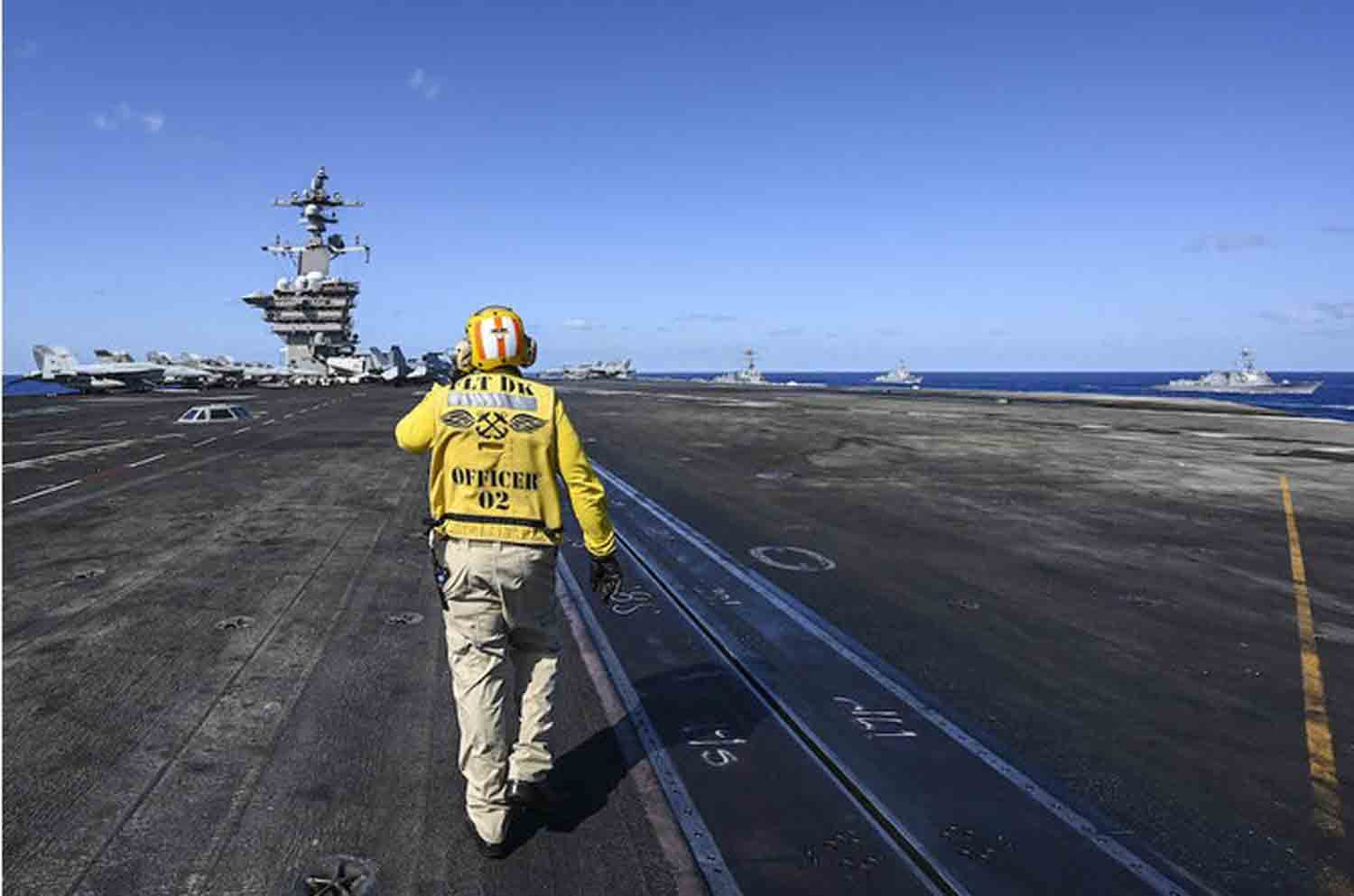
The complete absence of United States Navy aircraft carrier strike groups from the Middle East in early January 2026 marks a rare and strategically significant shift in American power projection. According to the U.S. Naval Institute (USNI) News Fleet and Marine Tracker, no U.S. carrier was operating within the U.S. Fifth Fleet’s area of responsibility as of January 5—an unusual development in one of the world’s most volatile security regions.
This gap in carrier presence comes at a particularly sensitive moment, as Iran experiences its most serious internal unrest since the 1979 Islamic Revolution. Nationwide protests, triggered by economic collapse, hyperinflation, and political repression, have evolved into open challenges to regime authority, raising the risk of miscalculation between Tehran and Washington.
President Donald J. Trump has publicly linked potential U.S. military involvement to the Iranian regime’s use of lethal force against protesters. On January 9, he warned that if Iranian authorities begin killing civilians “as they have in the past,” the United States would intervene. Such rhetoric carries heightened significance given the absence of forward-deployed carrier-based airpower, traditionally a cornerstone of U.S. crisis response.
Why Carrier Strike Groups Matter
Carrier strike groups are not symbolic deployments. They function as self-contained combat ecosystems, capable of sustained air operations, electronic warfare, maritime security, and precision strikes without reliance on host-nation bases. For decades, continuous or near-continuous carrier presence in the Persian Gulf, Arabian Sea, and Red Sea underpinned U.S. deterrence against Iran, allowing Washington to manage escalation while limiting exposure of fixed regional bases.
The current absence constrains U.S. response options. It compresses decision-making timelines and increases reliance on land-based forces that are both politically sensitive and more vulnerable to Iran’s expanding missile, drone, and proxy capabilities. This shift reflects not a routine deployment cycle, but a deeper structural strain between U.S. global commitments and finite naval capacity.
Where the Carriers Have Gone
The redistribution of U.S. naval power is driven by competing priorities. The USS Gerald R. Ford, the Navy’s most advanced aircraft carrier, has been deployed to the Caribbean under Operation Southern Spear, supporting U.S.-led operations following the January 3, 2026 capture of Venezuela’s former leader Nicolás Maduro.
At the same time, the USS Abraham Lincoln is operating in the Indo-Pacific, patrolling the Philippine Sea and South China Sea amid rising Chinese naval assertiveness. Other carriers remain tied to forward-deployed commitments in Japan or are undergoing maintenance and decommissioning preparation, limiting surge capacity.
As a result, the Persian Gulf, Red Sea, and Arabian Sea are currently without organic carrier-based airpower—a condition not seen in more than two years and a sharp departure from the sustained carrier presence maintained after the October 2023 Hamas attack on Israel.
Strategic and Operational Risks
From a force-planning perspective, the carrier gap reflects prioritization of near-peer competition in the Indo-Pacific and hemispheric contingencies over Middle Eastern crisis response. However, this recalibration intersects dangerously with Iran’s domestic instability.
Without carriers in theatre, U.S. military options against Iran become riskier and more visible. Redeploying a carrier from the Indo-Pacific would take days and would be immediately detected through open-source intelligence, eliminating strategic surprise and giving Iran time to disperse assets and activate air defenses.
Washington would instead rely on land-based bombers and fighters operating from bases such as Diego Garcia or Al Udeid in Qatar—assets that lack the persistence, flexibility, and survivability of carrier-based aviation and remain exposed to missile and drone attacks.
Iran’s Internal Crisis and Escalation Dynamics
Iran’s unrest has intensified rapidly since late December 2025. Protests initially sparked by the collapse of the rial and inflation exceeding 40 percent have expanded into nationwide demonstrations demanding regime change. By mid-January, reported casualties exceeded 100, despite internet shutdowns and mass arrests.
Strikes by oil workers and reports of defections among lower-ranking security personnel have further threatened regime cohesion. In this environment, any U.S. military action would likely be interpreted in Tehran as an existential threat rather than limited coercion, increasing the risk of an unrestrained response.
Iran retains significant retaliatory capabilities, including thousands of ballistic missiles, armed drones, naval assets capable of disrupting the Strait of Hormuz, and a network of regional proxies. Without carrier strike groups, defending U.S. bases, shipping, and energy infrastructure becomes more challenging.
Global and Economic Implications
The strategic implications extend well beyond the Middle East. Any disruption to shipping through the Strait of Hormuz—which carries roughly 20 percent of global oil supplies—could trigger sharp spikes in energy prices, destabilizing global markets.
Energy-importing economies in Asia would be particularly vulnerable, facing higher import costs, currency pressure, and inflationary stress. Geopolitically, the carrier vacuum also creates space for Russia and China to deepen their engagement with Tehran through diplomatic, intelligence, and military cooperation.
A Strategic Inflection Point
The absence of U.S. carrier strike groups in the Middle East reflects a broader strategic realignment under President Trump, emphasizing the Indo-Pacific and Western Hemisphere over sustained Middle Eastern presence. While this posture may reduce the likelihood of immediate escalation, it also erodes long-standing deterrence assumptions built on visible U.S. naval dominance.
As Iran’s internal crisis deepens and global naval resources remain stretched, the Middle East has become a testing ground for the limits of American maritime power in an era of simultaneous crises—where perception, timing, and miscalculation carry increasingly high stakes.