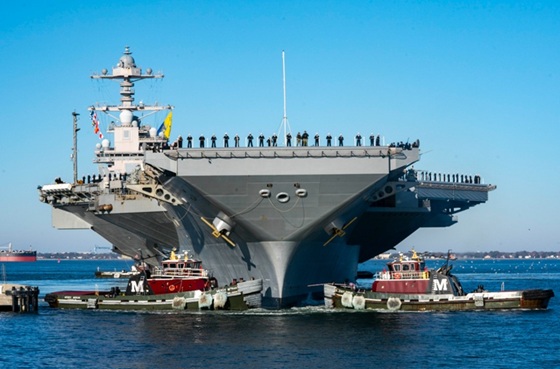
The deployment of the USS Gerald R. Ford off Israel’s Mediterranean coast has sparked intense strategic debate. Rather than positioning near Iran’s southern coastline or in the Gulf, the world’s largest and most expensive warship — valued at approximately $13.3 billion — has anchored near Haifa.
The move raises a key geopolitical question: Why place America’s most advanced aircraft carrier off Israel instead of closer to Iranian territory?
Defense analysts suggest the answer lies in a deliberate division of offensive and defensive naval strategy as tensions with Iran escalate.
Two Carriers, Two Missions: Sword and Shield Doctrine

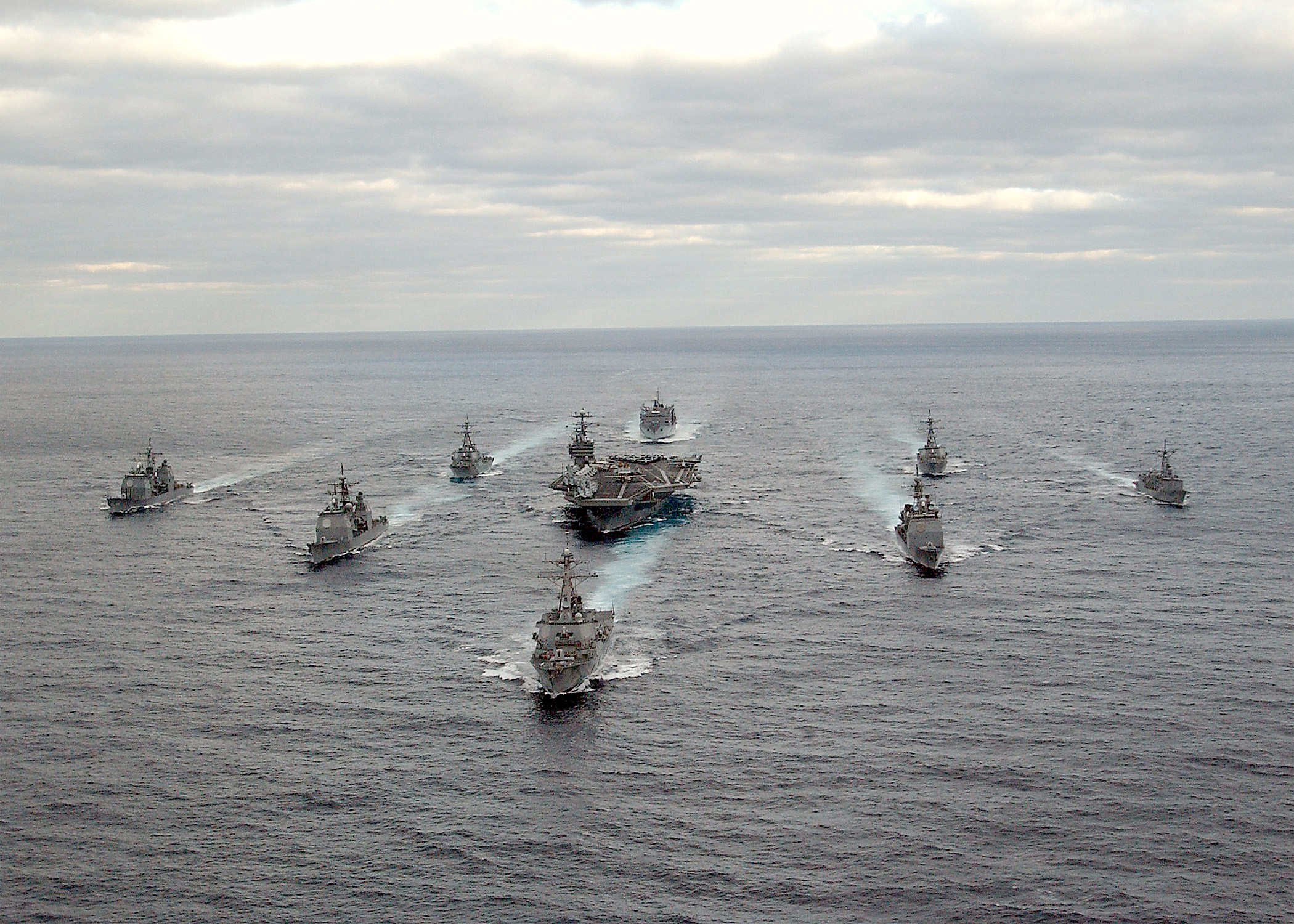
While the USS Abraham Lincoln operates closer to Iran’s strike envelope, reportedly positioned for rapid offensive capability, the Ford’s placement off Israel signals a defensive architecture.
Strategic observers describe this as:
- Lincoln positioned as the “sword” — capable of launching airstrikes into Iranian airspace within hours.
- Ford positioned as the “shield” — providing missile defense coverage over Israeli territory.
This dual-carrier structure separates offensive strike capability from defensive deterrence, a configuration not seen at this scale in decades.
Why Off Israel?

The Ford’s strike group includes advanced Aegis missile defense systems designed to intercept ballistic and cruise missiles. If Iran were to retaliate against U.S. strikes by targeting Israeli cities such as Tel Aviv or Haifa, those projectiles would pass through the defensive envelope of the carrier group.
This positioning creates a powerful strategic dynamic:
- Any Iranian missile aimed at Israel risks interception by U.S. naval systems.
- Retaliatory fire toward Israel could simultaneously threaten U.S. naval assets.
- Engagement with Israel’s airspace becomes intertwined with potential engagement against U.S. forces.
In essence, the deployment embeds American assets directly into Israel’s defensive grid.
Escalation Management or Escalation Guarantee?
Some analysts argue the Ford’s placement serves as escalation insurance — ensuring that any Iranian retaliation would involve U.S. forces, thereby solidifying alliance cohesion and political legitimacy for expanded military action.
Others interpret the move as deterrence by proximity. By positioning the carrier where Iranian retaliation might occur, Washington increases the cost of escalation for Tehran.
The logic is clear:
- If Iran strikes Israel, U.S. assets are immediately involved.
- If U.S. assets are engaged, the conflict automatically widens.
- The threshold between limited strike and broader war narrows significantly.
This architecture effectively links U.S. and Israeli defense outcomes in a single operational theater.
Strategic Implications for the Middle East
The Mediterranean deployment suggests several broader implications:
- Integrated U.S.–Israel Defense Posture
The positioning reinforces joint missile defense and operational coordination. - Deterrence Signaling to Iran
Iran must calculate retaliation paths carefully, knowing U.S. forces are within engagement range. - Alliance Assurance
The deployment signals to regional partners that Washington remains deeply committed to Israel’s security. - Operational Flexibility
The Lincoln remains positioned for offensive strike operations, preserving rapid response capability.
Historical Context
While dual-carrier deployments have occurred before, explicitly separating offensive and defensive missions in this way recalls large-scale Pacific theater strategies during World War II. However, today’s environment involves missile saturation, drone swarms, and layered air defense systems — adding complexity absent in historical analogues.
Risks and Uncertainties
The strategy carries inherent risks:
- Missile interception failures could draw the U.S. directly into conflict.
- Iranian asymmetric tactics, including drones and proxy forces, complicate the defensive umbrella.
- A miscalculation on either side could accelerate escalation beyond initial strike parameters.
Carrier strike groups represent both deterrence tools and high-value targets. Their placement is never accidental.
Conclusion
The deployment of the USS Gerald R. Ford off Israel reflects a calculated strategic choice. Rather than redundancy, it represents a deliberate architecture separating offense and defense while intertwining U.S. and Israeli security outcomes.
Whether this posture prevents escalation or ensures it unfolds under American-defined conditions remains an open question. What is clear is that the carrier’s positioning sends a powerful signal across the region: any retaliation calculus must now factor in the presence of America’s most advanced naval asset in the Eastern Mediterranean.