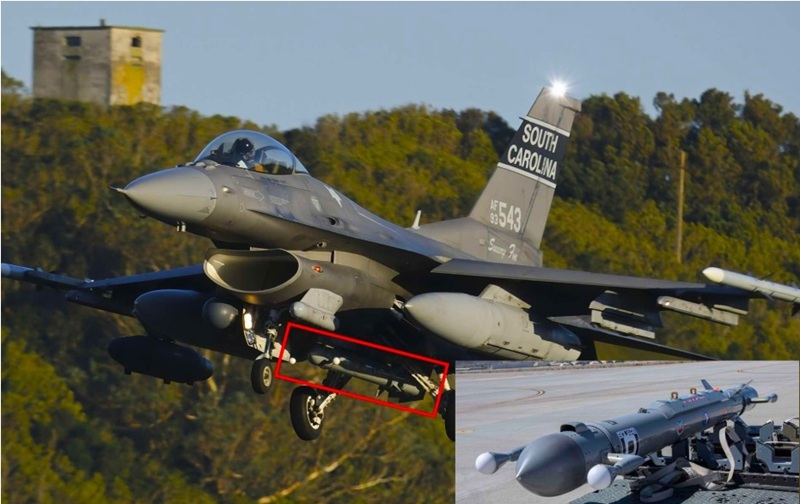
New imagery circulating in mid-February 2026 shows a formation of Block 52 F-16CJ “Wild Weasel” fighters from the South Carolina Air National Guard transiting eastward across the North Atlantic, apparently en route to the U.S. Central Command (CENTCOM) area of responsibility. Photographs and videos posted by aviation photographer Kurt Mendonça and shared by the X account @blocksixtynine indicate that each aircraft was carrying an Angry Kitten electronic warfare (EW) pod, a detail that has drawn attention from defense analysts.
Just noticed that all 12 SCANG Block 52 Vipers transiting LPLA were carrying Angry Kitten EA/EW pods en route to the Middle East. Fairly noteworthy for a lot of reasons. Can’t ever recall seeing EKs on jets potentially heading into ops, likely the first instance? 📸 Kurt Mendonça pic.twitter.com/JQWZlCN31A
— Abd (@blocksixtynine) February 19, 2026
The movement comes as the United States continues to reinforce airpower in and around the Middle East amid heightened tensions with Iran. While fighter deployments to the region are not unusual, the appearance of SEAD-optimized F-16CJs equipped with adaptive EW pods suggests something more specific than routine reinforcement.
The Block 52 F-16CJ is purpose-built for the Suppression and Destruction of Enemy Air Defenses (SEAD/DEAD) mission. In this configuration, the aircraft integrates specialized radar warning systems, electronic warfare suites, and the ability to employ AGM-88-series anti-radiation missiles against hostile emitters. Unlike general-purpose fighter deployments, Wild Weasel aircraft are intended to operate against integrated air defense systems (IADS), often during the opening phases of high-intensity air campaigns.
What distinguishes this deployment is the Angry Kitten pod visible on every jet. Developed by the Georgia Tech Research Institute, Angry Kitten is a Digital Radio Frequency Memory (DRFM)-based electronic warfare system. It can capture radar signals and retransmit them in altered forms, enabling a range of jamming and deception techniques, including false target generation and radar gate pull-off effects.
Originally designed as a training and test system to replicate adversary electronic attacks, Angry Kitten has evolved into a software-defined, rapidly reprogrammable EW pod. U.S. sources have previously described it as a “cognitive” system, capable of adapting to unfamiliar or changing radar waveforms. Its presence on operational F-16CJs headed toward a potential combat theater suggests it is now being treated as a frontline survivability and electronic attack capability, rather than a range-only asset.
In operational terms, this matters in the context of Iran’s layered air defense network, which combines long-range surface-to-air missile systems, medium-range platforms, legacy radars, and mobile units designed for emission control and rapid relocation. Such an environment complicates traditional SEAD tactics, particularly against frequency-agile radars and pop-up threats. A DRFM-based pod that can quickly respond to unfamiliar emitter behavior significantly improves the survivability of fourth-generation aircraft during early campaign phases.
Previous reporting by Army Recognition has noted that these F-16CJ units are primarily tasked with the Wild Weasel mission and appear oriented toward potential SEAD operations in the Middle East. Within a larger force package, Angry Kitten-equipped Vipers could function as forward electronic attack nodes, pushing jamming effects closer to high-value emitters while supporting strike, escort, and standoff jamming platforms. Likely mission profiles include pre-strike shaping, escort SEAD, and reactive engagements against newly activated air defense systems.
More broadly, the deployment reflects a U.S. Air Force shift toward distributed and modular electronic warfare. Rather than relying solely on a small number of dedicated electronic attack aircraft, EW capabilities are increasingly being spread across tactical fighters via pods that can be updated between sorties. This approach allows rapid adjustment of the electronic order of battle as intelligence evolves, particularly in fast-moving crisis scenarios.
The sight of South Carolina Air National Guard F-16CJs crossing the Atlantic with Angry Kitten pods is therefore unlikely to be a routine rotation. It highlights how legacy fourth-generation fighters are being adapted to remain relevant against modern air defenses through advanced electronic warfare and networked SEAD concepts. If tensions with Iran escalate further, these aircraft would be well positioned to play a leading role in efforts to suppress and degrade Iranian air defenses during the opening stages of any air campaign.