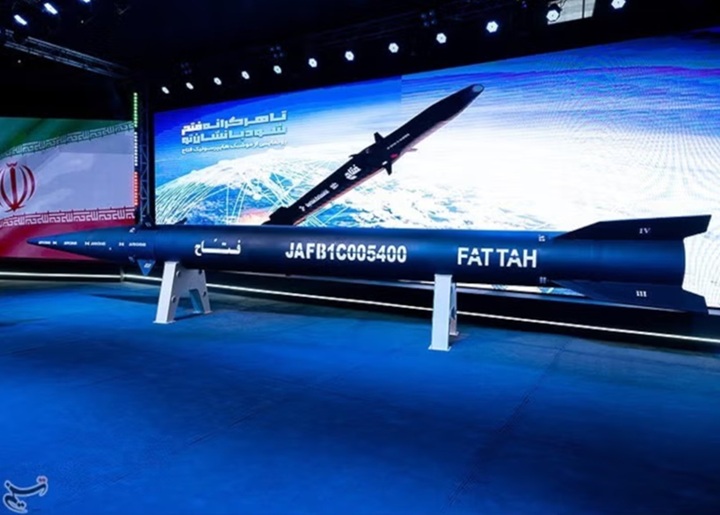
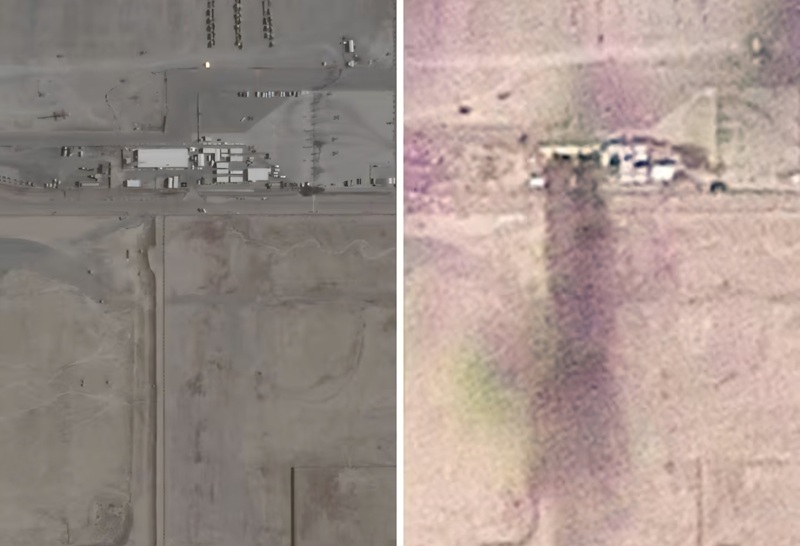
The confirmed deaths of six United States service members in a single precision strike on a temporary operations center inside a Kuwaiti civilian port mark a major strategic inflection point in Middle East force protection.
According to detailed accounts in the report , the strike destroyed a modular, three-section containerized tactical operations center with one direct hit — collapsing a critical command node responsible for communications, planning, and battlefield coordination.
All six US fatalities in the current phase of hostilities occurred in this single incident.
CENTCOM Update
TAMPA, Fla. – As of 4 pm ET, March 2, six U.S. service members have been killed in action. U.S. forces recently recovered the remains of two previously unaccounted for service members from a facility that was struck during Iran’s initial attacks in the region.…
— U.S. Central Command (@CENTCOM) March 2, 2026
A Precision Strike with Strategic Consequences
The target was a rapidly assembled container-based command post located within a civilian port facility in Kuwait. The site was chosen for logistical convenience but lacked hardened protection.
The munition — described as air-defense-evading — struck the central module of the three-part container complex, causing catastrophic structural failure and immediate operational paralysis.
Notably, no audible warning sirens or automated alert systems were reportedly triggered before impact.
This absence of early warning has raised serious concerns about:
- Radar coverage gaps
- Reaction time limitations
- Layered air defense effectiveness
- Detection-to-decision chain reliability
How the Strike Reframes Air Defense Assumptions
Layered air defense architectures typically integrate:
- Long-range surveillance radar
- Medium-altitude surface-to-air missile systems
- Short-range point defenses
- Electronic warfare assets
Yet in this case, the incoming threat appears to have traversed the defensive envelope without generating actionable detection cues.
If accurate, this suggests the weapon may have exploited:
- Low radar cross-section
- Depressed trajectory flight profile
- High-speed approach
- Electronic countermeasure masking
- Algorithmic classification gaps
The event demonstrates that air-defense evasion is no longer theoretical — it is operationally proven.
Why Containerized Command Posts Are Vulnerable
Container-based tactical operations centers are designed for:
- Rapid deployment
- Mobility
- Modular scalability
However, they lack reinforced compartmentalization and blast-resistant hardening.
A precision-guided munition optimized for overpressure and fragmentation can devastate such structures instantly.
The direct hit on the central module suggests deliberate targeting geometry intended to maximize internal shockwave propagation and personnel casualties.
Mobility, in this case, became vulnerability.
Civilian Infrastructure Now a Battlespace
The strike occurred inside a civilian port facility — a dual-use environment supporting both commercial logistics and military coordination.
This carries major implications:
- Commercial infrastructure is no longer presumed safe in contested theaters
- Shipping continuity and insurance risk are now strategic concerns
- Gulf states must reassess military-civilian integration
Visible fires at the port further amplified the psychological and economic impact.
The message is clear: logistics hubs are high-payoff targets.
Force Protection Doctrine Under Review
The incident compels urgent reassessment of forward-deployed US posture across US Central Command’s theater.
Key vulnerabilities exposed:
- Centralized command nodes
- Personnel concentration
- Lack of hardened blast segmentation
- Limited passive protection measures
- Insufficient redundancy
Future mitigation may require:
- Dispersed command architectures
- Redundant communication hubs
- Reinforced modular designs
- Underground alternatives where terrain permits
- Multi-spectral sensor integration (including infrared and passive detection)
- AI-driven anomaly detection
Milliseconds now determine survivability.
Strategic Messaging and Global Implications
By accounting for all six American fatalities in the current operational phase, the strike achieves disproportionate strategic impact.
It demonstrates that:
- Expeditionary infrastructure within missile envelopes remains vulnerable
- Precision lethality can compress human cost and geopolitical signaling
- No layered defense is fully impenetrable
For defense planners worldwide — including Indo-Pacific observers — the Kuwaiti incident becomes a case study in the limits of mobility-centric basing under precision strike threat.
What Comes Next?
While the munition type remains undisclosed — ballistic, cruise, or unmanned — its success in penetrating layered defenses forces recalibration.
Likely responses may include:
- Expanded air-defense deployments
- Enhanced electronic warfare coverage
- Greater dispersion of forward command nodes
- Hardening of dual-use infrastructure
But the strategic breach has already altered regional threat perception.
A single precision strike did more than destroy a container complex — it punctured assumptions about layered defense reliability in the Gulf.
This event will be studied in war colleges and defense ministries worldwide as a defining example of how modern precision warfare reshapes force protection doctrine.