The US Navy is quietly reshaping maritime operations in Africa, with Seabees constructing expeditionary infrastructure to support unmanned systems during Exercise Obangame Express 2026 in the Gulf of Guinea.
Personnel from Naval Mobile Construction Battalion 1 and 22nd Naval Construction Regiment are leading the effort, focusing on a critical capability: a floating pier designed for unmanned surface vessels (USVs).
This development signals a broader shift toward distributed, technology-driven maritime operations.
Floating Pier: A Game-Changer for Unmanned Naval Operations
At the core of the project is a deployable floating pier that enables:
- Launch and recovery of USVs
- Operations in infrastructure-poor environments
- Rapid deployment in contested or remote zones
Unlike traditional ports, this modular system allows naval forces to operate closer to mission areas, significantly improving response time and operational reach.
Chief Builder David Madmon emphasized the strategic importance:
“We’re building infrastructure that supports autonomous systems and expands what’s possible in maritime environments.”
Why the Gulf of Guinea Matters
The Gulf of Guinea remains one of the world’s most strategically sensitive maritime regions, plagued by:
- Piracy and illegal fishing
- Smuggling networks
- Weak maritime surveillance
Through U.S. Africa Command and U.S. Sixth Fleet, the U.S. is working with regional partners to strengthen maritime domain awareness.
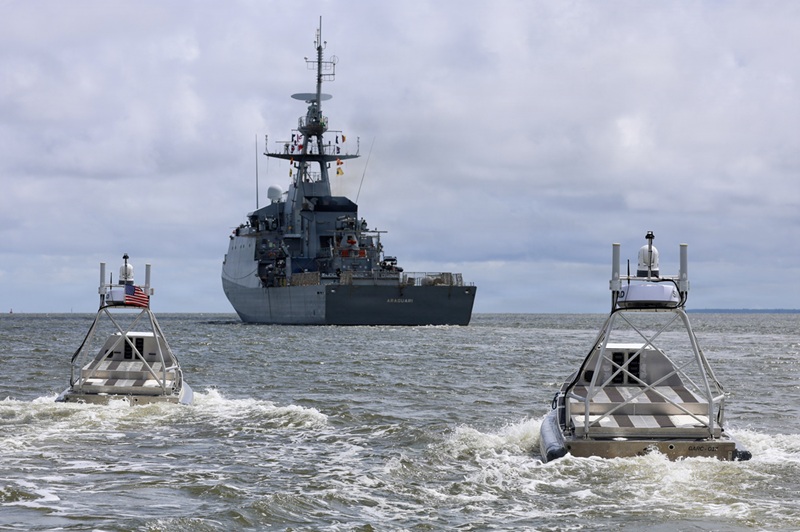
Unmanned systems are emerging as a force multiplier in this environment.
USVs: Expanding Reach Without Expanding Risk
Lieutenant Alex Varon of Task Force 66 highlighted the operational shift:
“Unmanned systems allow us to extend our presence and improve awareness without increasing demand on traditional platforms.”
USVs offer several advantages:
- Persistent surveillance
- Lower operational costs
- Reduced risk to personnel
- Scalable deployment
The addition of expeditionary infrastructure ensures these systems can be deployed anywhere, not just from fixed bases.
A New Model: Expeditionary + Autonomous Warfare
What makes this development significant is not just the technology — but the integration of engineering and autonomy.
The floating pier represents a new operational model:
- Engineering units (Seabees) build forward infrastructure
- Autonomous systems (USVs) extend operational reach
- Allied forces integrate into shared frameworks
This combination enables distributed maritime operations, a core concept in future naval warfare.
Multinational Cooperation at the Core
Obangame Express is one of three major regional exercises designed to enhance interoperability between:
- U.S. forces
- African partner nations
- International maritime stakeholders
The floating pier project also serves as a collaborative platform, allowing partners to develop shared tactics and procedures for unmanned operations.
Beyond the Exercise: Long-Term Strategic Impact
The infrastructure built during the exercise will not be dismantled after drills conclude.
Instead, it will support:
- Continued training
- Experimentation with autonomous systems
- Expansion of regional maritime capabilities
In countries like Cameroon, this represents a long-term investment in maritime security architecture.
Conclusion: Building the Future of Naval Warfare
From floating piers to autonomous vessels, the U.S. Navy is laying the groundwork for a new era of maritime operations.
The message is clear:
Future naval dominance will depend not just on ships — but on flexible infrastructure and unmanned systems that can operate anywhere, anytime.
And in the Gulf of Guinea, that future is already taking shape.