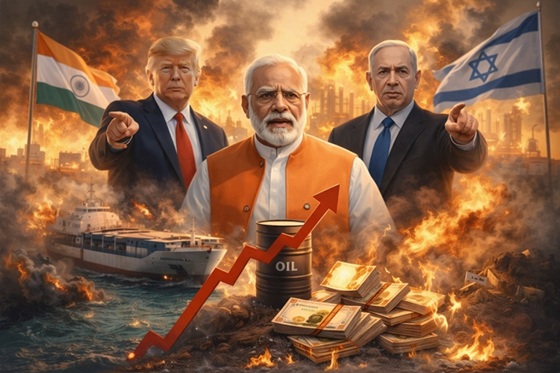
India’s economic growth and energy security are increasingly exposed to the volatile front lines of the Middle East conflict.
As tensions escalate following the Trump–Netanyahu military campaign against Iran, New Delhi finds itself deeply vulnerable to rising oil prices and potential disruptions in tanker traffic through the Strait of Hormuz — a chokepoint now at the center of geopolitical risk.
India’s Energy Shift: From Russian Discounts to Gulf Dependence
Over the past two years, India sharply increased imports of discounted Russian crude. However, under pressure from the United States — including threats of tariffs reportedly reaching as high as 50% — India curtailed Russian oil purchases.
As a result:
- Russian oil imports have fallen to their lowest level since March 2022.
- India has ramped up purchases of higher-priced Middle Eastern and US crude.
- Energy sourcing has shifted heavily toward Gulf routes.
This policy shift has reduced price advantages while increasing exposure to supply disruptions.
The Strait of Hormuz: A Single Point of Failure
The Strait of Hormuz has become a strategic chokepoint for India’s energy lifeline.
Current exposure levels are significant:
- Roughly 50% of India’s oil imports pass through Hormuz.
- About 60% of its LNG imports transit the strait.
- Nearly 80–85% of India’s LPG (cooking gas) is sourced from the Gulf and shipped via Hormuz.
Unlike crude oil, India maintains no strategic reserves of LPG. Any disruption in shipments could quickly affect households across the country.
In practical terms, the Trump–Netanyahu war has transformed Hormuz into a massive single point of failure for India’s economy.
The Economic Cost of Rising Oil Prices
The financial implications are substantial.
For India:
- Every $10 increase in oil prices adds approximately $13–14 billion to the annual import bill.
- Higher import costs widen the trade deficit.
- Fuel-driven inflation pressures consumer prices and industrial costs.
In a country where fuel prices directly impact food transport, electricity generation, and household budgets, sustained oil price spikes could slow growth momentum.
Strategic Trade-Off: Price Risk vs Supply Risk
By reducing Russian imports, India traded:
- A price risk (loss of discounted crude)
for - A supply risk (deeper reliance on Hormuz shipments).
In aligning more closely with the US–Israel axis against Iran, New Delhi accepted greater exposure to Gulf instability.
Meanwhile, President Donald Trump has described Indian Prime Minister Narendra Modi as a “very close friend,” while Israeli Prime Minister Benjamin Netanyahu has referred to Modi as a “brother.”
However, strategic friendship does not shield India from oil market realities.
China’s Strategic Advantage
In contrast, China faces fewer immediate Hormuz-related constraints.
Beijing can:
- Increase purchases of Russian oil and gas via overland pipelines.
- Avoid reliance on vulnerable maritime chokepoints.
- Secure discounted supplies at scale.
India’s curtailment of Russian imports may inadvertently strengthen China’s position, allowing Beijing to absorb additional Russian energy while insulating itself from Gulf disruptions.
At a critical geopolitical moment, New Delhi’s primary rival gains flexibility — while India assumes higher exposure.
What Happens If Hormuz Closes?
If the Strait of Hormuz were disrupted or temporarily blocked:
- Oil tankers could face delays or rerouting.
- Insurance premiums would spike.
- Energy prices would surge globally.
- India’s import-dependent energy system would feel immediate strain.
LPG shortages would be particularly sensitive politically, as cooking gas directly affects households.
Strategic Outlook
India’s energy strategy now faces three urgent questions:
- Can it diversify supply routes fast enough?
- Will it rebuild discounted Russian supply channels?
- Can it accelerate renewables and domestic production to reduce vulnerability?
The Trump–Netanyahu war has reshaped regional security dynamics — but for India, the most immediate battlefield is economic.
Energy security is now directly tied to geopolitical alignment.
And as oil markets tighten, India may find that the cost of strategic positioning is measured not only in diplomacy — but in billions of dollars.