Iran appears to be entering a period of intense political tension as divisions within the country’s leadership are increasingly surfacing in public. A sharp editorial published by the hardline outlet Raja News has openly criticized President Masoud Pezeshkian, signaling growing friction among influential factions aligned with Iran’s security establishment.
The criticism follows Pezeshkian’s recent televised address in which he apologized to Gulf states affected by the regional conflict. The gesture, intended to reduce tensions with neighboring countries, was interpreted by hardline circles as a sign of weakness at a time when Iran is engaged in escalating confrontation with external adversaries.
#Iran’s president #Pezeshkian just issued a video message. These were his main points:
1.He rejected unconditional surrender to the United States.
2.He apologized to neighboring countries targeted by Iranian attacks.
3.He said some attacks were carried out independently by… pic.twitter.com/ovAotwif4O— Arman Mahmoudian (@MahmoudianArman) March 7, 2026
Hardline Media Accuses President of Weak Leadership
In an editorial titled “A Burden on the Nation’s Spirit in the Middle of War. Take the Microphone Away from Pezeshkian,” Raja News accused the president of sending the wrong message during a critical wartime moment.
The article argued that the televised speech failed to demonstrate the level of national resolve expected during a military crisis. Instead, the editorial described the tone of the address as confused and overly conciliatory, claiming it reflected a diplomatic mindset unsuited to wartime leadership.
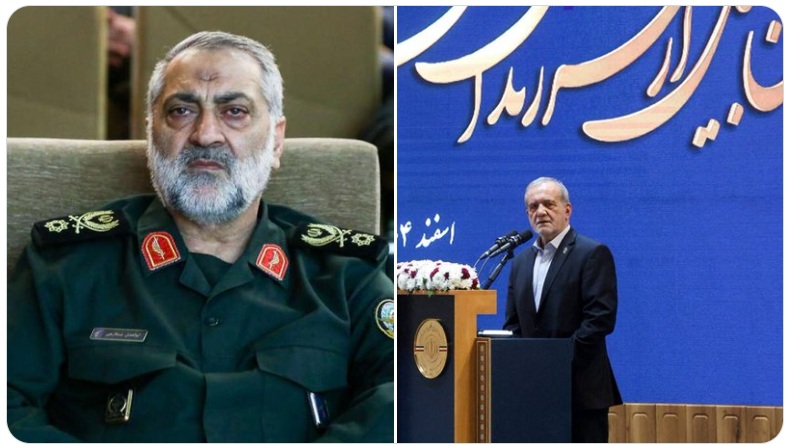
The #IRGCterrorists spokesman Abolfazl Shekarchi is saying something slightly different today from #Iran‘s regime’s President Masoud Pezeshkian, a member of the interim leadership council. Shekarchi offers a more permissive policy for retaliation against neighboring countries:… pic.twitter.com/Cb9PG0L6xK
— Jason Brodsky (@JasonMBrodsky) March 7, 2026
The piece opened by invoking a warning attributed to a former leader of the Islamic Revolution, suggesting that retreat in the face of an attacking enemy would provoke divine consequences. According to the editorial, the president’s remarks risked undermining national morale.
Dispute Over Military Messaging
Another major criticism centered on how Pezeshkian described recent Iranian military operations. During his address, the president suggested that some attacks had been carried out independently by field commanders.
Hardline commentators argued that referring to the strikes as “fire at will” operations could weaken Iran’s deterrence posture. The editorial claimed such language might provide legal arguments to international institutions and adversarial states seeking to challenge Iran’s claim that its actions were carried out in legitimate self-defense.
Shortly after the speech aired, statements from the spokesman of the armed forces’ general staff and an adviser to the commander of the Islamic Revolutionary Guard Corps (IRGC) appeared to clarify the situation. According to Raja News, these remarks were intended to correct the president’s statements and prevent strategic misunderstandings.
Apology to Gulf States Sparks Strong Backlash
The harshest criticism targeted the president’s apology to neighboring Gulf states that host American military bases. Pezeshkian had stated that Iran did not intend to attack its neighbors and described them as regional partners.
Raja News argued that such a message could undermine Iran’s strategic deterrence at a time when US forces in the region are involved in operations against Iranian targets. The editorial labeled the apology a serious mistake, warning that signals of restraint might embolden adversaries.
Debate Over Wartime Leadership
The editorial also framed the situation as part of a broader struggle over Iran’s wartime messaging and leadership.
It questioned why the public platform of the country’s temporary leadership council was entrusted to someone the outlet claimed lacked the authority expected from a wartime leader. According to the article, public communication during the conflict should reflect the posture of Iran’s armed forces and reinforce national unity.
Supporters of the hardline position argue that Iran must prepare for a decisive confrontation rather than signaling diplomatic flexibility.
Succession Questions Intensify Political Tensions
The commentary concluded by suggesting that until a third leader of the Islamic Revolution is formally chosen, official communication should be handled by figures who project strength and align closely with Iran’s military leadership.
At the same time, the editorial warned external observers not to interpret Iran’s internal disagreements as a sign of strategic weakness. It insisted that revolutionary forces remain committed to retaliating against any attacks on the country.
Growing Signs of Internal Strain
The unusually public criticism highlights the growing tension inside Iran’s political establishment as the country faces both external military pressure and internal uncertainty over future leadership.
Whether these divisions represent routine political debate or the early signs of a deeper power struggle remains unclear. However, the increasingly sharp rhetoric suggests that Iran’s wartime politics may be entering a volatile phase, with competing factions seeking to shape the country’s strategic direction during one of the most sensitive moments in recent years.