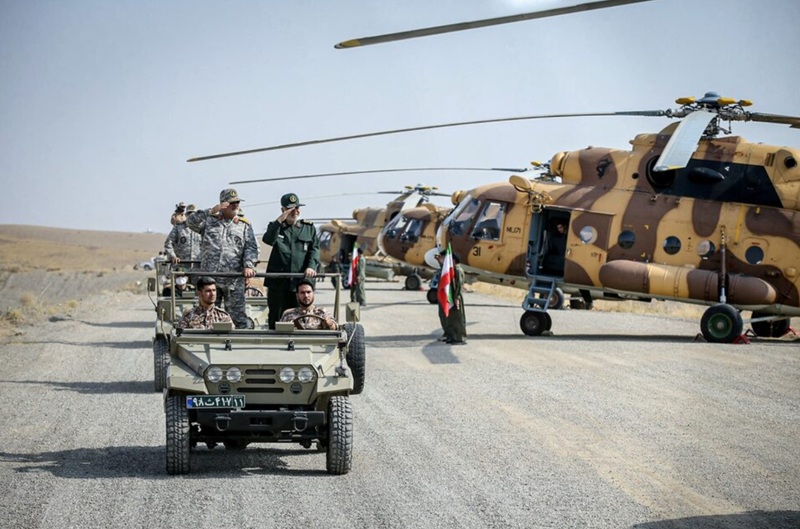
Iran’s current military posture may be less about coordinated strategy and more about the activation of a system designed to function without centralized leadership.
Security analysts increasingly point to the structure of the Islamic Revolutionary Guard Corps (IRGC) as a key factor shaping how the conflict is unfolding. The architecture of Iran’s military command system was deliberately designed to ensure that even the loss of national leadership would not halt military operations.
This doctrine, developed over the past two decades, may now be shaping the dynamics of the war.
The Origins of Iran’s Decentralized Military Doctrine
The concept of decentralized command within the IRGC can be traced back to the early 2000s.
After observing how quickly the United States dismantled Iraq’s centralized military command during the 2003 invasion, Iranian military planners began reassessing the vulnerabilities of centralized command structures.
Major General Mohammad Ali Jafari, who later became commander of the IRGC, played a major role in developing a new doctrine intended to prevent a similar collapse in Iran.
Between 2003 and 2007, strategic planning within the IRGC led to a restructuring of Iran’s military forces.
Creation of 31 Provincial Commands
The restructuring produced a unique command architecture.
Iran’s territory was divided into 31 provincial IRGC commands, each corresponding to one of the country’s provinces.
Each command was designed to operate with significant autonomy and includes:
- Independent headquarters
- Missile and drone units
- Coastal defense systems
- Fast-attack naval craft
- Local militia forces under the Basij network
- Pre-positioned weapons and logistical stockpiles
This system allows individual commands to continue operating even if national command centers are disrupted.
A System Designed for Leadership Loss
One of the key assumptions behind the doctrine was the possibility that Iran’s top leadership—including the Supreme Leader—could be targeted during a conflict.
Under Iran’s constitution, the Supreme Leader serves as commander-in-chief of all armed forces, holding ultimate authority over military decisions.
Because of this centralized legal authority, planners anticipated the need for a system capable of functioning even if the top command structure was incapacitated.
The decentralized command model was intended to ensure that military operations could continue at the provincial level without waiting for central directives.
Implications for the Current Conflict
Analysts say this structure has several important implications for the current war.
First, there may be no single command center whose destruction would end Iran’s military response.
Second, regional military activity may appear fragmented because different provincial commands can operate independently.
Third, the system makes it difficult for external actors to negotiate a ceasefire that would immediately halt all military actions.
In practice, any agreement reached with national authorities would still require compliance from multiple regional commands.
Challenges for Diplomacy and De-Escalation
The decentralized structure complicates diplomatic efforts aimed at ending the conflict.
For negotiators, the challenge is identifying a single authority capable of guaranteeing compliance across the entire military structure.
Similarly, regional states may face localized security incidents originating from specific Iranian coastal provinces without clear central coordination.
For global markets and maritime insurers monitoring the security of the Strait of Hormuz, this uncertainty adds another layer of risk.
A Doctrine Designed for Resilience
Military analysts emphasize that Iran’s decentralized system was not designed primarily for offensive victory.
Instead, it was designed for strategic resilience—ensuring that Iran’s military capability would survive even under extreme pressure.
By distributing command authority and military resources across multiple regions, Iran created a system that is much harder to disable through conventional decapitation strategies.
Strategic Implications
The existence of 31 semi-autonomous military commands means that the conflict could continue even if national leadership structures face disruption.
For military planners, diplomats, and energy markets alike, understanding this architecture is critical to interpreting the trajectory of the war.
Rather than a conflict controlled by a single command center, the situation may increasingly resemble a networked system capable of sustaining operations independently across multiple regions.