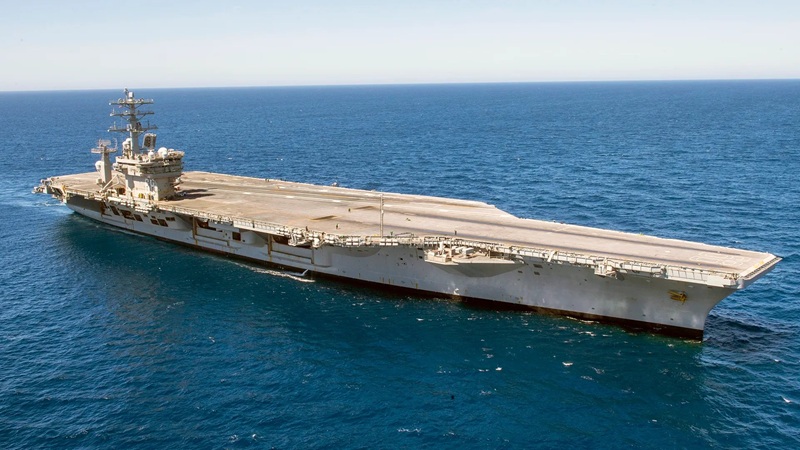
The United States Navy has postponed the retirement of the aircraft carrier USS Nimitz (CVN-68) until at least March 2027, ensuring that the Navy maintains its congressionally mandated fleet of 11 operational aircraft carriers during a critical transition period.
According to a report from Breaking Defense, the U.S. Navy has officially delayed the decommissioning of the aircraft carrier USS Nimitz (CVN-68) until at least March of 2027 to maintain a fleet size of 11 active carriers. Its replacement will be the USS John F. Kennedy (CVN-79),… pic.twitter.com/oKVbcoZj1W
— OSINTdefender (@sentdefender) March 14, 2026
The delay comes as the Navy awaits the delivery of USS John F. Kennedy (CVN-79), the second aircraft carrier of the Gerald R. Ford-class, which is expected to enter service in mid-2027.
A Historic Carrier Nearing the End of Service
Commissioned in 1975, the USS Nimitz is the lead ship of the Nimitz-class nuclear-powered aircraft carriers, one of the most successful warship classes ever built.
Over nearly five decades of service, the carrier has played a major role in multiple U.S. military operations around the world, including:
- Cold War naval deployments in the Pacific and Indian Oceans
- Operations in the Middle East, including missions in the Persian Gulf
- Afghanistan and Iraq war support missions following the 9/11 attacks
- Numerous humanitarian and deterrence deployments
The ship has become one of the longest-serving nuclear-powered warships in U.S. naval history.
Why the Retirement Is Being Delayed
The U.S. Navy aims to maintain 11 operational aircraft carriers, a number required by U.S. law to ensure global naval presence and rapid response capability.
However, the retirement of older carriers must be carefully timed to avoid temporary gaps in fleet strength.
By delaying the decommissioning of the USS Nimitz until at least 2027, the Navy ensures that the fleet remains at full strength until the arrival of its replacement.
Maintaining this carrier count is considered essential for U.S. military strategy, which relies heavily on carrier strike groups for power projection, deterrence, and crisis response.
The Arrival of USS John F. Kennedy (CVN-79)
The USS John F. Kennedy will be the second aircraft carrier built under the Ford-class program, which represents the next generation of U.S. carrier design.
Ford-class carriers incorporate several technological upgrades compared to the older Nimitz-class, including:
- Electromagnetic Aircraft Launch System (EMALS) replacing traditional steam catapults
- Advanced Arresting Gear (AAG) for improved aircraft recovery
- More efficient nuclear reactors providing greater electrical power
- Reduced crew requirements due to increased automation
- Enhanced radar and combat systems
These improvements are designed to increase sortie generation rates and reduce long-term operating costs.
The Strategic Importance of Aircraft Carriers
Aircraft carriers remain central to U.S. naval strategy, providing mobile airbases capable of projecting power anywhere in the world without relying on foreign bases.
A typical carrier strike group includes:
- The aircraft carrier itself
- Guided missile cruisers and destroyers
- Attack submarines
- Supply and logistics ships
Together, these formations allow the United States to conduct air operations, maritime security missions, and deterrence patrols across multiple regions simultaneously.
Challenges of Carrier Fleet Transition
Transitioning from the Nimitz-class to the Ford-class has proven complex and expensive.
The first Ford-class carrier, USS Gerald R. Ford (CVN-78), entered service in 2017 but experienced delays in bringing several advanced systems fully operational.
Despite these challenges, the Ford-class is expected to form the backbone of the U.S. Navy’s carrier fleet for the next several decades.
A Symbol of Naval Power
The USS Nimitz has served as a symbol of American naval power for nearly half a century.
Extending its service until 2027 ensures continuity in U.S. naval capability while the next generation of aircraft carriers enters operational service.
When the ship eventually retires, it will mark the end of an era for one of the most iconic warships in modern naval history.