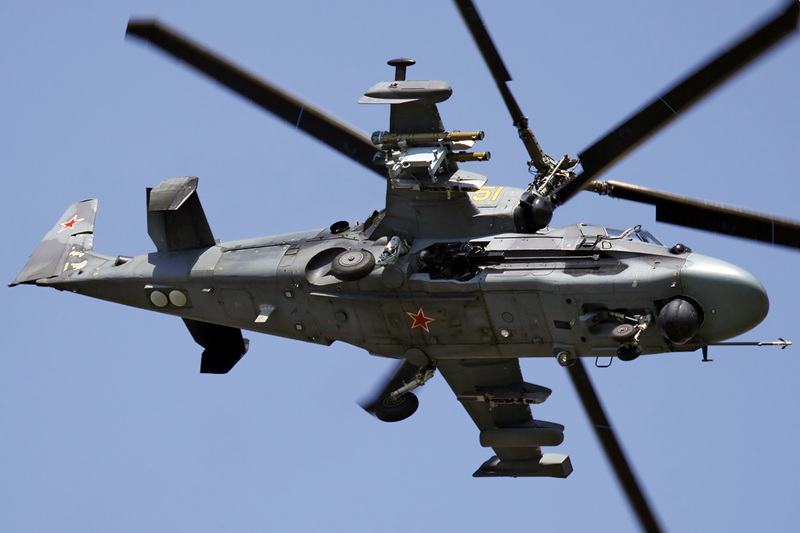
Leaked internal planning documents from Russia’s Arsenyev Aviation Company “Progress” indicate preparations for the export of up to 48 Ka-52M attack helicopters to a foreign customer identified only by the numerical code “156.”
If confirmed, the development could represent a significant evolution in Russia–China military-industrial cooperation, potentially influencing the strategic balance in the Indo-Pacific region and highlighting how sanctions-era defence trade continues to reshape global arms markets.
The documents, which began circulating on defence forums and social media in early 2026, reportedly detail supplier coordination, contract references, financing arrangements, and production timelines spanning 2025 to 2027. While neither Moscow nor Beijing has issued official confirmation, the paperwork suggests a structured export programme rather than exploratory discussions.
Leaked documents from the Russian helicopter manufacturer Progress Arsenyev Aviation Company reference the potential supply of Kamov Ka-52/M attack helicopters to a foreign customer identified by the country code “156,” which corresponds to China.
The document, dated July 15,… pic.twitter.com/EpC5rJXsCq
— OSINTWarfare (@OSINTWarfare) March 13, 2026
Documents Point to a Structured Export Programme
According to the leaked materials, the earliest document dated March 4, 2022, instructed the Progress aviation plant to prepare export documentation for 48 Ka-52M helicopters, including equipment packages, training provisions, and technical support for a foreign customer designated as “156.”
Subsequent documents appear to reinforce the scale of the proposed order:
- An April 2022 procurement request reportedly ordered 96 PZ-37 pyrotechnic igniters, components used in emergency ejection and canopy release systems—exactly matching the requirements for 48 helicopters.
- Internal paperwork referencing an export contract dated November 8, 2023, and a commission agreement from January 2024 suggests the project progressed into formal contractual stages within Russia’s defence export bureaucracy.
- A July 15, 2024 internal letter allegedly directed the factory to schedule production between 2025 and 2027 and to request pricing estimates from suppliers such as the Perm Gunpowder Plant.
The documents also outline the typical Russian arms-export payment structure handled through Rosoboronexport:
- 30% advance payment
- 50% upon readiness for shipment
- 20% after acceptance by the buyer
This payment structure is widely used in major Russian defence export contracts.
Why Analysts Believe “Customer 156” Is China
A central focus of analyst attention is the customer code “156.”
Russian export documentation and international classification systems identify 156 as the numeric country code for the People’s Republic of China, consistent with UN M49 and ISO-3166 standards.
Because no other country shares the same designation, many open-source intelligence analysts view the coding as strong evidence that China is the intended buyer, although official confirmation remains absent.
Further leaked material reportedly mentions training for specialists linked to the same coded customer at Russian facilities between 2024 and 2025, a step typically required before delivery of complex combat aircraft.
However, analysts caution that without official statements or visual evidence of aircraft deliveries, the conclusion remains an analytical interpretation rather than verified fact.
Why China Buying Russian Attack Helicopters Would Be Unusual
China has spent decades building indigenous attack helicopter capabilities, operating platforms such as:
- Z-10 attack helicopter
- Z-19 reconnaissance and light attack helicopter
Because of this strong domestic production base, a large foreign purchase would be strategically unusual.
Analysts therefore believe several alternative explanations are possible:
- Specialised operational roles not fully covered by current Chinese helicopters.
- Technology evaluation, allowing engineers to study foreign design features.
- Testing for high-altitude or maritime operations, where unique capabilities may be required.
The scale of the alleged order—48 helicopters—would represent a significant acquisition even for a major military power, suggesting a purpose linked to specific operational requirements.
Capabilities of the Ka-52M Attack Helicopter

The Ka-52M “Alligator” is the latest modernized variant of Russia’s Ka-52 attack helicopter and incorporates several major upgrades compared with earlier versions.
Key reported improvements include:
- Redesigned avionics and onboard computers
- Active phased-array radar for extended detection range
- Enhanced night and all-weather combat capability
- Integration with unmanned aerial vehicles (UAVs) for reconnaissance and targeting
- Support for longer-range guided weapons enabling stand-off attacks
The Ka-52 family also uses a distinctive coaxial rotor system, which provides strong maneuverability and stable performance in hot-and-high environments, making it potentially useful in mountainous terrain where conventional helicopters lose lift efficiency.
Some observers have also speculated about possible interest in the naval Ka-52K Katran variant for amphibious operations, although the leaked documents refer specifically to the land-based Ka-52M.
Sanctions, Wartime Production, and Arms Exports
The alleged export planning comes at a time when Russia’s defence industry is operating under sanctions pressure and wartime production demands related to the Ukraine conflict.
Despite these pressures, arms exports remain strategically important for Moscow because they:
- Generate revenue for the defence sector
- Maintain long-term military partnerships
- Strengthen geopolitical influence outside Western markets
The leaked documents suggest that Russia was prepared to schedule export production alongside domestic requirements, with deliveries potentially spread over 2025–2027.
However, sanctions affecting components, logistics, and international banking could complicate execution of any such contract.
Strategic Implications for the Indo-Pacific
If the alleged deal were confirmed, analysts say it could carry several strategic implications:
- Deeper Russia–China defence cooperation
- Potential technology exchange between two major military powers
- Increased attention from Indo-Pacific defence planners
- Possible influence on regional helicopter force structures
Yet without confirmed deliveries, the episode remains an unresolved question rather than a verified shift in military balance.
An Unconfirmed but Closely Watched Defence Story
For now, the leaked paperwork suggests that Russia may have seriously explored exporting Ka-52M attack helicopters to China, reaching a level of bureaucratic preparation rarely seen in speculative proposals.
But the absence of official confirmation, delivery records, or operational sightings means the project remains unverified.
Until Moscow or Beijing publicly addresses the issue, the alleged Ka-52M export programme will remain one of the most closely watched defence-industry stories of 2026.