Gwadar Port is experiencing a rare surge in activity — one that appears impressive on the surface but is driven less by economic success and more by regional instability.
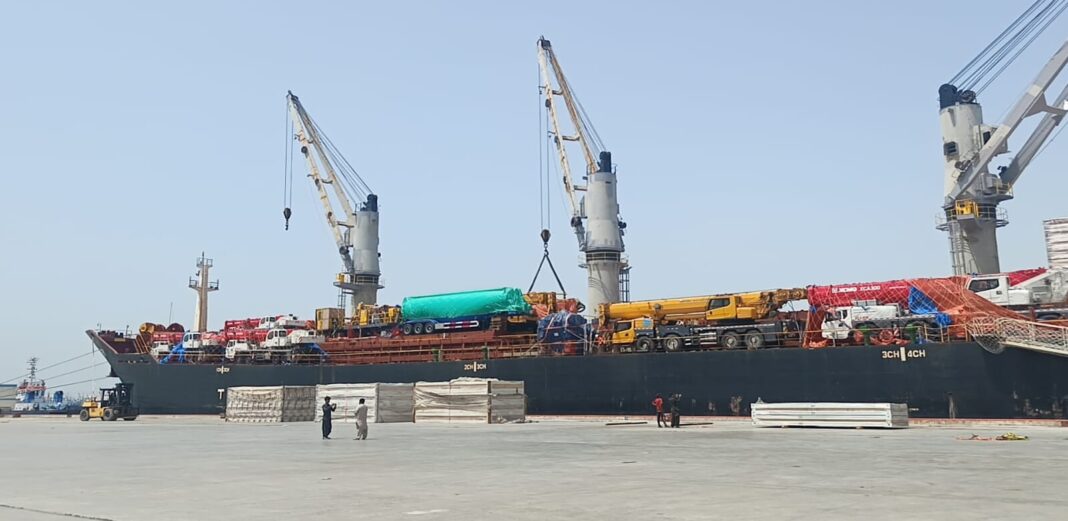
On April 16 alone, two cargo vessels docked at Gwadar carrying 368.7 tons of machinery and general cargo, alongside 5,000 metric tons of fertilizer. Earlier in the month, another vessel delivered over 14,000 metric tons of transshipment goods.
In total, Gwadar handled approximately 11,000 containers in April — a staggering figure for a port that processed just 8,300 containers in all of 2025.
For a port that historically saw fewer than 20 ships annually, this spike is unprecedented.
The Hormuz Effect: Crisis Driving Commerce
The surge is not organic growth — it is a direct consequence of disruptions in the Strait of Hormuz, one of the world’s most critical energy chokepoints.
Nearly 20% of global oil and LNG flows through Hormuz, making it a lifeline for global energy markets.
However, escalating tensions linked to the Israel–U.S. confrontation with Iran have turned the strait into a high-risk maritime zone. Repeated closures, blockades, and military escalation have:
- Driven up insurance costs
- Delayed shipments
- Forced shipping companies to avoid the route
As a result, vessels are diverting or pausing operations — and Gwadar has emerged as a temporary fallback.
Gwadar’s Strategic Geography — Finally Relevant
Gwadar’s proximity to Hormuz — combined with its relative distance from direct conflict zones — makes it an attractive option for:
- Temporary anchorage
- Cargo storage
- Transshipment operations
Its deep-water port and eastern bay allow it to handle large vessels, a key factor that originally attracted Chinese investment under CPEC.
But this advantage had long remained unrealized — until now.
A Temporary Logistics Buffer — Not a Trade Hub
Despite the surge, Gwadar is not yet functioning as a true commercial hub.
Instead, it is acting as a logistical buffer zone:
- Cargo is offloaded temporarily
- Stored (often free for up to a month)
- Reloaded and redirected once conditions improve
This pattern shows that Gwadar is absorbing overflow caused by crisis, not generating independent trade demand.
Why Rerouting Isn’t a Real Option
Alternative routes to bypass Hormuz are limited:
- Saudi Arabia’s East-West pipeline
- UAE’s Fujairah pipeline
Both provide only partial relief and cannot handle the bulk of global exports.
For shipments — especially from China to West Asia — maritime transit through Hormuz remains unavoidable.
This leaves ships with few options other than waiting — and Gwadar offers a convenient holding point.
Pakistan’s Strategic Positioning Adds to Gwadar’s Appeal
Pakistan’s evolving diplomatic role has also contributed to Gwadar’s rising relevance.
Islamabad has emerged as an unexpected mediator between Iran and the United States, enhancing its image as a relatively stable and neutral actor.
At the same time:
- Pakistan depends heavily on energy imports through Hormuz
- It shares a 900 km border with Iran
- Instability directly impacts its economy and border regions
This combination of vulnerability and diplomatic engagement has indirectly boosted confidence in Gwadar as a safer maritime node.
Short-Term Gains vs Long-Term Reality
While the current spike is economically beneficial in the short term, it does not yet signal sustainable growth.
Gwadar currently has:
- Capacity for ~16,000 containers
- Over 90,000 square meters of storage
But the demand being observed is temporary and crisis-driven, not tied to long-term trade routes or industrial activity.
The Bigger Question: Opportunity or Illusion?
The key question remains:
Is Gwadar finally taking off — or simply benefiting from instability next door?
History suggests caution.
Ports thrive on predictability, connectivity, and stable trade flows — not geopolitical disruption.
If the Strait of Hormuz stabilizes, much of this traffic could disappear as quickly as it arrived.
Conclusion: A Port Still Waiting for Its Moment
Gwadar’s recent surge is significant — but it is not transformation.
It reflects the shifting realities of a volatile region rather than the emergence of a new economic hub.
Until Gwadar generates consistent, destination-based trade and integrates into global supply chains, its long-awaited promise will remain just that — a promise.