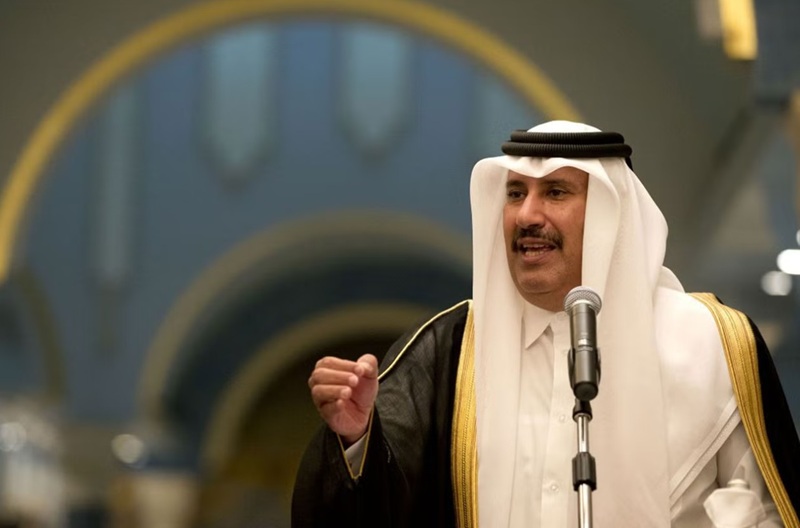
Amid rising regional tensions linked to the ongoing Iran conflict, a former Qatari prime minister has proposed the creation of a NATO-style military alliance among Gulf Cooperation Council (GCC) states, led by Saudi Arabia and supported by deeper defense cooperation with Turkey and Pakistan.
The proposal reflects growing concern among Gulf leaders about the region’s long-term security architecture as military confrontation between Iran, Israel, and the United States continues to reshape Middle Eastern geopolitics.
هذه الحرب في منطقتنا كغيرها من الحروب ستنتهي، ولكنْ هناك دروس وعبر يجب على دول مجلس التعاون أن تستخلصها وأهمها التكاتف والتحالف ووحدة الكلمة والموقف. فقد بات لا مناص أمام دول المجلس من إقامة حلف عسكري أمني فاعل وحقيقي وواقع على الأرض، كما هو حلف شمال الأطلسي، يكون فيه للسعودية…
— حمد بن جاسم بن جبر (@hamadjjalthani) March 13, 2026
The Core Proposal
The former Qatari leader outlined several key recommendations aimed at strengthening Gulf security:
- Formation of a collective defense alliance similar to NATO among GCC members
- Saudi Arabia serving as the central military leader within the alliance
- Development of joint Gulf defense industries to reduce reliance on foreign suppliers
- Resolution of internal GCC political disputes that weaken regional security cooperation
- Expansion of strategic military ties with Turkey and Pakistan
The central argument behind the proposal is that Gulf states should not bear the strategic and economic costs of a war they did not initiate.
With missile and drone attacks increasingly affecting the region, Gulf governments are facing mounting pressure to improve collective defense capabilities.
Historical Context: The GCC’s Security Dilemma
The Gulf Cooperation Council—comprising Saudi Arabia, the United Arab Emirates, Qatar, Kuwait, Bahrain, and Oman—was founded in 1981 during the Iran-Iraq War.
From its inception, the organization aimed to create a unified security framework to counter regional threats.
However, despite decades of discussion, the GCC has struggled to build an effective collective defense system.
Several initiatives have attempted to strengthen military cooperation:
Peninsula Shield Force (1984)
The GCC established a joint military force headquartered in Saudi Arabia, designed to respond to external threats. However, its size and operational integration remained limited.
Joint Air Defense Discussions
Gulf states have repeatedly explored integrated missile defense networks, particularly as Iran expanded its ballistic missile capabilities.
The Qatar Diplomatic Crisis (2017–2021)
A major political rift between Qatar and several GCC members weakened regional unity and highlighted the difficulty of building a cohesive security alliance.
These divisions have historically limited the GCC’s ability to function as a unified military bloc.
Iran’s Role in Shaping Gulf Security Thinking
Iran’s growing missile, drone, and naval capabilities have been a central driver of Gulf defense discussions.
The Persian Gulf contains some of the world’s most strategically important energy infrastructure and shipping routes, including the Strait of Hormuz, through which a significant portion of global oil exports passes.
In recent years, Gulf states have faced increasing security challenges, including:
- Missile and drone attacks on energy infrastructure
- Maritime security threats in the Gulf
- Regional proxy conflicts
These developments have reinforced arguments that collective defense structures are necessary to deter regional threats.
Impact of the Current Iran Conflict
The ongoing Iran-related conflict involving Israel and the United States has intensified security concerns across the Gulf region.
Several Gulf states have recently reported intercepting missiles and drones targeting their territory, highlighting the vulnerability of energy infrastructure and military bases.
At the same time, disruptions to shipping through the Strait of Hormuz have raised fears about global energy markets.
These developments have renewed debates about whether Gulf states should rely primarily on external security guarantees—particularly from the United States—or develop stronger independent regional defense capabilities.
The Role of Turkey and Pakistan
The former Qatari leader’s proposal also highlights the potential role of Turkey and Pakistan in Gulf security arrangements.
Both countries have strong military institutions and longstanding security relationships with several Gulf states.
Turkey already maintains a military presence in Qatar, while Pakistan has historically provided training and defense cooperation with Gulf militaries.
Expanding these partnerships could allow Gulf states to diversify their security relationships beyond traditional Western alliances.
Challenges to a Gulf NATO
Despite the strategic logic behind the proposal, creating a NATO-style alliance in the Gulf would face several obstacles.
Key challenges include:
- Political differences among GCC member states
- Different threat perceptions toward Iran
- Reliance on external security partnerships with Western powers
- Coordination of defense industries and military procurement
Building an integrated command structure similar to NATO would require a level of political unity that has historically been difficult to achieve in the region.
A Changing Security Landscape
The proposal reflects a broader shift in Middle Eastern security thinking.
As global power competition intensifies and regional conflicts evolve, Gulf states are increasingly considering how to build more self-reliant defense structures.
Whether the GCC can transform into a NATO-style military alliance remains uncertain.
However, the renewed debate highlights a growing recognition that the future security of the Gulf may depend on deeper regional cooperation rather than reliance solely on external powers.