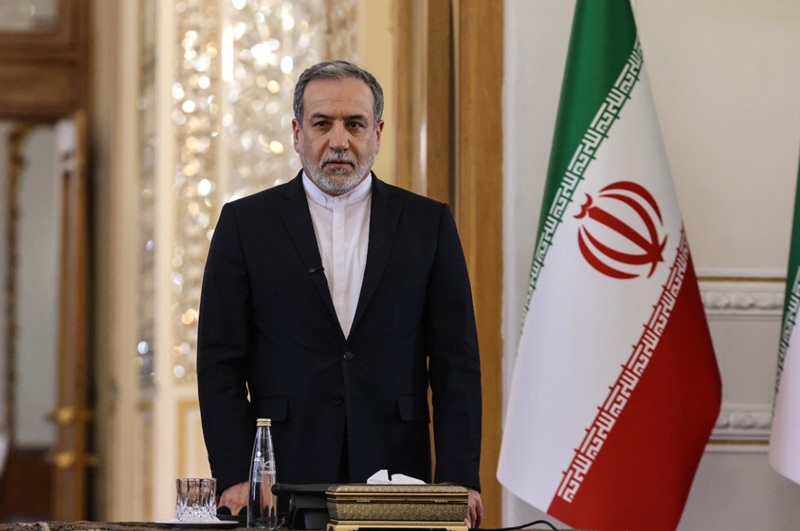
Iran’s Foreign Minister Abbas Araghchi has publicly accused the United Arab Emirates of direct involvement in military operations against Iran, escalating tensions between Tehran and Abu Dhabi during a high-profile BRICS foreign ministers’ meeting in New Delhi.
According to Iranian state media, Araghchi made the remarks on Thursday following exchanges involving the Emirati delegation at the BRICS gathering, suggesting that Gulf regional alignments during the Iran war are becoming increasingly contentious.
The accusation comes amid heightened regional friction following reports of Gulf involvement during the conflict and renewed scrutiny over military cooperation between Israel, Gulf states, and the United States.
🚨 Abbas Araghchi: “I tell the United Arab Emirates that Israel will not be able to protect you.”
Araghchi added:
“The UAE stood alongside the United States and Israel in this war.”
“I told the UAE representative that Israel and the United States will not be able to provide… pic.twitter.com/VS09Msx2H9
— The Middle East (@A_M_R_M1) May 14, 2026
Araghchi: UAE Was ‘Directly Involved’
Iranian state media quoted Araghchi as saying:
“I didn’t name the UAE in my statement for the sake of unity. But the truth is that the UAE was directly involved in the aggression against my country.”
Araghchi further criticized Abu Dhabi for what he described as silence during the opening phase of military strikes against Iran.
“When the attacks started, they didn’t even issue a condemnation,” he reportedly said.
Iranian reports did not specify the exact remarks made by the Emirati representative that triggered Tehran’s response.
Tensions Rise After Netanyahu Controversy
The diplomatic clash comes only a day after the UAE publicly denied comments made by Israeli Prime Minister Benjamin Netanyahu, who claimed he had visited the Gulf state during the Iran conflict.
Abu Dhabi swiftly rejected the statement, distancing itself from suggestions of direct wartime coordination.
Earlier, Araghchi had already reacted sharply, warning:
Those “colluding with Israel to sow division” would eventually “be held to account.”
The exchange has fueled speculation over the extent of quiet Gulf-Israeli security coordination during the regional crisis.
Iran Pressures Gulf States Over Security Alignments
According to Iranian media, Araghchi argued during the BRICS meeting that:
Neither U.S. military bases nor strategic alignment with Israel can guarantee Gulf security.
He reportedly urged the UAE to reconsider its regional posture toward Iran, emphasizing:
“We must live side by side in peace, and this requires peaceful relations and complete understanding between the two countries.”
The comments reflect Tehran’s longstanding argument that regional security should emerge through Gulf-based diplomacy rather than external military partnerships.
Background: War Deepened Gulf Fault Lines
The latest accusations come against the backdrop of the Iran war that began following U.S. and Israeli strikes on Iranian territory in late February.
Iran responded with:
- Missile strikes
- Drone attacks
- Retaliatory operations targeting regional facilities and military sites
Several Gulf states reportedly faced spillover risks during the conflict.
Recent Western media reporting has intensified regional scrutiny.
A report by The Wall Street Journal earlier this week alleged that the UAE conducted limited military operations against Iran during the conflict — claims that have not been independently confirmed publicly.
Separate reports have also suggested Saudi Arabia carried out undeclared military activity against Iranian-linked targets, though official acknowledgment remains absent.
BRICS Unity Tested by Iran-UAE Dispute
The Iran-UAE dispute is now casting uncertainty over diplomatic consensus within the BRICS grouping.
Iranian media reported concerns that divisions between Tehran and Abu Dhabi may complicate efforts to produce a final communiqué from the BRICS foreign ministers’ meeting.
Iranian Deputy Foreign Minister Kazem Gharibabadi reportedly acknowledged:
“Problems and communications” had emerged because of disagreements involving the UAE delegation.
This presents a challenge for BRICS, which has increasingly attempted to position itself as a platform for geopolitical coordination among emerging powers.
Why the UAE-Iran Relationship Matters
Despite periodic tensions, Iran and the UAE maintain significant economic and geographic interdependence.
The UAE serves as:
- A major regional commercial hub
- A transit center for Iranian trade
- A key maritime actor near the Strait of Hormuz
At the same time, geopolitical friction persists over:
- Security partnerships
- U.S. military presence
- Relations with Israel
- Maritime influence in the Gulf
The relationship therefore oscillates between economic pragmatism and strategic mistrust.
Regional Security Architecture Under Pressure
The accusations also highlight broader shifts in Middle Eastern geopolitics.
Several Gulf states have increasingly diversified their security partnerships, balancing:
- U.S. security guarantees
- Relations with Israel
- Economic ties with China
- Regional diplomacy with Iran
For Tehran, this evolving regional architecture presents a strategic challenge.
Iran increasingly views:
- Israeli-Gulf cooperation
- Expanded U.S. military access
- Regional missile defense coordination
as part of a broader containment framework.
Strategic Implications: More Diplomatic Pressure Ahead
The public nature of Araghchi’s remarks suggests Tehran may be:
Increasing diplomatic pressure on Gulf capitals to distance themselves from Israeli and U.S. security structures.
At the same time, Iran appears eager to avoid a complete rupture with neighboring states.
The emphasis on “peaceful coexistence” indicates Tehran may still seek:
- Regional dialogue
- De-escalation channels
- Security understandings with Gulf states
even while issuing strong public criticism.
Conclusion: Gulf Tensions Spill Into BRICS Diplomacy
Iran’s accusation that the UAE directly participated in military operations marks another sign of lingering instability following the regional conflict.
The dispute demonstrates that:
The political consequences of the Iran war are still unfolding — not only militarily, but diplomatically.
As BRICS attempts to project unity among rising powers, disagreements between members and partner states could complicate consensus-building on key regional crises.
For now, Tehran and Abu Dhabi remain locked in a difficult balancing act:
Economic interdependence on one side — deep strategic mistrust on the other.