The United States Air Force’s aerial refueling fleet has suffered a significant setback during the ongoing regional conflict involving Iran, according to emerging reports from defense sources.
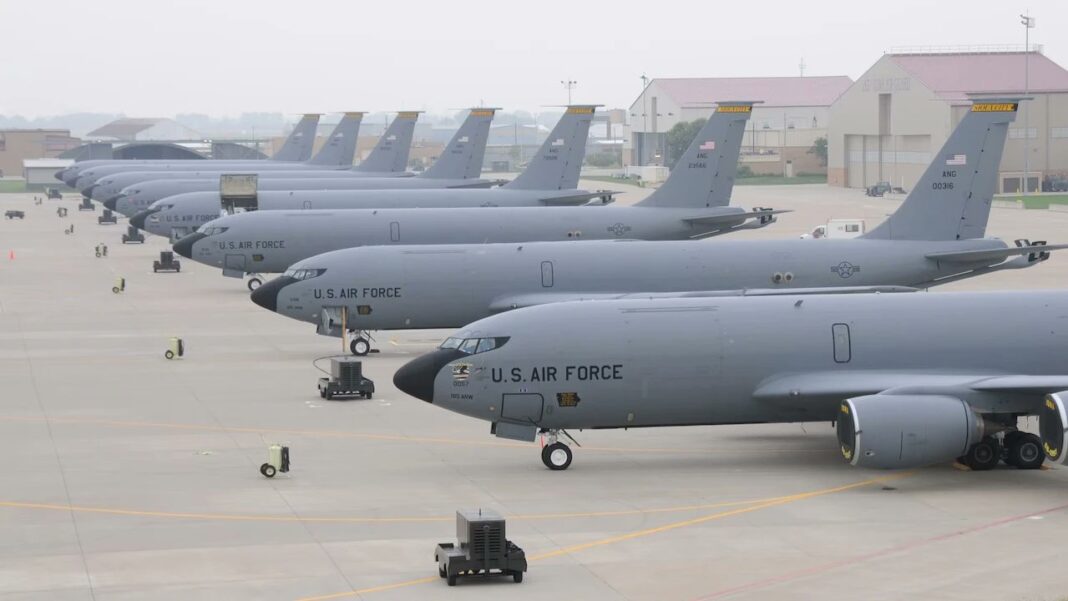
At least five KC-135 Stratotanker aircraft were reportedly damaged in an Iranian missile and drone attack targeting Prince Sultan Air Base in Saudi Arabia, a major logistical hub for US operations in the Middle East.
The incident comes just days after a separate tragedy in which two KC-135 tankers collided mid-air over Iraq, further straining one of the most critical components of American airpower.
Strategic Importance of Prince Sultan Air Base
Prince Sultan Air Base, located near Riyadh, is one of the largest American operational facilities in Saudi Arabia. The base sits deep inside the Saudi interior, roughly 600 kilometers from the Iranian coastline.
According to a report from the Wall Street Journal, citing two U.S. officials, five U.S. tankers were struck and damaged while on the ground at Prince Sultan Air Base in Saudi Arabia during an Iranian ballistic missile strike. Per one official, the battle damage to the tankers… pic.twitter.com/808Tdepl7l
— OSINTdefender (@sentdefender) March 13, 2026
Despite this distance, modern ballistic missiles can cover the gap extremely quickly. At high speeds, such missiles can reach the base in approximately six to eight minutes after launch.
This leaves very little warning time for personnel stationed on the ground.
Even if missile launch detection systems identify a threat, the time required to sound alarms and activate defensive systems is extremely limited. If missile defense systems fail to intercept the incoming threat, the base may be struck before aircrews can reach their aircraft.
Vulnerability of Large Support Aircraft
Large aircraft such as the KC-135 Stratotanker are particularly vulnerable to such attacks.
These aircraft typically remain parked in open areas of airbases due to their large size and the limited availability of hardened shelters. Their slow mobility and logistical role make them easier targets compared with combat aircraft that can scramble quickly.
Damage to aerial refueling tankers can have a major operational impact because these aircraft enable long-range missions for fighter jets, bombers, and surveillance aircraft.
Without them, the operational reach of US airpower in the region could be significantly reduced.
A Longstanding Problem in Warfare
The vulnerability of aircraft on the ground is not a new issue in military history.
During the Vietnam War, US airbases such as Tan Son Nhut and Bien Hoa were repeatedly targeted by Viet Cong mortar and rocket attacks.
Historical estimates suggest that about 5 percent of all US aircraft losses in the war occurred on the ground during base attacks. Around 75 aircraft were destroyed and nearly 900 were damaged as a result of these assaults.
Similar patterns appeared during US operations in Iraq and Afghanistan, where military bases frequently faced indirect fire attacks using rockets, mortars, and later drones.
This persistent threat environment has sometimes been described by military planners as a “rocket belt” or “drone belt” surrounding major bases.
Changing Threats: From Rockets to Drones and Missiles
Modern warfare has intensified these risks.
Where insurgent groups once relied primarily on crude rockets and mortars, today’s adversaries increasingly deploy precision ballistic missiles, cruise missiles, and armed drones capable of striking targets hundreds of kilometers away.
These systems can overwhelm traditional base defenses and threaten high-value aircraft parked on the ground.
US Response: Dispersing the Tanker Fleet
In response to the latest attack, the US Air Force is reportedly dispersing its KC-135 fleet across multiple bases throughout the Middle East.
Dispersed basing is designed to reduce the risk of losing multiple aircraft in a single strike.
Instead of concentrating critical assets in one location, aircraft are spread across several facilities, forcing adversaries to expend far more missiles and drones to achieve the same level of damage.
The Need for Hardened Infrastructure
Military analysts have long argued that hardened aircraft shelters, rapid relocation strategies, and dispersed basing are essential for survival in modern missile warfare.
Concentrating large numbers of aircraft in open parking areas can create lucrative targets for precision strikes.
Once a conflict begins, failure to disperse high-value assets quickly can dramatically increase the risk of catastrophic losses.
A Growing Challenge for Modern Airpower
The latest incident highlights a growing challenge for the United States and its allies.
As missile and drone technology becomes more accessible and sophisticated, even heavily defended bases far from front lines are no longer safe from rapid attack.
Protecting critical assets such as aerial refueling aircraft will likely remain a central concern for military planners as the conflict continues to evolve.