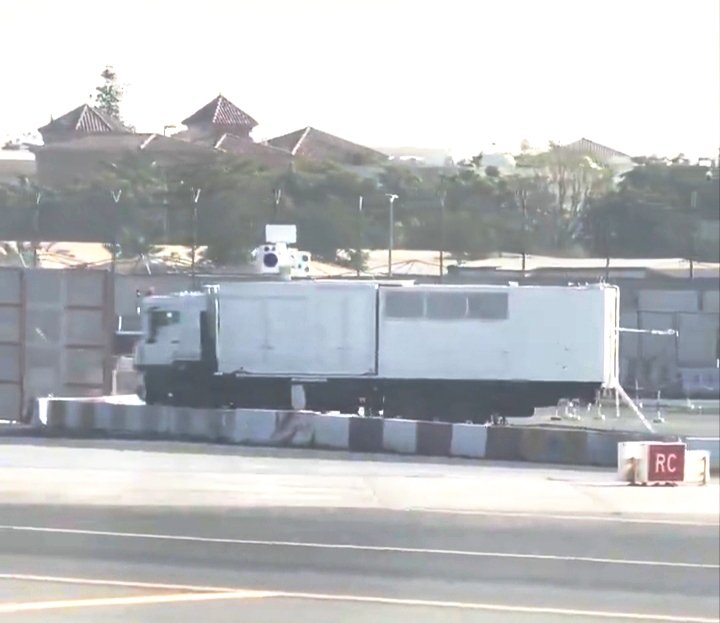
A Chinese vehicle-mounted laser weapon system designed for counter-drone operations has been spotted at Dubai International Airport, signaling a potential expansion of directed-energy air defense capabilities in the Gulf.
Images circulating across defense analysis platforms show a system closely resembling a tactical laser platform unveiled at the 2022 Zhuhai Airshow. Analysts suggest it may be linked to the Guangjian-21A system, though no official confirmation has been issued by either Beijing or Abu Dhabi.
A Chinese combat laser system (most likely the Guangjian-21A / 光箭-21A) designed for counter-UAV operations has been spotted at an airport in the UAE. pic.twitter.com/7pLNcp7vyk
— 𝔗𝔥𝔢 𝕯𝔢𝔞𝔡 𝕯𝔦𝔰𝔱𝔯𝔦𝔠𝔱△ 🇬🇪🇺🇦🇺🇲🇬🇷 (@TheDeadDistrict) May 6, 2026
What the System Is — And Why It Matters
The system represents a new class of directed-energy weapons (DEWs) optimized for countering drones and low-altitude aerial threats.
Key Features (Based on Zhuhai 2022 Data):
- Engagement at the speed of light
- High precision with minimal collateral damage
- Strong directional targeting
- Low cost per shot
- Sustained firing capability
Unlike traditional missile-based air defense systems, laser weapons rely on energy rather than physical interceptors.
This gives them a major advantage in high-volume drone attack scenarios.
Cost Advantage: Why Lasers Are Game-Changing
One of the biggest challenges in modern air defense is cost.
- Interceptor missiles can cost hundreds of thousands to millions of dollars per shot
- Small drones may cost only a few thousand dollars
Laser systems dramatically change this equation:
➡️ Near-zero cost per engagement
➡️ No need for physical ammunition
➡️ Continuous firing limited only by power supply
This makes them ideal for countering drone swarms, a growing threat seen in conflicts from Ukraine to the Middle East.
Operational Flexibility: Standalone or Networked Defense
The Chinese system is designed for flexible deployment:
- Can operate as a single vehicle unit
- Can be integrated into multi-vehicle networks
- Supports layered air defense architecture
This allows operators to:
- Protect critical infrastructure
- Secure high-value locations like airports
- Deploy rapidly in response to emerging threats
The system’s presence at Dubai International Airport suggests a focus on civil aviation security and infrastructure protection.
UAE’s Growing Focus on Counter-Drone Defense
The UAE has been actively investing in counter-UAS (unmanned aerial system) technologies in response to:
- Drone and missile attacks in the region
- Threats to energy infrastructure
- Risks to aviation hubs and urban centers
The adoption of laser systems reflects a shift toward layered air defense, combining:
- Kinetic interceptors
- Electronic warfare systems
- Directed-energy weapons
China Expands Defense Exports in the Middle East
The appearance of this system also highlights China’s growing role as a defense technology exporter.
Beijing has increasingly marketed:
- Counter-drone systems
- Missile defense technologies
- Advanced sensors and surveillance platforms
The Middle East, with its evolving threat environment, has become a key market for such systems.
Limitations of Laser Weapons
Despite their advantages, laser systems are not a complete solution.
Key Constraints:
- Limited effective range
- Reduced performance in adverse weather (dust, fog, humidity)
- Most effective against small, slow targets
As a result, they are typically used as part of a layered defense system, not as a standalone shield.
Strategic Implications: The Future of Air Defense
The deployment of a Chinese laser weapon in the UAE reflects broader trends in modern warfare:
➡️ Rise of low-cost drone threats
➡️ Shift toward energy-based weapons
➡️ Increasing importance of cost-effective defense
Directed-energy systems are expected to play a growing role in:
- Military operations
- Infrastructure protection
- Urban security environments
Conclusion: Directed Energy Moves From Concept to Deployment
The appearance of a Chinese laser weapon system in the UAE marks a significant milestone in the evolution of air defense technology.
It underscores a key reality:
The future of air defense is not just about missiles — it is increasingly about energy, speed, and cost efficiency.
As drone threats continue to evolve, systems like these are likely to become a standard component of modern defense networks.